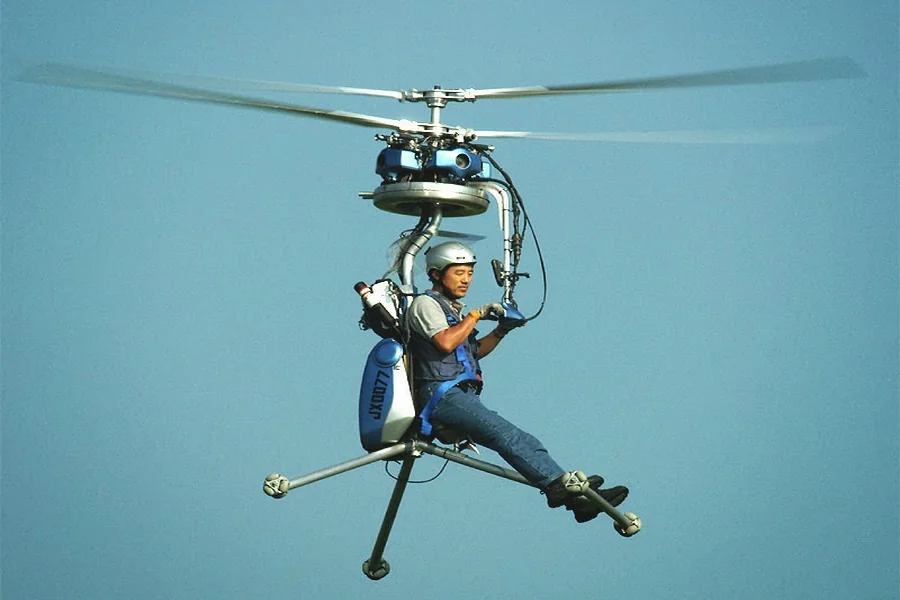
The smallest helicopter is the GEN H-4 helicopter designed by GEN Corporation in Japan which is a very small helicopter with a single seat. It is quite unlike a conventional helicopter design with a closed cabin, enclosed rotors, or a central rotor surrounded by stabilizing blades.An open-frame design, no enclosed cab and two coaxial rotors mounted above the pilot make it look very different from the conventional helicopter.
Although small, the GEN H-4 is a true crewed aircraft that is capable of vertical takeoff, hovering, forward flight and landing. The GEN H-4 is the smallest helicopter in terms of rotor length, as Guinness World Records certifies. It has a rotor diameter of just 4 meters (13 feet) and an empty weight of about 70 kg (154 pounds).
The helicopter has a capacity of one person and runs on four small gasoline engines. It is one of the most interesting personal aircraft ever built, thanks to its unique engineering.
The smallest helicopter is one with a rotor blade of only 10 inches.
Quick Answer: What Is the Smallest Helicopter?
The GEN H-4 is a helicopter that, by the Guinness World Record, is the smallest in the world in terms of rotor length. The diameter of the rotor is approximately 4 meters, its empty weight is 70 kg and it carries one pilot.
It is a helicopter with two coaxial counter-rotating rotors as opposed to the typical main-rotor and tail-rotor configuration.
The aircraft can fly at speeds of about 90 km/h (59 mph), climb to altitudes of about 1,000 m (3,280 ft) and fly for about 30 minutes according to Guinness World Records.
Smallest Helicopter Quick Facts
| Feature | GEN H-4 |
| Helicopter | GEN H-4 |
| Manufacturer | GEN Corporation |
| Country | Japan |
| Capacity | 1 person |
| Empty Weight | About 70 kg (154 lb) |
| Rotor Diameter | About 4 m (13 ft) |
| Rotor Type | Coaxial counter-rotating |
| Number of Engines | 4 |
| Engine Type | GEN 125-F |
| Engine Output | About 10 hp each |
| Fuel | Gasoline |
| Maximum Speed | About 90 km/h according to Guinness |
| Maximum Flight Time | Up to about 30 minutes |
| Tail Rotor | No |
| Guinness Record | Smallest helicopter by rotor length |
Guinness lists a rotor length of only 4 meters and an aircraft weight of approximately 70 kg.
How Small Is the Smallest Helicopter?
The GEN H-4 is significantly smaller than the helicopters that are typically seen.
It has a primary rotor diameter of about:
- 4 meters
- 13.1 feet
- 157 inches
The empty aircraft weighs only about:
- 70 kilograms
- 154 pounds
This means the entire empty helicopter will weigh less than many of the large motorcycles.
Historically it is reported to be approximately 2.4 meters tall. The basic components of the aircraft are: Rotor system, landing gear, controls, engines, fuel system and the seat.
No large passenger cabin or cargo space.
The aircraft’s lightness is partly due to this minimalist design.
Why Is the GEN H-4 So Small?
The GEN H-4 was designed with the concept of a light-weight private helicopter in mind and not a traditional passenger aircraft.
There are a few design aspects that make it smaller and lighter.
Single-Seat Design
Only one person is allowed in the helicopter.
If extra seats are removed, they do not require:
- A large cabin
- Passenger doors
- Extra structural reinforcement
- Additional controls
- Large baggage compartments
- The outcome is a very compact aircraft.
Open Cockpit
The pilot’s cockpit does not have a traditional closed cockpit, but is instead surrounded by an open structure.
Rather, the pilot is seated on an exposed seat that is attached to the lightweight structure of the helicopter.
This substantially decreases the quantity of material needed.
Coaxial Rotors
The GEN H-4 has two main rotors positioned on the same vertical axis.
They rotate in opposite direction.
This setup counteracts most of the torque that would otherwise tend to spin the helicopter body in the direction of the rotor turning.
This arrangement means that the H-4 has no need for a conventional tail rotor.
The removal of the tail rotor further simplifies the aircraft, and makes it shorter.
What Are the Dimensions of the Smallest Helicopter?
The largest measurement is the diameter of its rotors.
Coaxial rotors in the GEN H-4 are around 4-meters diameter.
Over the years, manufacturer details have also been recorded as around 2.4 meters overall.
Over a simplified size overview:
| Measurement | Approximate Size |
| Rotor Diameter | 4 m / 13.1 ft |
| Height | About 2.4 m / 7.9 ft |
| Empty Weight | 70–75 kg / 154–165 lb |
| Seats | 1 |
| Main Rotor Sets | 2 |
| Tail Rotor | None |
Exact published specifications can vary slightly depending on the source and prototype configuration.
How Much Does the World’s Smallest Helicopter Weigh?
Guinness World Records states that the GEN H-4’s empty weight is around 70 kgs / 154 lbs.
Other historical material provide a figure of nearer to 75kg if configuration is considered.
Either number is very small for a manned rotorcraft.
For reference, Robinson Helicopter states that the empty weight of the two-seat R22 Beta II is around 880 pounds (399 kg).
That is, the weight of the GEN H-4 is significantly less than that of any small conventional training helicopter.
Smallest Helicopter vs Normal Helicopter
The differences become clearer when the GEN H-4 is compared with a conventional light helicopter such as the Robinson R22.
| Feature | GEN H-4 | Robinson R22 Beta II |
| Seats | 1 | 2 |
| Empty Weight | About 70 kg | About 399 kg |
| Rotor Diameter | About 4 m | About 7.7 m |
| Cabin | Open | Enclosed |
| Tail Rotor | No | Yes |
| Rotor Layout | Coaxial | Conventional |
| Typical Role | Experimental/personal | Training/personal flight |
Robinson’s current specifications give the R22 Beta II an approximate empty weight of 399 kg and maximum gross weight of 622 kg.
The comparison shows just how compact the GEN H-4 really is.
What Engines Does the Smallest Helicopter Use?
Which of the following engines does the smallest helicopter use?
The GEN H-4 has four GEN 125-F engines.
- Each engine is a small:
- Two-cylinder engine
- Air-cooled engine
- Two-stroke engine
- Approximately 125 cc engine
- Approximately 10-horsepower powerplant
They have four engines that all work together to lift the necessary power.
The published technical descriptions give about 10 hp per engine, which implies about 40 hp of installed power.
And several smaller engines were used rather than one large engine was another unusual feature of the design.
Why Does the Smallest Helicopter Have Four Engines?
There are four engines for redundancy as well as power.
Typical helicopters are typically powered by a single or dual engine that is moderately strong. The GEN H-4 is different, as it is powered by four lightweight engines.
This enabled airplane designers to have the power split into multiple small engines but retain the power plant of each one being compact.
But several engines also end up having added mechanical complexity.
As such, the H-4 is a testament to the possibility of solving the problem of an extremely light helicopter with a novel engineering solution.
How Does the Smallest Helicopter Fly?
The GEN H-4 follows the same basic aerodynamic principle as other helicopters.
Rotating rotor blades create lift.
When sufficient lift exceeds the aircraft’s weight, the helicopter rises vertically.
The difference is mainly in its rotor configuration.
Counter-Rotating Rotors
The helicopter has two sets of rotor blades rotating in opposite directions.
One rotor creates torque in one direction while the second creates torque in the opposite direction.
These forces largely cancel each other.
As a result, a tail rotor is unnecessary.
Direction Control
The rotor head can be tilted to change the direction of thrust.
Tilting the rotor system forward moves the helicopter forward.
Tilting it sideways allows lateral movement.
Engine power controls how much lift the rotor system produces.
The controls were designed around a handlebar-like arrangement rather than the cockpit controls normally associated with larger helicopters. Guinness specifically notes the aircraft’s handlebar-style control system.
Does the World’s Smallest Helicopter Have a Tail Rotor?
No.
The GEN H-4 does not require a conventional tail rotor.
A normal single-main-rotor helicopter needs a tail rotor primarily to counter the torque created by the main rotor.
Without it, the helicopter’s fuselage would tend to rotate.
The GEN H-4 solves the problem with two coaxial rotors spinning in opposite directions.
Because their torque effects oppose one another, the traditional tail rotor can be removed.
This contributes significantly to the aircraft’s compact size.
How Fast Is the Smallest Helicopter?
Guinness World Records states that the GEN H-4 has a top speed of approximately 90 km/h or 59 mph.
That is slower than many larger helicopters but still impressive for an aircraft weighing only around 70 kg empty.
For comparison, the Robinson R22 Beta II can cruise at up to approximately 96 knots or 178 km/h according to Robinson Helicopter’s current specifications.
| Helicopter | Approximate Published Speed |
| GEN H-4 | Up to about 90 km/h |
| Mosquito XE | Around 130 km/h maximum |
| Robinson R22 Beta II | Up to about 178 km/h cruise |
The goal of the GEN H-4 was extreme compactness rather than high-speed transportation.
How Long Can the Smallest Helicopter Fly?
The GEN H-4 can remain airborne for up to approximately 30 minutes, according to Guinness World Records.
That limits its practical travel distance compared with larger helicopters.
A short endurance makes the aircraft more suited to:
- Demonstration flights
- Experimental aviation
- Recreational flying
- Short personal flights
- Technology demonstrations
It was not designed to replace helicopters used for long-distance transportation.
How High Can the Smallest Helicopter Fly?
Guinness World Records reports a maximum altitude of approximately 1,000 meters or 3,280 feet for the GEN H-4.
Altitude capability depends on several factors including aircraft weight, engine performance, air density, weather, and temperature.
Small rotorcraft are particularly sensitive to operating conditions because the available power and rotor efficiency directly affect how much lift can be produced.
Who Invented the Smallest Helicopter?
The GEN H-4 is closely associated with Japanese inventor Gennai Yanagisawa and GEN Corporation.
Development took place in Japan, and the project became internationally known because of the aircraft’s unusually compact design.
The H-4 eventually gained recognition from Guinness World Records as the smallest helicopter based on rotor length.
The design demonstrates how reducing a helicopter to its essential systems can produce an aircraft very different from conventional helicopters.
Where Was the Smallest Helicopter Made?
The GEN H-4 was developed in Japan by GEN Corporation, which was based in Nagano Prefecture.
The helicopter attracted attention internationally because of its lightweight construction and unusual appearance.
Instead of looking like a traditional helicopter, the aircraft resembles a flying seat beneath a compact rotor system.
Its design made it easy to recognize at aviation demonstrations.
Is the GEN H-4 Still Produced?
The GEN H-4 should mainly be considered a historical experimental and ultralight helicopter project rather than a normal current-production aircraft.
Published aviation references report that production plans were suspended after only prototypes and a limited number of aircraft were produced.
This is important for anyone searching for the smallest helicopter to buy.
Holding a world record does not mean the aircraft is currently available as a normal commercial helicopter.
Can You Buy the Smallest Helicopter?
The GEN H-4 has previously been offered as a kit or limited-production aircraft, but it is not a typical currently marketed production helicopter.
Historical pricing also varied significantly over time.
Therefore, older online prices should not be treated as a current purchase price.
Anyone interested in owning a tiny helicopter today would usually look at currently supported ultralight or experimental helicopter designs instead.
What Is the Smallest Helicopter You Can Own?
This depends on what is meant by “smallest.”
The GEN H-4 holds Guinness recognition for smallest helicopter based on rotor length, but other small personal helicopters may be more relevant for modern ownership.
One example is the Mosquito series.
The Mosquito XE is a single-seat kit helicopter with an enclosed cockpit. Published specifications list:
- Main rotor diameter: about 5.95 m
- Empty weight: about 135 kg
- Gross weight: about 277–280 kg
- Single pilot
- Conventional main and tail rotors
It is larger and heavier than the GEN H-4 but resembles a conventional helicopter more closely.
GEN H-4 vs Mosquito XE
| Feature | GEN H-4 | Mosquito XE |
| Seats | 1 | 1 |
| Empty Weight | About 70 kg | About 135 kg |
| Main Rotor Diameter | About 4 m | About 5.95 m |
| Cabin | Open | Enclosed |
| Main Rotor System | Coaxial | Conventional |
| Tail Rotor | No | Yes |
| Engines | Four small engines | One engine |
| Primary Interest | Extreme compactness | Personal/kit helicopter |
The Mosquito XE demonstrates that a personal helicopter can remain very small while using a more familiar helicopter layout.
However, the GEN H-4 remains substantially lighter and has a much smaller rotor diameter.
Is the Smallest Helicopter Smaller Than a Car?
Its structure is different enough that direct comparisons are difficult.
The GEN H-4’s 4-meter rotor diameter is wider than most passenger cars.
However, its central aircraft structure is extremely small because there is no large cabin or fuselage.
More importantly, its approximately 70 kg empty weight is dramatically lower than the weight of almost any road car.
So the helicopter is very light even though its rotor blades still require a relatively wide operating area.
Can a Small Helicopter Land Anywhere?
Not necessarily.
A helicopter’s physical ability to land in a small area does not automatically mean the landing is legal or safe.
Helicopter operations can be affected by:
- National aviation regulations
- Local laws
- Airspace restrictions
- Property permission
- Pilot requirements
- Aircraft certification
- Obstacles
- People nearby
- Rotor clearance
- Weather
Even a tiny helicopter needs enough clear space for its rotating blades.
The GEN H-4 has a rotor diameter of about 4 meters, so the actual safe operating area must be considerably larger than the seat and frame.
Is the World’s Smallest Helicopter Safe?
Size alone cannot determine aircraft safety.
Safe helicopter operation depends on the aircraft’s design, maintenance, pilot training, operating limits, weather, and regulatory approval.
The GEN H-4 also differs considerably from certified passenger helicopters.
It is an extremely lightweight and exposed design.
The pilot does not have the same type of enclosed fuselage found on helicopters such as the Robinson R22.
Therefore, the aircraft should be understood primarily as an unusual ultralight or experimental helicopter design rather than a tiny equivalent of a commercial passenger helicopter.
Why Aren’t All Helicopters This Small?
Helicopters become larger because practical aircraft need room and weight capacity for many systems.
A normal helicopter may need to carry:
- Multiple passengers
- More fuel
- Large engines
- Avionics
- Emergency equipment
- Baggage
- Strong landing gear
- Transmission systems
- Cabin structures
- Heating or ventilation
- Sound insulation
Larger rotor systems are also necessary to safely lift greater weights.
The GEN H-4 achieves its tiny size partly by eliminating many features expected in conventional helicopters.
What Is the Smallest Two-Seat Helicopter?
When people search for the smallest practical two-seat helicopter, the Robinson R22 is often one of the best-known examples.
It is far larger than the GEN H-4 but still very compact by conventional helicopter standards.
Robinson currently lists:
- 2-seat configuration
- Approximately 399 kg empty weight
- Maximum gross weight of 622 kg
- Cruise speed up to 96 knots
- Maximum range of around 250 nautical miles
The R22 is widely associated with training and personal helicopter operations.
The key difference is that the R22 is designed as a conventional enclosed two-seat helicopter while the GEN H-4 focuses on extreme minimalism.
Smallest One-Seat vs Two-Seat Helicopter
| Feature | Small One-Seat Helicopter | Small Two-Seat Helicopter |
| Example | GEN H-4 | Robinson R22 |
| Seats | 1 | 2 |
| Empty Weight | About 70 kg | About 399 kg |
| Cabin | Open | Enclosed |
| Training Use | Limited/experimental | Common |
| Passenger Capacity | None | 1 passenger |
| Design Goal | Minimum size | Practical light helicopter |
Adding only one additional seat requires significantly more aircraft structure, payload capacity, fuel, and power.
This explains why even small two-seat helicopters are much heavier than the GEN H-4.
What Is the Smallest Helicopter Rotor?
When discussing crewed helicopters, the GEN H-4 is notable for its approximately 4-meter main rotor diameter.
Helicopter rotors cannot simply be made extremely short.
Rotor blades must move enough air to generate the lift needed to overcome the aircraft’s weight.
A smaller rotor has less disk area.
Designers must therefore carefully balance:
- Rotor diameter
- Rotor speed
- Blade shape
- Engine power
- Aircraft weight
- Blade loading
This engineering balance is one reason reducing helicopter size is difficult.
How Does a Small Helicopter Generate Enough Lift?
Lift depends partly on how much air the rotor accelerates downward.
The GEN H-4’s extremely low weight helps enormously.
Because the helicopter weighs much less than conventional aircraft, its rotor system does not need to lift hundreds or thousands of kilograms.
The aircraft combines:
- Very low structural weight
- Approximately 4-meter rotor diameter
- Four lightweight engines
- Counter-rotating rotor blades
- Minimal cockpit structure
Together, these features allow the aircraft to perform vertical flight despite its small dimensions.
Advantages of Very Small Helicopters
Small helicopters can offer several theoretical benefits.
Lower Aircraft Weight
Less mass means less lift is required simply to keep the aircraft airborne.
Smaller Storage Requirement
A compact airframe may require less storage space than a conventional helicopter.
Personal Flight
A one-seat aircraft is designed entirely around a single pilot.
Simple Cabin Structure
Removing passenger accommodation reduces structural complexity.
Lower Material Requirement
A lightweight frame requires much less material than a full passenger cabin.
However, these advantages must be balanced against significant limitations.
Disadvantages of the Smallest Helicopter
Extreme size reduction creates compromises.
Major limitations include:
- Only one seat
- Very limited cargo capability
- Short endurance
- No passenger capacity
- Limited weather protection
- Small operating envelope
- Limited practical transportation use
- Exposure of the pilot
- Experimental nature of the design
A tiny helicopter can therefore be fascinating from an engineering perspective without being the best aircraft for everyday transportation.
Interesting Facts About the Smallest Helicopter
Here are several notable facts about the GEN H-4:
- It was developed in Japan.
- It carries one person.
- It weighs approximately 70 kg empty.
- Its rotors measure roughly 4 meters across.
- It uses two counter-rotating rotor systems.
- It does not need a conventional tail rotor.
- It uses four small engines.
- Guinness World Records recognizes it as the smallest helicopter based on rotor length.
- Its controls have been described as handlebar-style controls.
- Guinness reports a top speed of around 90 km/h.
- Flight endurance can reach approximately 30 minutes.
- Its appearance is closer to a flying seat than a traditional passenger helicopter.
Final Thoughts
The smallest helicopter recognized by Guinness World Records is the GEN H-4 from Japan. Its approximately 4-meter rotor diameter and 70 kg empty weight make it dramatically smaller and lighter than conventional helicopters.
Its design is equally unusual. Instead of using one main rotor and a tail rotor, the GEN H-4 uses two coaxial counter-rotating rotors. Four small engines provide power while an open-frame structure keeps weight to a minimum.
The GEN H-4 was never meant to compete directly with practical passenger helicopters. Its importance comes from demonstrating just how small a crewed helicopter can become when engineers prioritize minimum weight and dimensions.
For comparison, even compact aircraft such as the Mosquito XE and Robinson R22 are considerably larger and heavier. That makes the GEN H-4 an unusual example of minimalist rotorcraft engineering and one of the most memorable personal helicopter designs ever built.