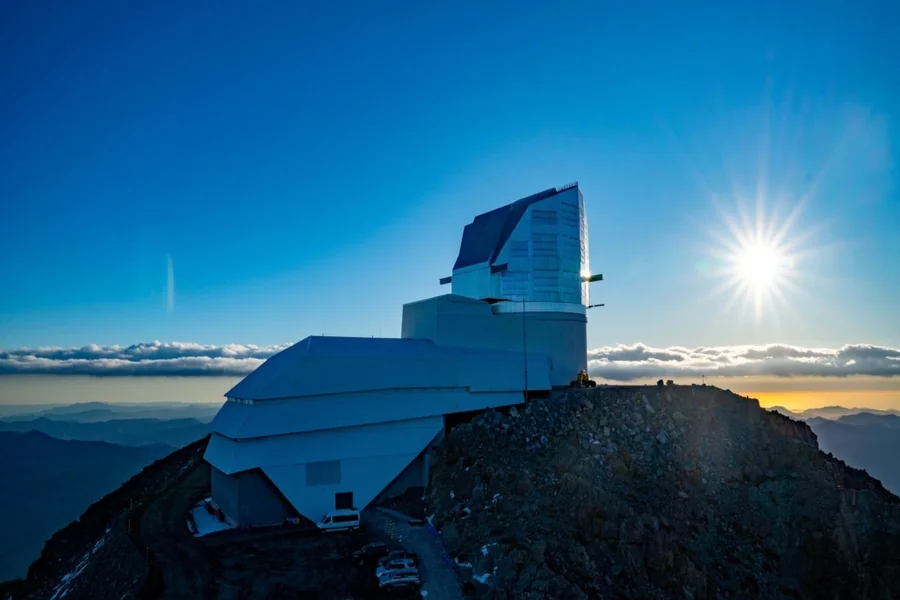
People looking for the biggest camera are looking for a camera larger than a DSLR camera or professional cinema camera. The new holder is the LSST Camera at the NSF–DOE Vera C. Rubin Observatory in Chile today. This is a very big scientific camera with a huge 3,2 gigapixel sensor, some 3 tons of weight and dimensions of a small car.
The LSST Camera was built to take photos of vast areas of the night sky. It is used by scientists to investigate galaxies, stars, asteroids, supernovae, dark matter and other changes in the universe.
Quick Answer: What Is the Biggest Camera in the World?
The biggest digital camera in the world is the LSST Camera, installed on the Simonyi Survey Telescope at the Vera C. Rubin Observatory in Chile. It has a resolution of about 3,200 megapixels or 3.2 gigapixels.
Biggest Camera Facts at a Glance
| Feature | Details |
| Camera | LSST Camera |
| Location | Vera C. Rubin Observatory, Chile |
| Resolution | 3.2 gigapixels |
| Megapixels | About 3,200 MP |
| Weight | About 3,010 kg |
| Length | Around 4.49 meters |
| Height | Around 1.65 meters |
| Field of View | 9.6 square degrees |
| Telescope | Simonyi Survey Telescope |
| Main Purpose | Astronomical sky survey |
| Builder | SLAC National Accelerator Laboratory and partners |
SLAC lists the camera at about 4.49 meters long, 1.65 meters high, and 3,010 kg in weight.
Why Is the LSST Camera the Biggest Camera?
The LSST Camera gets its name from both the size of the camera and its tremendous digital imaging system.
It’s not just a big lens on a standard camera frame. The whole camera is a complicated scientific device with sensors, filters, lenses, electronics, cooling systems and support systems.
It has a 3.2-gigapixel imaging system and can capture an amazing amount of detail in a single exposure.
According to Rubin Observatory, the LSST Camera is “the world’s largest digital camera.
How Big Is the Biggest Camera?
The biggest camera is roughly comparable in size to a small car.
The SLAC Camera is about:
- 4.49 meters or 14.73 feet long
- 1.65 meters or 5.5 feet high
- 3,010 kilograms or 6,635 pounds
It is therefore much larger than consumer cameras, professional cinema cameras, and most other digital imaging systems.
The camera, too, weighs about three metric tons, Rubin Observatory adds.
How Many Megapixels Does the Biggest Camera Have?
The biggest camera has approximately 3,200 megapixels, equal to 3.2 gigapixels.
For comparison:
| Camera Type | ApproximateResolution |
| Smartphone camera | 12–200 MP |
| Professional mirrorless camera | 24–100+ MP |
| Medium-format camera | 50–150+ MP |
| LSST Camera | 3,200 MP |
An individual LSST image contains a vast amount of information, and, if shown at full resolution, would occupy hundreds of Ultra HD screens. Rubin Observatory estimates that it would take about 400 Ultra HD televisions to show one image at full size.
Where Is the Biggest Camera Located?
The NSF–DOE Vera C. Rubin Observatory (VCO) is home to the world’s largest digital camera on Cerro Pachón, Chile.
The observatory’s 8.4-meter Simonyi Survey Telescope (SST) carries the LSST Camera.
The exceptional high altitude astronomical observing sites allow Chilean astronomers access to vast regions of the southern sky, making this an important site for astronomy.
The camera was finished built at SLAC National Accelerator Laboratory in the USA before being sent to Chile.
In March 2025, Rubin Observatory shared news of the camera’s successful installation on the telescope.
Who Built the Biggest Camera?
The LSST Camera was assembled at SLAC National Accelerator Laboratory and at a number of scientific institutions.
Years of engineering and collaboration were needed to prepare for construction.
Important contributors included:
- SLAC National Accelerator Laboratory
- Brookhaven National Laboratory
- Lawrence Livermore National Laboratory.
- IN2P3/CNRS in France
- Other universities/research organizations:
Brookhaven helped with the digital sensor array, Lawrence Livermore National Laboratory and its partners on large optical elements. Electronics, sensor design and camera’s filter exchange system were all aided by French researchers.
What Does the Biggest Camera Photograph?
The LSST Camera takes pictures of night sky.
It’s not meant to make one amazing photo, though. It is used primarily for the purposes of repeated sky observations.
The camera can assist scientists to discover objects and events like:
- Galaxies
- Stars
- Supernovae
- Asteroids
- Comets
- Variable stars
- Moving celestial objects
- Objects that could impact Earth and pose a hazard.
Comparisons between images taken at different times can be used to determine the movement or change of objects.
The Rubin Observatory survey aims to make a very large time-lapse photograph of the southern sky.
How Does the Biggest Camera Work?
The Simonyi Survey Telescope is first hit by light.
The light that is gathered and focused by the telescope mirrors goes to the LSST Camera. The image is captured inside the camera by a large number of digital sensors.
The LSST Camera Field of View ( FoV ) is 9.6 square degrees.
This large field enables astronomers to capture a large area of sky without spending long periods of time on one small portion of the sky using the telescope.
Six Optical Filters
There are also six optical filters on the camera.
The filters enable scientists to view various portions of the light spectrum. The change of filters gives more information about the stars, galaxies and other astronomical objects.
Rubin Observatory claims the filters can be replaced in less than 2 minutes.
Why Does the Biggest Camera Need to Stay Cold?
Electronic noise can be generated from digital imaging sensors.
Nanometers of sensor noise can affect measurements if the scientists are attempting to detect very faint astronomical objects.
This is why the LSST Camera’s sensors are extremely cold.
The sensors are maintained at around -100°C or -148°F to minimize the number of bad “bright” pixels and enhance the quality of the imaging results, says Rubin Observatory.
How Fast Can the Biggest Camera Take Pictures?
The LSST Camera is intended for repeated imaging, not for occasional photography.
The camera was able to begin a new detailed image every 40 seconds, beginning in 2026, according to Rubin Observatory.
This is significant because it’s a large resolution and repeated observation.
One picture tells information about the sky at one time.
Over months and years, thousands of images are captured, and the scientists can recognize the changes and movement.
What Is the Biggest Camera Used For?
The camera is capable of operating with the Legacy Survey of Space and Time, or LSST.
The project is designed to repeatedly photograph the southern sky for about a decade.
The scientists can then study a number of important aspects of astronomy with the information that they have obtained.
Dark Matter
Although dark matter is not normally seen as visible light, scientists can learn about its effects by observing its gravitational effects and the distribution of matter in space.
Dark Energy
LSST observations are expected to give more information on the expansion of the universe.
Asteroids and Comets
Software is able to identify objects moving through the sky using repeated images.
It can aid the scientific community in identifying asteroids, comets and other objects in the Solar System.
Exploding Stars
Astronomical events such as supernovae can suddenly be seen.
The more they are observed the more likely it is that they will be spotted soon.
Galaxy Evolution
Large surveys enable scientists to examine large numbers of galaxies at different distances and stages of development.
Biggest Camera vs Normal Digital Camera
The difference between the LSST Camera and a normal camera is enormous.
| Feature | Normal Camera | LSST Camera |
| Main Purpose | Everyday photography | Scientific astronomy |
| Resolution | Usually tens of megapixels | 3,200 megapixels |
| Size | Handheld | About the size of a small car |
| Weight | Usually under a few kilograms | About 3,010 kg |
| Location | Portable | Mounted on telescope |
| Subjects | People, places, objects | Stars, galaxies, asteroids |
| Cooling | Usually unnecessary | Sensors cooled to about -100°C |
A normal camera needs to be portable and convenient.
The LSST Camera has a completely different goal. It needs extreme sensitivity, a huge field of view, and reliable operation over years of astronomical observation.
Is the Biggest Camera Also the Highest-Resolution Camera?
This depends on how the term is defined.
The LSST Camera is officially described by Rubin Observatory as the largest digital camera in the world, and its sensor contains 3.2 billion pixels.
However, image-resolution records can be measured differently.
Some projects create extremely large photographs by combining hundreds or thousands of separate images. Those stitched photographs may contain more total pixels than a single LSST exposure.
That is different from having billions of pixels physically available in one scientific camera’s focal plane.
How Detailed Are Images From the Biggest Camera?
A 3.2-gigapixel photograph contains roughly 3.2 billion pixels.
This allows scientists to examine both large sections of the sky and tiny details within those sections.
The camera recently captured observations of the COSMOS field using its 3.2-gigapixel imaging system. A stacked image created from hundreds of observations included more than half a million galaxies and over 50,000 stars.
This demonstrates why such a high-resolution camera is useful for astronomy.
Researchers need both wide coverage and fine detail.
Why Was Such a Large Camera Necessary?
Astronomical cameras often face a trade-off.
A telescope can photograph a small area with high detail, or a wider area with less detail.
Rubin Observatory was designed to combine a wide field of view with high-resolution imaging.
That allows researchers to repeatedly survey enormous areas of the sky.
The result is less like taking individual photographs and more like producing a continuous scientific record of the changing universe.
Biggest Camera and the Future of Astronomy
The biggest camera represents an important change in how astronomers study space.
Traditional astronomy often focused on individual objects or small sections of the sky.
Modern sky surveys collect enormous datasets containing billions of objects.
Computers can then compare observations and automatically flag unusual activity.
Rubin Observatory says the LSST will build a detailed time-lapse view of the southern sky throughout its ten-year survey.
This could support research in areas ranging from planetary science to cosmology.
Final Thoughts
The biggest camera is unlike anything used in everyday photography. The LSST Camera at the Vera C. Rubin Observatory combines a 3.2-gigapixel sensor, car-sized body, three-ton weight, large field of view, and specialized cooling system.
Its size is impressive, but its scientific purpose matters even more.
By repeatedly photographing the southern sky, the LSST Camera gives astronomers a way to track billions of objects and study how the universe changes over time. From nearby asteroids to distant galaxies, this camera is designed to collect information on a scale that traditional cameras cannot match.