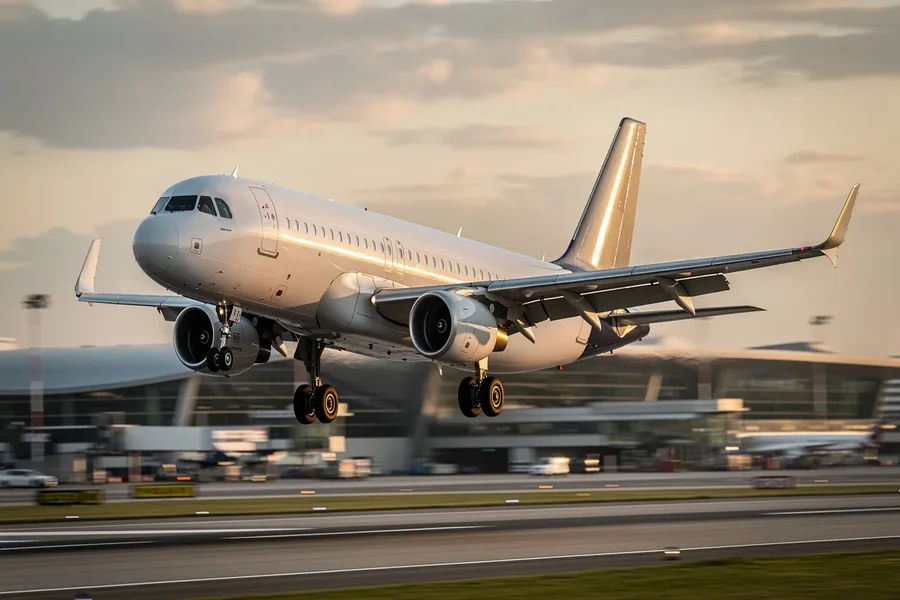
Airbus A320 capacity is the total number of passengers that can be accommodated on-board the aircraft as per its seating configuration and cabin layout. The standard variant of the Airbus A320 usually has 140 to 170 seats, but can be configured for a maximum of 180 passengers in a high-density seating arrangement. There are various types of seat configurations available for airlines depending on the route, level and the need of cabin. This actual capacity may differ, depending on the airline, even if the same A320 is in use.
What Is The Airbus A320 Capacity?
The Airbus A320 is one of the most popular single-aisle passenger aircraft used in commercial aviation. Its purpose is primarily for short and medium haul operations. The A320 family has been in service with airlines since 1988 and is now a very familiar sight at all the world’s airports.
If anyone is doing a search for airbus a320 capacity, they would probably want to know how many passengers can be accommodated in the aircraft. That answer will vary on a case-by-case basis and is dependent upon the type of A320 and, more significantly, the airline’s seating arrangement.
The first two generations of the A320, the A320-100 and A320-200, were based upon a typical two-class configuration. The standard configuration would allow for about 140-170 passengers. Airbus gives a maximum seating capacity of 180 passengers for the A320 in high density.
A typical airline can have less than full capacity for a variety of reasons, such as space for business class seating, larger galleys, lavatories, crew areas, or other cabin features.
The key points are:
- Normal class capacity: approximately 140-170 passengers
- Maximum certified capacity: Up to 180 passengers
- Cabin type: Single-aisle
- Best use: Short and medium distance flights
- Economy seating: 6 seats across (3-3)
This agility is another factor making the A320 valuable to the various types of airlines.
Airbus A320 Seating Capacity By Configuration
Airlines may have different configurations that alter the number of people an A320 can accommodate.
For instance, a full-service airline can segment the cabin into business class and economy class. Business class seats can be larger than economy class seats. This means that the number of passengers carried is smaller.
A single-class cabin can be used by a low-cost carrier. Seats may be closer together so that the airline can fit in more passengers on the same plane.
This is a basic overview:
| Airbus A320 Configuration | Approximate Passenger Capacity |
| Two-class layout | 140–170 |
| Single-class layout | Around 170–180 |
| High-density configuration | Up to 180 |
| Typical full-service setup | Around 150–165 |
These numbers are meant to be used as general ranges of capacity and not exact numbers. The airlines can set the configuration of their planes.
The Distance between seats also counts. Seat pitch is the distance between the point on one seat and the same point on the seat in front. With more generous spacing it typically means that there are fewer rows in the cabin.
So the capacity of the A320 isn’t just about how many seats it can hold. The final number depends on design of the cabin, safety specifications, exits, galleys and approval.
How Many Seats Does An Airbus A320 Have?
The standard Airbus A320 features a single-aisle cabin arrangement in most of its economy class layouts with 3-3 seating configuration. This equates to three seats on either side of an aisle.
Depending on the airline’s layout the number of rows will vary.
A two-class plane could feature business class up front and economy class in the back. Some airlines may have business class seats in the exact same configuration as economy class seats, but with the middle seat empty or the middle seat set up differently.
The airline can make more room in the cabin for seating in high density configuration. With the proper configuration, the A320 can seat up to 180 passengers, according to Airbus.
This makes the aircraft an option for airlines seeking to optimise their fleet size and cost.
But for passengers, two A320s flying for different airlines can be very different. One can provide more personal space, fewer seats, and the other can be designed to maximise the number of passengers.
Airbus A320 Cabin Layout And Passenger Space
Cabin layout is tightly coupled with passenger capacity. The A320 is designed with a cabin layout which can be configured to accommodate the needs of airlines.
The single-aisle configuration ensures the aircraft’s usefulness on short-haul routes. Onboard/offboard access to the aircraft is possible from the front and rear doors depending on the airport configuration and aircraft type.
A normal economy cabin has six seats to a row:
3 seats + aisle + 3 seats
This configuration is widely used throughout the A320 family and enables the aircraft to operate with a high number of passengers without the need to use a wide-body aircraft.
The cabin also has spaces that are not directly related to the creation of passenger seating. These include:
- Lavatories
- Galleys
- Flight attendant areas
- Emergency exits
- Overhead storage
- Crew workspaces
- Passenger entry areas
These spaces are essential and the airline cannot just turn all of the seats on the aircraft into seats.
Aviation Safety Regulations must also be followed for maximum seating capacity. Emergency evacuation needs are even more crucial. The seating capacity of an aircraft is related to the time it takes to evacuate the people on board.
As a result, not all airlines have the optimum seating arrangement for the largest number of seats.
Airbus A320 Capacity Compared With Other A320 Family Aircraft
The A320 is part of a larger family that includes the A318, A319, A320, and A321. They have a lot of similar design characteristics, but vary by fuselage length and capacity.
The A319 is a shorter, and usually a lower passenger carrying, engine than the A320. The A321 is longer and is able to accommodate much more passengers.
The A320 is in the middle in terms of number of passengers.
| Aircraft | General Capacity Range | Relative Size |
| Airbus A318 | Around 100–130 passengers | Smallest |
| Airbus A319 | Around 120–160 passengers | Smaller than A320 |
| Airbus A320 | Around 140–180 passengers | Mid-size |
| Airbus A321 | Around 180–244 passengers depending on version | Largest |
Exact numbers are depending on the version and cabin layout.
The A320 has stayed in demand due to its convenient midpoint. It is capable of carrying a sufficient number of passengers on busy routes without sacrificing aircraft operational qualities.
The A320neo is the same number of passengers as the older A320. It’s primary differences are newer engines, aerodynamic changes, and other efficiency-enhancing technologies.
The A320neo’s cabin size and seating capacity would be the same for the passenger, but for the airlines, it would provide them with benefits in operating efficiency.
What Affects Airbus A320 Capacity?
There are a number of factors that influence the actual number of passengers an A320 can carry. While there is a certified limit, airlines determine how to utilize the space in the cabin within the limits.
1. Cabin Configuration
The number of classes is the most apparent. In a single class configuration, more passengers can fit in the single class cabin than in a two class cabin.
2. Seat Pitch
The more leg room that you need, the more cabin space you will need. The further apart the rows are, the less number of rows will fit on the board.
3. Business Class
More passenger capacity can be maintained with business class seating. Business seats may also need extra cabin space or other services depending on the airline.
4. Lavatories and Galleys
The number of facilities required for airlines depends on the passengers going on the flight. Cabin service equipment takes up space that could otherwise be used for seating.
5. Safety Regulations
Aviation safety requirements also have an impact on passenger capacity. Cabin arrangement, evacuation procedure and emergency exits shall comply with relevant certification requirements.
6. Aircraft Variant
There are a number of variants of the A320 family. Within the same aircraft type such as A320, there may be variations in the cabin layouts and specifications depending on the generation and configuration of the aircraft.
That’s why the term Airbus A320 capacity never always refers to a single number of passengers.
Why Is The Airbus A320 So Widely Used?
But the appeal of the A320 is not just its passenger capacity. Other factors that are taken into account by airlines include operating costs, range, airport compatibility, maintenance and fleet commonality.
The A320 is good for aircraft that require a greater number of seats than a smaller regional jet, but not a wide-body jet.
It can also be operated in many short-and medium-haul flights, due to its single aisle design. It can be used for domestic services, regional international services, and for other services where there is a demand for passengers for the size of the aircraft.
The wider A320 family is an important consideration, too. Several different types of aircraft can be used to operate multiple aircrafts with similar cockpit and operational characteristics. This can make it easier to plan a fleet and train crews.
The A320 also has a high production volume, and is well known to airlines, airports, pilots, maintenance shops, and passengers.
It’s the 3-3 seating layout that’s familiar to its passengers. The layout is immediately recognisable to most travellers, particularly in short-haul flights.
Final Thoughts
In most airline configurations, the Airbus A320 carries between 140 and 170 passengers, and in high-density configuration, the capacity is up to 180 passengers. The exact number varies according to the cabin design, seating configuration, class configuration and the applicable safety requirements of the airline.
The A320 isn’t actually a single-passenger aircraft, it’s a flexible aircraft for airlines. A full-service carrier can opt for fewer seats to offer more cabin space and various service levels. A dense configuration can be used on a low cost airline to maximise passenger numbers.
This versatility has made the A320 one of the most easily identifiable and popular single-aisle jets in the commercial aviation industry. If you’re looking to compare aircraft sizes, knowing how big they are at normal cruise and at maximum capacity really paints a picture of what the A320 can do.