The worlds oldest mall is generally considered to be Trajan’s Market in Rome, Italy. The massive structure was constructed around 100–110 AD during the reign of Emperor Trajan and consisted of several multi-storied structures including shops, offices, storage areas, etc. Put another way, folks were meeting in a location to purchase goods almost 2000 years prior to the existence of the contemporary shopping centre.
There is a bit of an explanation in the term “mall” and Trajan’s Market is indeed one. The ancient Romans never used that word, and this was not a modern-day mall, complete with department stores, escalators and food courts. But its layout of multiple commercial units within a single large planned development is one of the earliest for a building that bears remarkable resemblance.
Why Was Trajan’s Market So Advanced?
People typically went shopping in ancient Rome in the markets, or through individual shops or stalls, that were located in the busy streets. Trajan’s Market was a very concentrated place of many activities.
It was amazing because of a number of features.
- Several floors: The complex was arranged at various floors along the incline of Quirinal Hill.
- There were a number of commercial rooms – it has been estimated that there were probably once some 150 shops, offices and other rooms.
- Its central location – It was located near the Trajan’s Forum, one of the most important public institutions of ancient Rome.
- Strong structural engineering – much of the structure as a whole is still standing due to the use of Roman brick and concrete.
- Mixed uses – The buildings were likely to have served more than just retail functions, though they may have also included offices, administration and storage functions.
That last fact is important because not all the rooms in the complex were necessarily shops. Trajan’s Market was probably more involved than a huge, old fashioned shopping mall. Nevertheless, its commercial nature is evident and it is often referred to as an early shopping mall.
The Worlds Oldest Mall Still Standing
Trajan’s Market is in the heart of Rome, near the Trajan’s Forum and close to numerous famous sites in Rome, along the Via dei Fori Imperiali.
It was built about 100-110 AD. The complex was built around the natural contours of the hillside and consisted of multiple levels, connected by a series of stairs. The outside appearance of its rows of brick arches may seem familiar. Walkways linked rooms used by residents, merchants and administrators in their daily activities.
It is now part of the Museum of the Imperial Fora. There are sections of the old structure that can be walked through, and it gives an impression of the size and sophistication of the structure.
This is what sets Trajan’s Market apart. This isn’t just a place that historians have got from written sources. There are still many visible remnants of the physical structure.
Was It Really a Shopping Mall?
That’s where it gets a little more complicated.
Trajan’s Market is sometimes referred to as the Worlds Oldest Mallcovered shopping mall or shopping centre, while it is actually considered by archaeologists to have served a number of purposes other than retail. The rooms may have been shops; others were likely administrative offices or related to the functioning of the adjacent Imperial Forums.
To say it’s like the mall in the Roman Empire might be useful, but too literal.
Should you be referring to the oldest surviving large commercial complex similar to a mall, then Trajan’s Market is a good choice.
If you’re talking a shopping arcade constructed with a specific purpose in mind, like how today’s malls were built, it’s ahead of us more than 1,700 years.
What About Galleria Vittorio Emanuele II?
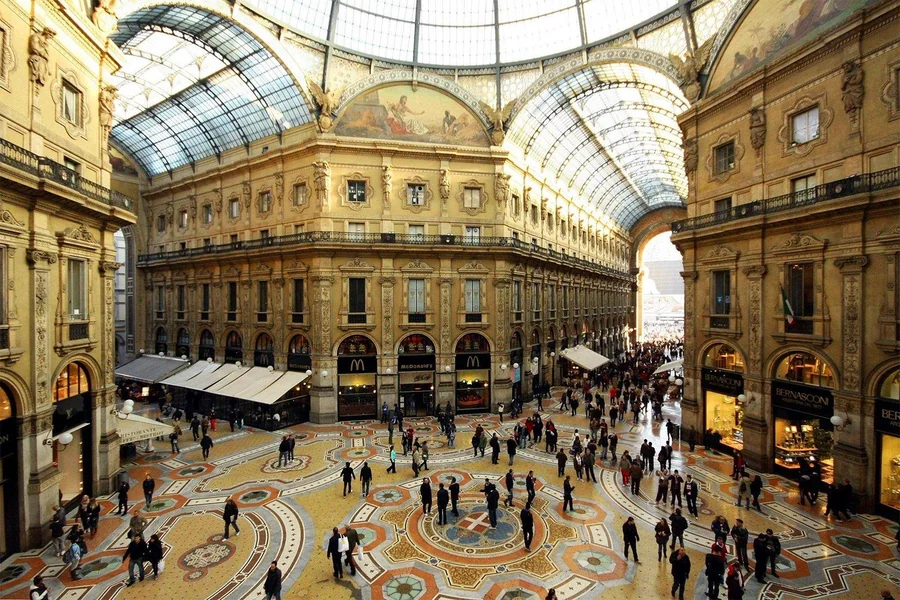
The Galleria Vittorio Emanuele II in Milan, Italy was one of the most significant developments to the modern shopping mall.
The spectacular covered arcade was built during the 19th century and connects Piazza del Duomo with Piazza della Scala. It has a glass and iron roof over fine walks and shops, restaurants and cafés.
The Galleria is Italy’s Worlds Oldest Mall and one of the oldest shopping centers of the kind, according to the official tourist organization of Milan.
This is not quite so much Trajan’s Market, but rather a more familiar place to shop. Walk through a protected area, shop, dine, hang out, meet friends etc. without shopping.
That social aspect is what will be a hallmark of malls a century later.
The Galleria is still alive and thriving today, and houses luxury stores, restaurants and historic businesses. It’s not just an archaeological ruin. It’s still doing something pretty close to what it’s designed to do.
The First Modern Enclosed Mall
If by “mall” you specifically mean the fully enclosed, climate-controlled shopping centers common in the United States and elsewhere, the record belongs to Southdale Center in Edina, Minnesota.
Southdale opened on October 8, 1956. Designed by architect Victor Gruen, it brought shops together around an indoor public area protected from Minnesota’s cold winters. The original mall had 72 tenants along with features including a skating rink and other public amenities.
That design became hugely influential.
Instead of shoppers moving between stores along outdoor streets, they could park nearby, enter one controlled environment and visit numerous businesses without going outdoors again.
It sounds completely normal now. In the 1950s, it represented a major shift in retail design.
Three Different “Oldest Mall” Records
The confusion around the world’s oldest mall usually comes from mixing three different definitions.
Trajan’s Market, Rome — around 100–110 AD
This is commonly described as one of the world’s earliest shopping-center-like complexes. It combined numerous commercial and administrative spaces in a large multi-level structure.
Galleria Vittorio Emanuele II, Milan — 19th century
This is one of the oldest surviving purpose-built shopping galleries and remains an active luxury shopping destination today.
Southdale Center, Minnesota — 1956
This was the first fully enclosed, climate-controlled shopping mall in the United States and helped establish the format that later spread around the world.
All three can appear in answers about the “first mall,” depending on what the writer means by the word.
Why Did Shopping Malls Become So Popular?
The basic idea behind malls has remained remarkably consistent for centuries: put many things people want in one convenient place.
Ancient shoppers needed access to merchants. Nineteenth-century shoppers wanted attractive covered spaces where they could browse and socialize. Twentieth-century consumers wanted parking, climate control, department stores, restaurants and entertainment under one roof.
Modern malls simply pushed that idea much further.
Large shopping centers eventually added movie theaters, food courts, supermarkets, arcades and entertainment areas. In some countries, malls developed into destinations where families could spend an entire day without ever needing to leave the building.
That makes the connection with Trajan’s Market interesting. The technology, stores and architecture changed dramatically, but the basic attraction of centralized commerce did not.
Can You Visit the Worlds Oldest Mall Today?
Yes.
Trajan’s Market survives in Rome as an archaeological and museum complex. Visitors can enter portions of the ancient buildings and walk through spaces that formed part of the commercial and administrative center almost two thousand years ago.
The site now houses the Museum of the Imperial Fora, which helps explain Trajan’s Forum and the surrounding Roman structures.
For anyone accustomed to modern malls filled with digital signs and escalators, seeing several floors of Roman brickwork makes the age of the idea especially clear.
People have been looking for convenient places to shop for a very long time.
Final Thought
The worlds oldest mall is generally identified as Trajan’s Market in Rome, built around 100 to 110 AD. Calling it a mall is somewhat modern terminology, because the complex probably included administrative and commercial spaces rather than functioning exactly like today’s shopping centers.
For something closer to a traditional covered shopping arcade, Milan’s Galleria Vittorio Emanuele II is one of the oldest major examples still operating. And for the modern enclosed, climate-controlled mall format, Southdale Center in Minnesota marked the major turning point in 1956.
The buildings may look completely different, but the basic idea hasn’t changed much in almost 2,000 years: gather shops, services and people together in one convenient place.

1 Comments