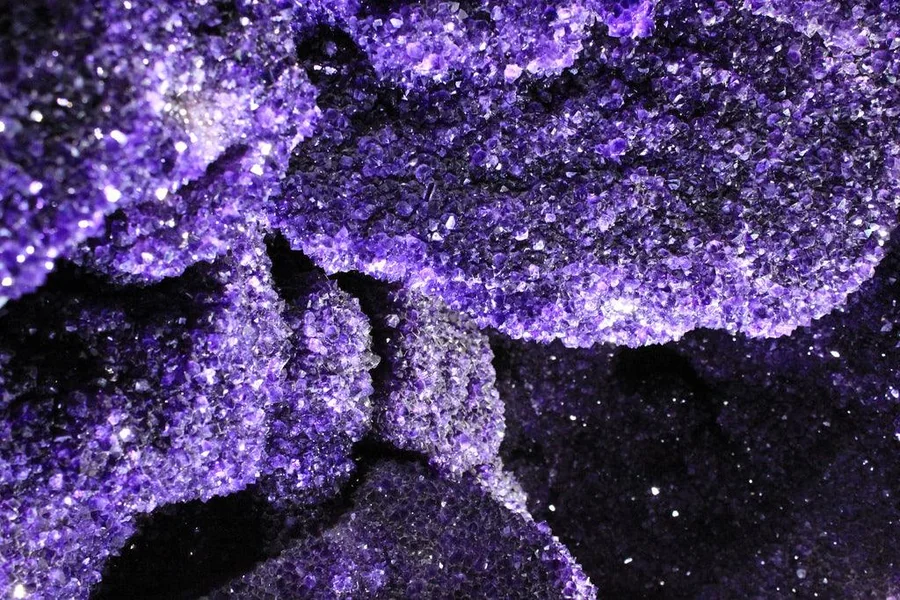
Usually, the largest amethyst in the world is referred to as a giant amethyst geode instead of a single amethyst. Guinness World Records says the heaviest amethyst geode in the world is a 13,000kg (28,660 lb) specimen found in Minas Gerais, Brazil. It’s approximately 3 meters long, 1.8 meters broad, and 2.2 meters tall. It is one of the geodes discovered in Uruguay and which is exhibited at the Shandong Tianyu Museum of Natural History in China. The Empress of Uruguay is another renowned giant, which has been reported as the world’s tallest amethyst geode at 3.27 meters tall.
What Is The Biggest Amethyst In The World?
The largest amethyst geode ever discovered is the subject of most of the searches one receives for the ‘biggest amethyst in the world‘. There can be a lot of confusion in the answer as there have been several very large specimens described as the largest in the world.
The world’s largest amethyst geode according to Guinness World Records is a 13 metric tonne specimen. It is about 3m long, 1.8m wide and 2.2m tall. The specimen was first found in Uruguay and later on kept in China at the Shandong Tianyu Museum of Natural History.
The confusion is due to another prominent specimen, Empress of Uruguay. Currently, it’s approximately 3.27 metres tall and weighs approximately 2.5 tonnes. Mineral and gem literature often calls it the “world’s largest amethyst geode.
It is significant for the difference. What is meant by the term “biggest” may depend on the weight, overall size, height or size of the original specimen. The Guinness Book stands alone in providing definitive information on the size of the largest amethyst geode ever recorded in terms of weight.
The Largest Amethyst Geode By Guinness World Records
This is an impressive specimen of how big a natural amethyst geode can grow, and was recognized by Guinness as such.
It was recorded at:
- Weight: 13,000 kilograms, or about 28,660 pounds
- Length: 3 meters, or about 9 feet 10 inches
- Width: 1.8 meters, or about 5 feet 10 inches
- Height: 2.2 meters, or about 7 feet 2 inches
- Original location: Uruguay
- Current display: Shandong Tianyu Museum of Natural History, China
- Record date: October 27, 2008
The specimen is referred to as an amethyst geode, which is not a single amethyst crystal. The difference does count because geodes can have thousands of quartz crystals inside the inside of a cavity in rock.
Large amethyst geodes are a specialty of Uruguay. The northern Artigas area of the country is known for their amethyst stones, and some of the biggest geodes discovered anywhere in the world. Geological studies of the area indicate the area is a world-class source of giant amethyst geodes.
The record specimen was found in Uruguay before being transported to China. Today, it is displayed in the Shandong Tianyu Museum of Natural History under the mineral collection.
The Empress Of Uruguay: Another Famous Giant Amethyst
The Empress of Uruguay should be highlighted as one of the most renowned and talked about giant amethysts.
Known as the Empress, it was found in Artigas department, Uruguay, in 2007. It is about 3.27m or 10.7ft tall and weighs about 2.5 tons.
It is particularly striking due to its size and vertical form. The geode was carefully removed from the enclosing basalt and it reportedly took several months. The specimen has been opened to allow the public to look inside and admire the amethyst crystals, while preserving most of the original structure.
The work of the Empress has also been shown abroad. Reports of displays in places such as the American Museum of Natural History. It’s also linked to The Crystal Caves in Atherton, Queensland, Australia.
This is a great lesson for anybody studying the world’s largest amethyst. The largest specimen may be the “largest” in one instance, and not achieve the official Guinness record for the largest amethyst geode.
The Empress is higher than the Guinness, for instance, but the Guinness is a lot heavier. This is why there may be multiple responses to the same questions on various websites.
How Do Giant Amethyst Geodes Form?
If you want to know why Uruguay has such massive amethyst geodes you should know how they are created.
Amethyst is a type of quartz that is purple in color. It is composed of minerals that are the result of quartz-rich fluids being deposited in open spaces in the rock and slowly filling the space over time. Quartz crystals have the ability to grow on the walls of a cavity over an extended period.
Many amethyst geodes have formed in ancient basalt in the volcanic rocks of southern Brazil and northern Uruguay. The basalt is formed by giant volcanic eruptions related to the Paraná volcanic province. Later, the spaces created in the rock filled with minerals.
The general procedure can be broken down into several steps:
- Volcanic rock forms. Large bodies of basalt are formed by ancient lava flows.
- Gas cavities develop. The molten volcanic rock can contain gas, which forms air pockets within the rocks when the rock cools.
- Mineral-rich fluids enter. The dissolved minerals in the water flow through cracks and holes.
- Quartz starts to form. The walls of the cavity are coated with silica.
- Amethyst develops. Causes of the purple colour: trace elements and growth conditions.
- The cavity slowly fills with crystals. Crystals may grow to be large and numerous over a period of time.
The outcome is a geode that has a dark shell and is lined with purple quartz crystals.
The largest specimens occur where the original cavity is very large and the conditions are favorable for the growth of the minerals for a long time. This is one of the many reasons why the giant geodes of Uruguay and surrounding areas are so significant to mineral collectors and geologists.
Why Is Amethyst Purple?
Amethyst is a type of quartz and pure quartz is often colourless. The colour of amethyst is due to defects and trace elements in the quartz structure, the natural radiation and conditions in which the crystals were formed.
This colour may vary significantly. There are specimens of amethyst with a much deeper purple than this, and some amethyst is pale lavender.
Amethyst is popular as a gemstone because of its colour. But the size is not the only factor in determining the value of a large specimen. Other factors that collectors might take into account are the clarity, color, condition, locality, shape, and scientific or historical value of the specimen.
Uruguayan amethyst has a special reputation for being purple in color and for having beautiful formations. Artigas has been developing a significant industry in the extraction and processing of amethyst and other minerals.
This is also the reason why not all giant geodes are giant gemstones. Each crystal within a geode can be different in size, shape, color and quality.
Biggest Amethyst vs. Biggest Amethyst Crystal
Another frequent mistake is when people think of geode when they actually are viewing a single amethyst crystal.
A geode is a rock that has an inner cavity lined with crystals. A large amethyst geode, then, is not necessarily one big crystal, but can be many tons of crystals.
One amethyst crystal is not like the other. It is a single crystal of quartz that has the purple hue of amethyst.
It seems that there is no one universally accepted category in Guinness to define one giant ‘amethyst crystal’, like there is for the largest amethyst geode. There are many large individual crystals and clusters, documented in mineral databases and auction records, but the size of the individual crystals varies, and often is limited to certain localities or collections.
This means it is beneficial when comparing claims online.
When someone claims to have discovered the “biggest amethyst”, ask them:
- Does it seem to be made of a single crystal?
- Is it a crystal cluster or something else?
- Is it a geode?
- On which measurement: height, length, or weight?
- Does the statement have an official document to back it up?
If those details aren’t included, two sites could be reporting the same gem as the largest amethyst and both could be right.
In general searches, the safest way to proceed is to use the Guinness-recorded amethyst geode weighing 13,000 kg and consider the Empress of Uruguay as another exceptional, tall amethyst.
Final Thoughts
The term “biggest amethyst in the world” is easy to understand, but it’s not necessarily the same thing as “largest amethyst ever found.”
The largest amethyst geode is a 13,000 kg specimen from Uruguay in the official Guinness World Records as the largest amethyst geode in the world. It is approximately 3 m long, 1.8 m high and 2.2 m wide.
Another big player in the tale is the Empress of Uruguay. It is approximately 3.27 metres in height, also taller than the one that is listed in the Guinness Record, and is often referred to in other sources as the world’s largest amethyst geode.
Both specimens demonstrate the importance of Uruguay to the world of amethyst. Giant geodes and high quality purple quartz are found in the country’s northern deposits.
If you are looking for the largest amethyst in the world, it is essential to pay close attention to the headline. “Largest” can mean heaviest, tallest, longest, or largest single crystal. After this distinction is made, the various claims of the present invention become easier to understand.


2 Comments