state
What is the size of Montana?
The size of Montana is 147,165 sq miles or 381,156 sq km. It is 255 miles
(410 km) wide and 630 miles in length (1,015 km). The capital city is Helena.
Geographical Information
The latitude is 44 degrees, 21’ N to 49 degrees, N. The longitude is 104 degrees, 2’ W to 116 degrees, 3’ W. Granite Peak is the highest point at 12,807 ft (3,904 m). Kootenai River is the lowest at 1,800 ft (549 m). The mean is 3,396 ft.
The state is noted for its mountain ranges, including the Northern Rocky Mountains as well as the Bitterroot Mountains. The Beartooth Plateau is the largest landmass in America at 10,000 ft (3,000 m).
Population
The size of Montana’s population is quite small, compared with the other states. As of 2008 the population was 967,440. The density is 6.5/sq mi or 2.51/sq km.
The earliest census done for Montana was n 1870. The population was 20,685. The total increased to 142,924 in 1890. Another major increase occurred in 1900 with the population reaching 243,329.
By 1920 the number of people in Montana had reached 548,889. The 1960 census showed the population was at 674,767. There were 786,690 individuals living in Montana in 1980. There were 902,195 individuals there by the year 2000.
Montana’s Major Cities
Billings is the most heavily populated with 89,847 residents. Next is Missoula with 57,053, Great Falls with 56,690, Butte-Silver Bow with 33,892 and Bozeman with 27,509. At number six is Helena with a population of 25,780.
The size of Montana’s Kalispell City is 14,223 while Havre is number eight with 9,621 residents. Anaconda-Deer Lodge has a population of 9,417 and Miles City 8,847. Helena Valley Southeast is home to 7,141 while Helen valley West Central has a population of 6,983. The population figure for Livingston is 6,851 and for Laurel 6,255.
Ever Green’s population has been estimated at 6,215; for Lewistown it is 5,813. Belgrade is the 17th most heavily populated with 5,728. Orchard Holmes is at number 18 with 5,199. At number 20 is Sidney with a population of 4,774.
Biggest Counties
The size of Montana’s counties (population wise) are as follows: Yellowstone County (pop: 142, 348), Missoula County (107,320), Gallatin County (89,824), Flathead County (88,473), Cascade County (82,026), Lewis and Clark County (60,925) and Ravalli County (40,664) is at number seven.
Silver Bow is number eight with 32,803 and Lake County is at nine with a population of 28,690. Lincoln County is number ten with a population of 18,971.
Hill County is at number 11 with a population of 16,454, while Park County is the 12th biggest with 16,189. Glacier County is number 13 with 13,297 followed by Big Horn with 12,841. Jefferson County is number 15 with 11,255. There are a total of 56 counties in the state.
The 16th biggest county is Fergus with 11,195 followed by Custer County with 11,149. Sanders County is number 18 with 11,034 while Roosevelt County has a population of 10,089. At number 20 is Carbon County with 9,657.
The size of Montana’s county population as given here are for 2008. Like the state’s population, the figures will change in a few months or years.
What is the size of New York?
Considered as the third most populous state in the U.S.,
New York goes by the nickname ‘the Empire State.’ The largest city is New York City, while the capital is Albany. It is surrounded by Quebec on the north, Ontario on the west side, Vermont on the east and Pennsylvania on the south. By visiting this place, people can find beautiful state parks such as the Montauk Point State Park, Catskill Park and Adirondack Park. In addition to these highly interesting aspects, it is also good to learn the size of New York.
The Size of New York
What is the size of New York? In terms of land area covered, New York ranks 27th overall amongst the various states in the U.S. It measures 141,299 square kilometers or 54,555 square miles. It is 530 kilometers or 330 miles long and 455 kilometers or 285 miles wide. The highest point is Mount Marcy, which stands tall at 1,629 meters or 5,344 feet.
The largest cities in the state include Utica, Schenectady, Mount Vernon, New Rochelle and Albany. The other five big cities are Syracuse, Yonkers, Rochester, Buffalo and New York City. New York City is in itself comprised of five different counties, namely Richmond, Kings, Queens, Manhattan and the Bronx.
Additional Facts and Other Important Details
New York set a gross state product amounting to $1.1 trillion in 2007. This ranks third after the bigger states of Texas and California. Its agricultural outputs include apples, vegetables and cattle. In terms of industrial outputs, its economy relies heavily on tourism, chemical products and machinery. Likewise, it also receives major contributions from the electric equipment, scientific instruments as well as publishing industries.
Furthermore, the state exports an extensive selection of goods including minerals, commodities and foodstuffs. Additionally, it also exports automobile parts, cut diamonds and electronics. These products are sent to places such as Hong Kong, Israel, Switzerland, the United Kingdom and Canada. On the other hand, the state imports lumber, rough diamonds, electricity, natural gas, aluminum, gold and oil from other countries.
In the United States, New York City plays a major role in the country’s economic success by serving as the center of communication, finance and banking. Moreover, it also plays home to the New York Stock Exchange. Aside from these things, the state is also serves as reliable producer of agricultural products like maple syrup, onions, potatoes, cabbage, cherries and apples. In 2004, the state produced approximately 200 million bottles of wine from its 212 wineries and 30,000 acres of vineyards.
What is the size of Oklahoma?
The size of Oklahoma is 69,898 sq mi (181,186 sq km).
The length is 298 miles (480 km) and it is 230 miles (370 km) wide. The capital is Oklahoma City.
Geographical Information
The water area is 1.8% and the latitude is 33 degrees, 37’ N to 37 N. the longitude is 94 degrees, 26’ W to 103 W. Black Mesa is the highest point at 4,973 ft (1,515 m). Little River is the lowest point at 289 ft (88 m).
The state is in the midst of the Great Plains and Ozark Plateau. There are ten ecological regions in the state, including four mountain ranges. Forests cover almost 25% of the landscape.
Population
The 2008 census puts the population at 3,642,361. The density is 52.7 sq mi or 20.34 km2.
The size of Oklahoma’s population back in 1890 was 258,657. It grew by more than 200% in 1900, reaching 790,391. The population registered another big jump ten years later; the 1910 census reported there were 1,657,155 individuals living in the state.
By 1930 the figure had grown to 2,396,040. However the figure didn’t break the 3 million mark until the 1980s when records showed 3,025,290 were living in the state. The 1990 figure showed there were 3,145,585 people living there.
German ancestry comprised 14.5%, followed by American at 13%. Irish ancestry was next at 11.8% and the English at 9%. 11.5% were Native American and 8% had African American ancestry. Oklahoma has the second greatest number of Native Americans with almost 400,000.
Size of Oklahoma Cities by Population
Oklahoma City is at number one with 506,132. It is followed by Tulsa with a population of 393,049. Norman is the third biggest (population 95,694) while Lawton is at number four (population 92,757).
Broken Arrow has a population of 74,859, putting it at number five. Edmond is sixth with 68,315. Midwest City is at number seven with 54,088 residents. Enid is at number eight with 47,045. Moore has a population of 41,138, while Stillwater has an estimated population of 39,065.
Muskogee is the 11th most heavily populated with 38,310 followed by Bartlesville (population 34,748). Shawnee is at 13th place with a population of 28,692. Ponca City is the 14th biggest with 25,919 residents. Ardmore is at number fifteen with 23,711.
Protected Areas
The size of Oklahoma’s Tallgrass Prairie Preserve (39,000 acres or 158 sq km) is the biggest on the planet. There are half a dozen national parks in the state. There are also 50 state parks and two protected grasslands.
Oklahoma has 10 million acres (or 40,000 km2) of forests. Six percent of it is public land. The Black Kettle National Grassland encompasses an area of 31,000 acres (127 km2).
The Wichita Mountains Wildlife covers 69,000 acres (238 km2). The Chickasaw National Recreation Area is the biggest in the state. It covers an area of 4,500 acres (18 km2).
It isn’t just the size of Oklahoma’s natural attractions that are impressive. It also has a high per capital income and its GDP (gross domestic product) is among the fastest growing in the Untied States.
What is the size of Rhode Island?
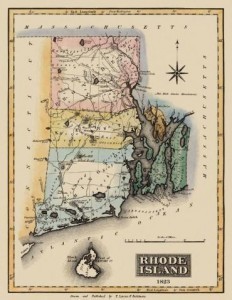
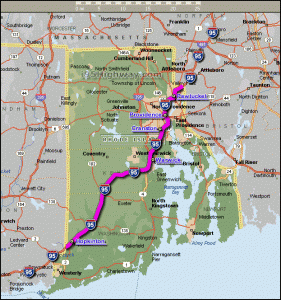
The size of Rhode Island is 1,545 sq miles or 4,000 sq km.
Rhode Island is 37 miles (60 km) wide. The length is 48 miles (or 77 km). The capital is Providence.
Geographical Information
The water area is 32%. The latitude is 41 degrees, 09’ N to 42 degrees, 01’ N and the longitude is 71 degrees, 07’ W to 71 degrees, 53’ W. Jerimoth Hill at 812 ft (257 m) is the island’s highest point. The Atlantic Ocean is the lowest at 0 ft (0 m). The mean is 200 ft (60 m).
When measuring the size of Rhode Island, it is usually divided into the lowlands of Narragansett Bay and the New England Upland. Block Island is 12 miles (19 km) off the mainland. The largest island is Aquidneck Island.
Conanicut is the second biggest island and Prudence is third. Narragansett Bay encompasses over 30 islands. The official state rock is Cumberlandite, which is located only in Rhode Island.
Population through the Years
The 2008 population estimate was 1,050,788. The density is 1,012 sq mi or 390.78 sq km, second in the US.
The earliest census dates from 1790. It stated the population was 68,825. It rose to 83,059 in 1920 and to 108,830 in 1840. Rhode Island’s population was 217,353 by 1870 and reached 428,556 by 1900.
Rhode Island’s population according to the 1920 census was 604,397. By 1950 the population had gone up to 791,896. The figure rose to 946,725 in 1970. The 1990 census showed the island’s population had reached 1,003,464.
Size of Rhode Island Cities
Providence is the biggest city by population with 175,255, followed by Warwick with a population of 85,925. Cranston is at number three (population 81,479). Pawtucket is at number four with a population of 72,998.
East Providence is at number five with 49,123 and Woonsocket is at sixth place with 43,940. Newport is in seventh place with its population of 24,409. Central Falls is next (population 19,159).
Other major cities are Westerly (17,682), Barrington (16,819) and Valley Falls (11,599). Newport East has a population of 11,463, while Greenville has 8,626 residents.
The population of Wakefield-Peacedale is 8,468. Cumberland Hill’s population is 7,738 and for Tiverton it is 7,282. Kingston’s population has been estimated at 5,446.
Rhode Island Cities by Housing Units
If the size of Rhode Island cities will be by housing units, the figures will be as follows. Providence has 67,915 followed by Warwick with 37,085. Cranston is third with 32,068 and Pawtucket is next with 31,819. East Providence is at number five with 21,309 and Woonsocket is at sixth with 18,757.
North Providence is in 7th place with 14,867 housing units. Newport’s housing units number 13,226. West Warwick is ninth with 13,186 and Bristol at tenth with 8,705 housing units. Westerly is at number 11 with 7,812, Central Falls is next with 7,270 while Barrington has 6199.
The size of Rhode Island puts it in 50th place among all the states. But its cultural and geographical features rank among the highest in America.
What is the size of South Dakota?
Known as the U.S. state which was named after American Indian tribes Lakota as well as Dakota Sioux, South Dakota is found in the Midwest region of the country. The state is divided into three regions, namely the eastern region, the western region and the Black Hills. The longest and largest river in the place is the Missouri River. Other rivers that can be found are the White, Big Sioux, James and Cheyenne rivers. In order to know more about this place, it is best to start with identifying the size of South Dakota.
The Size of South Dakota
What is the size of South Dakota? The size of the state can be determined in terms of territory and population. The total area covered by South Dakota is 199,905 square kilometer while the width of the place is 340 kilometers. The state’s length is 610 kilometers. Harney Peak is the highest peak in the place with a height of 7,244 feet. On the other hand, the lowest point is the Big Stone Lake with a depth of 966 feet. Finally, the mean elevation in the state is 2,200 feet.
Another way of determining the size of this place is by population. Ranked as the 46th most populous state in the U.S., the estimated population in 2008 is 804,194. The population density in the place is 4.05 per square kilometer. The ancestry groups present are Norwegian, Native American, Irish, German and English.
Additional Facts and Other Interesting Details
South Dakota ranked 26th among other U.S. states in terms of per capita personal income in 2008. One of the contributors to the improving economy in the place is the service industry. Other industries present are the health care, finance and retail industries. Aside from these, the agricultural sector contributes to the economic state in the state.
Tourism is also important to the economy of South Dakota. The place features different attractive and relaxing sites to see such as the Wind Cave National Park and the Badlands National Park. In addition to the national parks, people can also view monuments like the Jewel Cave National Monument. When it comes to historical sites, tourists can find the Lewis and Clark National Historic Trail, the Missouri National Recreational River and the Minuteman Missile National Historic Site in the place. Finally, people can spend time at natural attractions like lakes including the Lake Francis Case, Lake Sharpe as well as Lake Oahe.
What is the size of Arkansas?
A highly interesting place situated at the southern part of the U.S.,
Arkansas is also known by the nicknames ‘the Land of Opportunity’ and ‘the Natural State.’ Its largest city is Little Rock, which is at the same time its capital. In terms of population, it is ranked 32nd overall in the United States, with more than 2,855,390 residents as of 2008. In addition to these interesting details, it is also good to know the size of Arkansas.
The Size of Arkansas
What is the size of Arkansas? In terms of land area, Arkansas ranks 29th overall amongst the different states in the U.S. It measures 137,002 square kilometers or 53,179 square miles. It has a length of 420 kilometers or 261 miles. Its width is 385 kilometers or 239 miles. The highest point in the state is Mount Magazine, which stands high at 840 meters or 2,753 feet. On the other hand, the lowest point is Ouachita River, which is only 17 meters or 55 feet.
Additional Facts and Other Important Details
Many people find Arkansas a very nice and pleasant place to visit because it is home to numerous protected areas under the Natural Park System. These include the Pea Ridge National Military Park, the Little Rock Central High School National Historic Site and the Hot Springs National Park. Aside from these, it is also home to the Fort Smith National Historic Site, the Buffalo National River as well as the Arkansas Post National Memorial. Furthermore, you can also see here one of the National Historic Trails referred to as the Trail of Tears.
The climate in the state is described generally as humid subtropical. At times, it also has extreme weather conditions, particularly in the areas between the Gulf States and the Great Plains. These places experience up to 60 days of destructive thunderstorms. According to history books, a Spanish explorer named Hernando de Soto became the very first European to arrive at Arkansas, which took place sometime at the closing parts of the 16th century.
The estimated gross domestic product of Arkansas was $85 billion in 2005. It is rich in agricultural outputs, particularly milk, hogs and rice. Furthermore, its economy relies also in other agricultural products such as cotton, cattle as well as eggs. The place is also rich in industrial outputs, which include paper products, electric equipment and food processing.
The northwestern part of the state plays home to various global companies such as Tyson Foods, J.B. Hunt and Wal-Mart. The place also has a very good education system, which features globally competitive colleges and universities like the University of Central Arkansas, the University of Arkansas System and the Arkansas State University System.
What is the Size of Colorado?
Also known as ‘the Centennial State,’
Colorado is situated within the Rocky Mountain region. It is surrounded by Utah to the west, Kansas and Nebraska to the east as well as Oklahoma and New Mexico to the south. This place is famous for the magnificent scenery produced by the plains, rivers and mountains. Aside from these interesting details, it is good to know other valuable information including the size of Colorado.
The Size of Colorado
What is the size of Colorado? This state ranks 8th in the U.S. in terms of total land area, which measures 269,837 square kilometers or 104,185 square miles. It has a width of 451 kilometers or 280 miles, while its length is measured at 612 kilometers or 380 miles. The highest point in the state is Mount Elbert, which measures 4,401 meters or 14,440 feet high. Meanwhile, the lowest point is the Arikaree River, which only measures 1,010 meters or 3,315 feet.
Additional Facts and Other Important Details
In 2008, the estimated population of Colorado was 4,939,456. The largest city is Denver, which is at the same time the state’s capital. Based on the Bureau of Economic Analysis, the total state product was $236 billion in 2007. Today, it relies heavily on various industries such as dairy products, wheat and cattle. Furthermore, its economy receives a regular boost from the hay and corn industries.
The federal government also plays a major role in the economic progress of the state. Some of the federal facilities found within this area include the United States Geological Survey in Lakewood, the National Institute of Standards and Technology within the Boulder area and the Peterson Air Force Base somewhere in Colorado Springs.
Other important contributors to the steady performance of its economy include the tourism, transportation equipment and food processing industries. In addition to these, the same positive economic contributions can also be expected from the molybdenum, gold and other mineral industries. Amongst the different states of the country, Colorado is considered the biggest producer of beer.
Overall, Colorado is comprised of 64 counties. As of July 2008, the most populous were Arapahoe County, El Paso County and the County of Denver. The state is very proud of its well-organized and highly extensive education system, which is made up of various universities and colleges. These include the University of Northern Colorado, the Colorado Northwestern Community College as well as the Pikes Peak Community College. The state is also very proud to present a relatively long list of nationally protected areas including the Sand Creek Massacre National Historic Site, the Great Sand Dunes National Park and Preserve as well as the Canyons of the Ancients National Monument.
What is the size of Nevada?
What is the size of Nevada? If you are concerned how big or small is
Nevada compared to other states, you have come to the right page. In this article, we will give you the basics on the size of Nevada and some other facts that may interest you.
The Seventh Largest State
Nevada is the seventh largest state covering the Great Basin in the northern part and the Mojave Dessert in the southern part. It has an area of 110,567 square miles or 286, 367 square kilometers. Nevada is a mountainous state that experience semiarid and desert climates, which is hot during summer (at 46 degree Celsius) and cold during winter (at -12 degree Celsius).
As of 2008, Nevadans account to 2.6 million residents, ranking 35th in the United States. The largest and most widely populated city in Nevada is undoubtedly Las Vegas, which is the heart of the state’s lively industries. The capital city of the state, however, is Carson City.
Other Interesting Facts About Nevada
Nevada is home to many successful industries. It is best known for its easy marriage and divorce, gambling, and entertainment. People who want to have some fun usually troop to Nevada because that’s what the state stands for. There is no dull moment when you are around town. You have the option to either enjoy lively entertainment or the relaxing beach life. Whichever way to go, you will definitely be treated to one of the best vacations of your life.
For the most part, Nevada is known as a state that house active brothels that are legalized. Yes, prostitution is legal in some parts of the state although counties have to adhere to some requirements to be able to and may choose not to if they wish.
With its active entertainment industry coupled with agriculture and mining, Nevada’s economy is worth over a hundred billion. Nevada enjoys an economic advantage as a whole. Then again, that is not always good news. In fact, it’s being highly progressive is also the known trigger for some bad news. Nevada is currently facing issues regarding population. Overcrowded schools and roads are common problems. Rising crime rates are also seen. Nevada also ranks third as one of the worst states in terms of managing litter in public properties next only to Mississippi and Louisiana.
No matter what, Nevada remains to be an interesting state to have an adventure on. With its many offerings for fun and entertainment, it is no longer surprising that tourism takes the biggest slice of the state’s income pie.
What is the size of Georgia?
The total area size of Georgia is 59,425 sq m (equal to 153,909 sq km).
It is 298 miles (480 km) in length and 230 miles (370 km) wide.
Geographical Information
2.6% of Georgia’s area is water. The latitude is 34.985 degrees N with a longitude of 85.605 degrees W. Georgia’s highest point is Brasstown Bald at 4,784 ft (equivalent to 1,458 m). The lowest point is the Atlantic Ocean at 0 ft (0 m). The mean is 591 ft (180 m).
Its dimensions make Georgia the biggest state east of the Mississippi River (by land area). If water area is included the size of Georgia makes it the fourth biggest after Michigan, Florida and Wisconsin.
Population Size
Georgia’s population as of 2007 was 9,544,750. It was up by 180,809 from the previous year. The historical population growth of the city is as follows.
During 1790, the population figure was 82,548. In 1810 the population had reached 251,407 and 20 years later in 1830 had reached 516,823. By 1860 the figure had breached the 1 million mark (1,057,286). In 1880 the population size was 1,542,181; in 1900 the figure was 2,216,331.
During the 1920s, Georgia’s population was 2,895,832; by the 1940s it had reached 3,123,723. In 1950 it increased to 3,444,578, and in 1960 had gone up to 3,943,116. The 1980s saw the size of Georgia’s population reach 5,463,105. By 1990 the figure was put in at 6,478,216; in 2000 it was 8,186,453.
Demographics
The demographics of Georgia (as of 2000) shows 68.34% are white, 29.38% black and 0.66% American Indian / Alaskan Indian. 2.48% are Asian and 0.12% native Hawaiian. 7% are Latino. 90% of the population speaks only English.
5% can speak Spanish. 0.9% can speak French, 0.8% can talk in German and 0.6% can speak in Vietnamese. 2004 statistics indicate 8% of its population is below 5 years of age. 27% are below 18, and 8.5% over 65 years of age. 50% of the population are females, 30% of these are African Americans.
African American Population Size
Prior to the Civil War, almost half the size of Georgia’s population were comprised of African Americans. Even to this day, African Americans make up the bulk of the population in rural counties.
In terms of African American population percentage, Georgia is the third highest. It is next only to Mississippi and Louisiana. From 2006 to 2007, the state had a black population growth of 84,000, the largest in the US.
Climate
The weather in the state is characterized as humid subtropical. The summers are very hot, with the highest temperature reaching 112 F (44 C). The lowest is -17 F (-27.2 C). In terms of precipitation, it can range from 45 inches to 75 inches. The hot summers are marked by occasional thunderstorms during the afternoons.
Finally, the size of Georgia’s human population is matched by the diversity of its fauna and flora. There are 250 tree species, 58 plant types and 80 types of reptiles. There are also several types of fish and bird variants in the state.
What is the size of Hawaii?
The land area size of Hawaii is 10,931 sq mi or 28,311 sq km. Its
width is 1,422 miles (equal to 2,450 km).
Geographical Information
41.2% of Hawaii’s area is water. The latitude is 18 degrees, 55’ N to 28 degrees, 27’ N. The longitude is 154 degrees, 48’ W to 178 degrees, 22’ W. Hawaii’s highest elevation point is Mauna Kea at 13,796 ft (4,205 m).
If the base of the mountain is employed, it will reach 33,500 ft (10,200 m), taller than Mt. Everest. The lowest point is the Pacific Ocean at 0 ft (0 m). The mean is 3,035 ft (925 m).
Population Size
As of 2005, the population of Hawaii was estimated to be 1,275,194. It has increased by 5% since the year 2000. The following is an overview of the historical growth and size of Hawaii’s population.
In 1900, it was 154,001 and then increased to 191,874 in 1910.
During the 1920s the population figure was 255,881; in 1930 the figure was 368,300 and in 1940, it was 422,770. The 1950 population figure was 499,794 and in 1960 it was 632,772.
In 1970 Hawaii’s population was 769,913; the figure increased to 964,691 in 1980. By 1990 it had breached the 1 million mark (1,108,229) and by the year 2000 the figure was 1,211,538.
Demographics
27% of the population are comprised of white Americans (24% non Hispanic); African Americans made up 2.4% and 0.2% of the population are American Indians. Asian Americans comprised 38.7% of the population while Pacific Islanders made up 9%.
A 2008 study on the size of Hawaii’s population revealed 175,000 were Filipino Americans. Over 110,000 were American Japanese.
In terms of ancestry, Filipinos made up 13.8% followed by the Japanese at 12%. Next is the Polynesian at 9%, German (7%), Irish (5%) and English 4%. The rest are made up of Chinese, African, Italian, Mexican, French and other ancestry groups.
The Major Islands
Hawaii (also known as the Big Island) measures 4028 sq mi (10,432 sq km). It has an elevation of 13,796 ft (equal to 4,025 m). Next is Maui, which measures 727.2 sq mi (1,883 sq km). The elevation is 10,023 ft (or 3,055 m).
Kaho’olawe measures 44.6 sq mi (115.5 sq km) with an elevation of 1,483 ft (452 m). Lana’I’ area is 140.5 sq mi (363.9 sq km) with a height of 3,666 ft (1,028 m).
When analyzing the size of Hawaii’s islands, Moloka’i must be mentioned. It is 260 sq mi (or 673 sq km). The elevation is 4,961 ft (1,512 m). O’ahu has an area of 596.7 sq mi (equivalent to 1,545 sq km). The elevation is 4,003 ft (1,220 m). Kaua’i has an area measuring 552.3 sq mi (180 sq km). The elevation is 5,243 ft (1,598 m).
Climate
During the summer, temperatures can reach up to 80 F (30 C). In the evening the temperature could fall to 70 F. Snow has also been reported at Mauna Loa in the Big Island. Mount Wai’ale’ale is noted for its rain. The rainfall averages 480 inches per year.
Assessing the size of Hawaii can be an interesting exercise. But for the people there, it’s not the dimensions that matter, but the surroundings.