Posts Tagged ‘music’

Dimensions of a Drum Kit

Wednesday, March 3rd, 2010

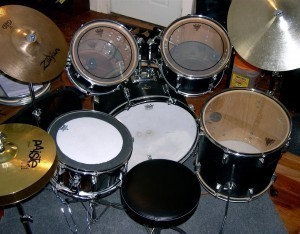
The drum kit size will depend on what components are installed.Drum Kit The following setups are commonplace although there are numerous variations around.

Basic Components

A typical drum kit consists of a crash cymbal, the hi-hat, the bass drum, the floor tom, toms and snare drum. Additional components are the rototom, the china cymbal, the octoban, swish cymbals, tambourine, wood block and many more.

The Standard Sizes: Rock and Fusion

Most drum kits include the two toms, the bass, snare drum and floor tom. The dimensions of the kits are based on the individuals components. In the United States and other countries, the standard drum kit size refers to the “rock size”. These include a 14” snare drum, 22” bass drum, 16” floor tom and mounted toms (12”and 13”).

Fusion is another drum kit setup which uses different components and dimensions. They include 10” and 12” mounted toms, a 20” bass drum, a 14” floor tom and the 14” snare drum. Note that in some cases the bass drum used is 22”.

How Drum Kit Dimensions are Expressed

Whether it’s tom, bass or snare, their dimensions are usually expressed by diameter x depth. For example a snare drum measuring 14 x 5.5” refers to the formula mentioned above. However, some manufacturers reverse the formula (depth x diameter). In this case the drum kit size will read as 5.5 x 14”. If you’re going to buy kits, you need to examine the specifications.

Dimensions of a 5 Piece Rock Kit

This configuration is usually known as “2 up 1 down”. In most cases, one rack tom measures 12 x 9” and the other 13 x 10”. The bass drum measures 22 x 18”, the floor tom 16 x 16” and the snare drum 14 x 5.5”.

The depths for fusion drum kits are also fairly standardized. For the 20” bass drum it is 16”; for the 10” rack tom it is 8” and 9” for the 12” rack tom. For the 14” floor tom it’s also 14”. For the 14” drum it is 5.5”.

Keep in mind the drum kit size will change if the configuration is altered. For example, some fusion drum kits employ two floor toms and just one rack tom. This can affect the dimensions, not to mention the sound.

The space needed for the set will vary. However, a 5.5 drum riser will be able to hold a 4 piece kit with a couple of crash cymbals. A hi hat and china cymbals can also fit in.

The sizes of the cymbals vary. Some are as small as 8” and go up to 14”, 18” up to 20”. The hi tom can measure 13 x 10”.

Tone and Sound

The bigger the drums, the greater the volume and sound. This comes at the expense of mobility. The only way to find the right compromise is to experiment with various drum kits.

If you’re just learning, going for the starter drum kit size will be sufficient. Eventually you can upgrade it as your skill level goes up.

Dimensions of a Grand Piano

Wednesday, February 17th, 2010

Characterized by its horizontal strings and frame, the grand piano is one of the basic configurations of modern pianos. It differs from other types such as the transposing piano and the silent piano. It is divided into several subcategories including the baby grand, the parlor grand and the concert grand. In this specific type of piano, each key has a repetition lever. Besides these interesting aspects, it is also important to know the dimensions of a grand piano.

The Grand Piano Dimensions

The grand piano varies in size, depending mainly on its different types. For instance, the biggest amongst the different types is the concert grand. It has a length of 7 feet and 2.61 inches to 9 feet and 10.11 inches or 2.2 meters to 3 meters. Also called boudoir grand, the parlor grand comes next in terms of size. Its length ranges from 5 feet and 6.92 inches to 7 feet and 2.61 inches or 1.7 meters to 2.2 meters. The grand piano is the smallest amongst these three different main types.

Additional Facts and Other Interesting Details

If pianos are longer, the strings are longer as well. This will create lower inharmonicity as well as richer and larger sound. The term ‘inharmonicity’ primarily refers to the degree of overtone frequencies. In the case of baby grand pianos, which are shorter but with strings that are thicker, more inharmonicity can be expected. Because of its longer strings, the concert grand vibrates better and more accurately compared to the thicker and shorter strings of the baby grand. The strings of a concert grand produce truer overtones.

In public concerts, the preferred choice is full-size grand pianos. In 1884, the New York-based piano manufacturer Sohmer & Co. introduced the smaller grand, which is the preferred choice today for houses and other places with less space available.

The other major type of piano is the upright piano, which is characterized by its vertical design. The movement of the hammers is horizontally. Compared to the grand piano, a common problem with this specific piano type is wear and tear. Known for its longer strings and taller frames, this kind of piano is also referred to as an upright grand. Characterized by a shorter cabinet, the standard height of studio pianos is somewhere around 42 inches to 45 inches. Meanwhile, console pianos have shorter hammers for a more compact action. Compared to studio models, this type of console piano is shorter by a few inches. The term ‘upright’ is commonly used by musicians to describe pianos that are taller than studio pianos.

How Big is MTV?

Monday, February 8th, 2010

A cable television network based in the City of New York, Music Television (also called MTV) is managed by Viacom. The network was launched on 1 August 1981 to feature music videos hosted by video jockeys or VJs. MTV became popular in the 1980s, which led to the introduction of different television programs like reality shows in the 1990s that attracted viewers from many countries.

Music Television is affiliated with numerous channels in the United States and other countries including Germany, Turkey and Portugal. The size of this cable television network can be determined by looking at the list of MTV programs and channels.

The Size of MTV

How big is MTV? Music Television has 49 music series including the television programs “Making the Video,” “Hottest MCs in the Game” and “AMTV.” Aside from music series, this cable television network has 25 news series, which include “Teen Cribs,” “True Life,” “My Life” and “Detox.”

Music Television reality television programs are categorized into five, namely general reality shows, celebrity reality programs, comedy reality shows, game shows and sports. The television network has 79 general reality shows, 23 celebrity programs, 12 comedy programs, 41 game shows and 8 sports programs.

In addition to reality programs, Music Television owns the right to broadcast 71 scripted shows including “The Vampire Diaries,” “Human Giant,” “North Palm Wrestling” and “South Park.” Additionally, the television network has 13 talk shows such as “Dogg After Dark,” “The Jon Stewart Show” and “The New Tom Green Show.” Moreover, the network has 18 seasonal television programs, which include “Summer in the Keys,” “Backstage Pass Week” and “MTV New Year’s Eve.”

Additional Facts and Other Interesting Details

Another way of determining the size of Music Television is by identifying the number of MTV channels internationally. MTV has 42 channels in North America, which include Palladia in the United States, TV Land in Canada and MTV Hits in Mexico. The television network has 18 channels in South America such as VH1 Latin America in Chile, MTV Hits in Brazil and VH1 Soul in Argentina.

Music Television has 121 channels in Europe including Nick Premium in Germany, Game One in France and VH1 Europe in Hungary. The television network is also present in North Africa and Middle East. The network has 5 channels in the regions including Nickelodeon Arabia and Nickelodeon Israel.

The network has 32 channels in Asia Pacific, which include Nickelodeon Korea and VH1 Thailand. Lastly, Music Television has 3 channels in Central Africa, South Africa and Slovakia including Nickelodeon.

Baby Grand Piano Dimensions

Sunday, February 7th, 2010

One of the most famous types of piano, a baby grand piano has horizontal strings that are used to produce a more accurate and fuller sound. This musical instrument is sometimes called by other names like petit grand or living room grand. Even if it is smaller than a grand piano, it produces better sound quality compared to upright pianos. Learn more about this instrument by knowing the standard baby grand piano dimensions.

The Dimensions of a Baby Grand Piano

A baby grand piano is very popular amongst music lovers and pianists, especially those who do not have enough space inside their homes. Its length is around 4 feet 11 inches to 5 feet 6 inches. In terms of width, this music instrument is at least 6 feet wide. Its weight depends on materials used, but normally, it weighs 500 pounds to 1,300 pounds.

Additional Information and Other Interesting Details

A baby grand piano is one of the most expensive musical instruments. Some of the factors that contribute to its relatively high price are the features available, the materials from which it is made of as well as the brand. Prices usually range from $2,000 to $3,000. To save money, it is best to check out newspaper listings, websites and local music stores for used instruments.

Despite the extravagant cost of a baby grand piano, many people buy this musical instrument because of its aesthetic value as well as sound quality. It is best to purchase a piano made of hardboard and hardwood materials like Western Sitka Spruce. Expect it to last for several years if it is made by any of the top piano makers in the world including Yamaha, Cameron & Sons as well as Schoenut.

Regular cleaning and proper maintenance are important to maximize the utility of a baby grand piano. Maintaining this musical instrument is not that difficult. Make sure that you tune it three times a year. Additionally, let a piano expert check its pitch whenever you move it to another place.

Aside from regular tuning, it can help to put a humidifier inside the room where the baby grand piano is to be placed because humidity can affect its pitch. Whenever you clean it, avoid using dishwashing soap with harmful chemicals. Use a soft cloth or a duster to remove dirt. To remove stains from this instrument, damp a soft cloth in a mixture of water and mild detergent. Moreover, ask help from experts if you want to replace piano strings.

Koto Dimensions

Friday, January 29th, 2010

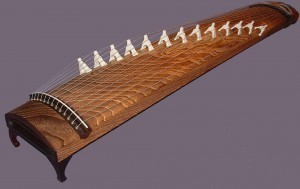
Considered as the national musical instrument in Japan, a standard koto is comprised of 13 movable bridges with 13 strings. Made from the finest kiri wood, it is played by using three different fingers, namely the middle finger, the index finger and the thumb. To improve its appearance, it can be adorned with various types of materials like metal figures, tortoise shell as well as inlays of ebony and ivory. In addition to these basic facts, it is also interesting to know something about the koto dimensions.

The Dimensions of a Koto

A standard Japanese koto is usually 10 inches wide and 72 inches long. Aside from this, there is also the Chinese koto or yo-kin, which is a small music instrument comprised also of 13 strings. Its height is about 5 inches while its length is 3 feet and 7 inches. An ancient form of this instrument is the sage-koto, which is comprised only of 9 strings, the length of which is 2 feet. Invented during the Engi era, the sumi-koto has a width of 4.5 inches and a length of 3 feet and 7 inches.

Additional Facts and Other Interesting Details

Invented by the Chinese, the koto was brought to Japan during the 7th century. It was a very popular Chinese musical instrument, comprised only of five strings. Later on, a couple more strings were added. It came into Japan during the early parts of the Nara Period, which took place from 710-784. During that time, the instrument already featured 12 strings, which later on became 13 strings. Throughout Asia, it comes in different forms, namely the dan tranh of Vietnam, the komungo of Korea as well as the qin of China.

A Japanese composer named Yatsuhashi Kengyo had the most influence in the koto’s development as a musical instrument. He was a highly skilled blind musician who lived from 1614 to 1685. He introduced an interesting new style of playing this instrument, which he referred to as kumi uta. Because of his numerous contributions, he was dubbed as the ‘Father of Modern Koto.’

When the Meiji Period started in 1868, western music finally arrived in Japan. A blind music composer named Miyagi Michio became the very first individual who combined the interesting elements of traditional koto music with western music. His works that involved the use of koto went more than 300. These contributions eventually led to the increase of this stringed instrument’s popularity. Moreover, he was also credited for the advancement of traditional forms, the creation of novel playing techniques as well as the invention of the 17-string bass koto.

Today, this instrument is used widely in various kinds of music including pop music, experimental music and jazz.

MIDI Keyboard Sizes

Friday, January 29th, 2010

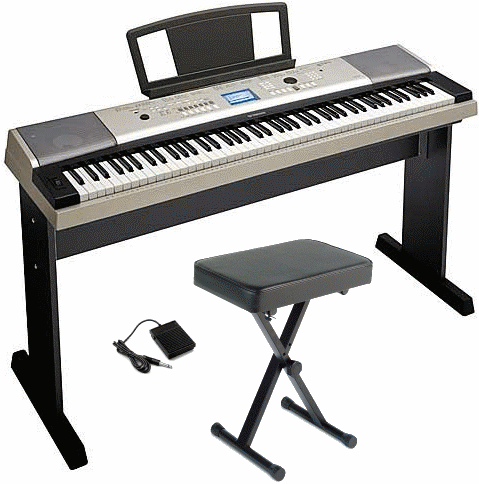
Defined as a digital keyboard device that comes in a piano-style, the MIDI keyboard sends MIDI commands or signals to other devices belonging to the same interface. The acronym ‘MIDI’ stands for the protocol called Musical Instrument Digital Interface. Primarily, it does not create sound. Its basic function is to send MIDI signals to a module with the capacity to reproduce digital samples or sounds resembling standard analog music instruments. Aside from these facts, it is also interesting to find out the different MIDI keyboard sizes.

The Sizes of MIDI Keyboards

One of the leading brands of high quality MIDI keyboards is Korg. It offers the K Series USB-MIDI controllers designed for use in music studios. The smallest in this product line is the K25, which measures 19.25 inches wide, 8.70 inches deep and 2.72 inches high. It only weighs approximately 1.5 kilograms or 3.31 pounds. The next product is the K49, the physical dimensions of which are 32.20 inches by 8.70 inches by 2.72 inches. In terms of weight, it is heavier at 2.4 kilograms or 5.29 pounds. The biggest in this line is the K61, the height of which is 38.66 inches, the width is 8.70 inches and the height is 2.72 inches.

Another topnotch brand of MIDI keyboards is M-Audio. It features the Axiom product line comprised of various innovative designs, one of the most interesting of which is the Axiom 49. Its dimensions are 31.9 inches by 11.2 inches by 2.6 inches. It weighs 4.5 kilograms or 10 pounds.

Additional Facts and Other Interesting Details

The MIDI keyboards under the K-Series are packed with numerous interesting and highly convenient features. Amongst the various assignable controllers found on these products are a couple of buttons, two knobs the ClickPoint. Aside from these, you can also find a footswitch jack, a modulation wheel and a pitch bend wheel. The octave shift is comprised of buttons to perform up and down options.

These Korg K-Series MIDI keyboards are also capable of producing an assortment of sounds like the honky tonk piano, standard piano and grand piano. Aside from these, they can produce the sounds of the church organ, jazz organ and vibraphone. The specifications of the M1 Le Software Synthesizer include 33 different effect types, 144 PCM waveforms as well as 32-note polyphony. Each of these products is also equipped with four outputs, the Realtime MIDI control and 200 presets, which are further subdivided into 100 combinations and 100 programs. Moreover, they are velocity sensitive with four velocity curves and a full-size keyboard.

Saxophones Dimensions

Wednesday, January 27th, 2010

Simply referred to as sax, the saxophone is a woodwind musical instrument. It is commonly made from high quality brass. It is played using a single-reed mouthpiece, which is similar to that of a clarinet. In 1841, a Belgian musician and designer of musical instruments named Adolphe Sax invented the sax, with the goal of creating a versatile brass instrument and loudest amongst the different woodwind instruments. Additionally, there are other interesting things to learn about it including the different dimensions of saxophones.

The Dimensions of Saxophones

The saxophone comes in various forms, one of the most common of which is the tenor saxophone. It measures about 28 inches high and 18 inches wide. The sopranino is considered the smallest type of sax, the height of which is approximately 7 inches only.

In addition, there is also an alto saxophone, the average length of which is 25.2 inches, while the average width is 4.72 inches. Meanwhile, the length of a soprano saxophone is 27.56 inches, with an average width of about 7.87 inches. In terms of weight, one of the heaviest is the baritone saxophone, which weighs about 13 to 14 pounds.

Additional Facts and Other Interesting Details

Most saxophones are usually made out of high quality brass. However, they are classified more as woodwind instruments because they make use of oscillating reeds that produce sound waves. From 1920, almost all saxophones feature key touches, which are usually made from materials like mother of pearl or plastic. Phosphor bronze is also used to make saxophones because it produces slightly varied tonal qualities. Some of the known manufacturers of this particular kind of sax include Bauhaus Walstein and Yanagisawa.

When it comes to designs, the soprano saxophone and the sopranino are the simplest, which are usually straight. In the early parts of the 1840s, Sax decided to apply for a patent spanning 15 years. This decision came after he was able to construct different kinds of saxophones with varying sizes. The patent eventually expired in 1866. After that, instrument manufacturers and saxophonists decided to implement their very own enhancements to the key work and designs of sax.

After a saxophone is completed, the bare brass is usually coated with a thin layer of colored or clear acrylic lacquer. As an alternative, silver plate can also be used. The main purpose of this is to prevent oxidation from damaging the brass. Add to that, it also gives the instrument a longer lasting shiny appearance. Other possible coatings include gold and nickel.

Honky Tonk Dimensions

Monday, January 25th, 2010

Also referred to as a tack piano, a honky tonk is a modified version of the piano. This musical instrument features hammers with nails or tacks. Once the strings are hit, they produce a more percussive tinny sound. Its design tries to emulate how a poorly maintained piano sounds. The felt hammers are described as hard and compact. This particular type of keyboard is used in various music genres including rock, pop and jazz. Furthermore, it is widely used to create classical music. In addition to these facts, it is also quite interesting to learn something about the honky tonk dimensions.

The Dimensions of a Honky Tonk

A standard honky tonk measures close to 155 centimeters or 61.02 inches long and 146 centimeters or 57.48 inches wide. It weighs approximately 252 kilograms or about 540 pounds. In terms of shape and size, it is not far from that of a regular piano.

Additional Facts and Other Interesting Details

Unlike regular pianos, a honky tonk is associated with a number of disadvantages. One of these problems is the use of tacks. These materials are discouraged in pianos because they can be lodged right onto the other parts once ejected accidentally. They may lead to jamming, which is one of the major causes of broken parts. Aside from this problem, the tacks create holes in the hammers, which can somehow affect the quality of sound being produced.

Today, a honky tonk is used for making classical music. For instance, an American composer named Lou Harrison created the elegiac Symphony No.2, the orchestration of which includes the use of this particular type of piano. In addition, it is also a very good musical instrument for jazz. The jazz fusion band called Weather Report released the music album entitled “Mysterious Traveller,” wherein lead members Joe Zawinul and Wayne Shorter played honky tonks.

In recent years, rock and pop musicians find this keyboard instrument very interesting, which is why they made use of it as part of their music releases. The American rock band The Doors made use of this piano in recording singles like “L.A. Woman” and “People Are Strange.” When Dave Matthews Band released the 1996 album “Crash,” a tack piano was used to record the song “Crash Into Me.”

One of the most popular songs that made use of a tack piano to play some of its parts is “Good Vibrations,” which was recorded by the iconic American rock band the Beach Boys. Aside from this, the highly popular music vocal group called the 5th Dimension used a honky tonk for the intros of two of its most successful songs, namely “Wedding Bell Blues” and “Sweet Blindness.”

Organ Dimensions

Monday, January 25th, 2010

Primarily a keyboard instrument, the organ can be played using both feet and hands. It plays a very important role in music, which produces an interestingly unique but definitely pleasant sound. In the Western musical tradition, it is considered one of the oldest musical instruments. It is classified into various types, the most popular of which include the Hammond organ, reed organ as well as pipe organ. In addition to these basic facts, it is also good to know something about the different organ dimensions.

The Dimensions of an Organ

Organs vary in size depending on their classification. For instance, the dimensions of an average Hammond organ are 28 inches long, 48 inches wide and 38 inches high. Meanwhile, the dimensions of a Wurlitzer organ include a length of 25 inches, a width of 47 inches and a height of 37 inches. A standard Lowrey electronic organ is usually 36 inches high, 45 inches wide and 24 inches deep. The dimensions of a standard continuo organ are 44 inches by 33 inches by 20 inches.

The average height of a renaissance portative organ is 28.5 inches, the width 15.5 inches and the depth 7 inches. The average height of a mechanical action chamber organ is 76.38 inches, the width 33.86 inches and the depth 21.26 inches. The width of a Flentrop cabinet organ is 46 inches, its height 72 inches and its depth 44 inches. Other cabinet organs measure close to 42 inches by 28 inches by 83 inches. A single manual organ measures 96 inches high, 60 inches wide and 22 inches deep.

Additional Facts and Other Interesting Details

One of the most popular types of organ is the pipe organ, which makes use of wind going through the pipes to create sounds. It features a keyboard touch, which does not affect dynamics. Furthermore, this part is considered non-expressive. It is custom-built for homes, concert halls and churches.

A smaller organ is often described as portative, which means that it is compact enough to be carried while playing. Likewise, it can also be called positive, which means that it can be placed easily in various locations.

In 1950, Laurens Hammond developed a special type of organ called the chord organ. It has some similarities with an accordion, particularly the chord buttons designed for use by the left hand. The Hammond organ was launched in the 1930s, which became the very first highly successful electric version of the organ.

Starting from the 1980s, digital organs have been in circulation, which feature sampling to make sounds. Today, there are different types of mechanical organs available such as the dance organ, the fairground organ as well as the barrel organ.

Tambourine Sizes

Sunday, January 24th, 2010

When looking for the right tambourine sizes for a musical occasion, consider the tambourine measurements and number of circumference jingle pairs. Loudness depends on tambourine sizes and the number of jingles. Below are some examples.

Five to Six-Inch Size

The smallest yet effective among tambourine sizes for lively public musical performances is a 5 or 6-inch wooden shell topped with goat skin head. It has a thickness of 2 inches. Tambourine measurements between 5 to 6 inches in diameter usually have 4 pairs of jingles. This is good for kids’ tambourine dance numbers or a mini choir concert. Grade school pupils should be able to handle this cheer device well.

Seven to Eight-Inch Size

Tambourine sizes from 7 to 8 inches in diameter are good for kids from 10 to 12 years old. These tambourines often have 5 to 6 pairs of jingles and of wooden shell with topping of goat skin head. They have a thickness of 2 inches. They are easy to swing around and carry during live musical performances even for kids in the above age bracket.

Tambourines for Professional Use

Tambourines used by professional dancers or musical bands or praise and worship teams have tambourine sizes from 9 to 10 inches in size. They have 2-inch thickness. They are either of wooden or metal shell with goat skin head as top covering. Tambourine measurements may exceed 10 inches and may be as big as 12 inches. They often have from 8 to 16 pairs of jingles for extra metallic jingling accompaniment as the tambourine is tapped or shaken.

Jingle Sizes

Jingles are rattling tins circular in shape placed in pairs at the circumference of a tambourine. The smallest could measure from 1 to 1 and half inches in diameter, the biggest could measure 2 inches, especially if there are only 4 pairs. Their thickness could be less than 1 mm. Jingles are used to keep the rattling sound going while the tambourine top is not yet tapped or pounded.

Tambourine Top

The goat skin head should always be a bit oversized than the actual diameter of the tambourine. This allows for stretching out on the top and sealing at the inner sides. Thus, if the diameter is 7 inches the top covering material should be 7 and a half inches. A thoroughly stretched top covering is vital for an effective tambourine.

If a musical performance requires the use of tambourines, make sure to have the right tambourine sizes with the appropriate tambourine measurements.