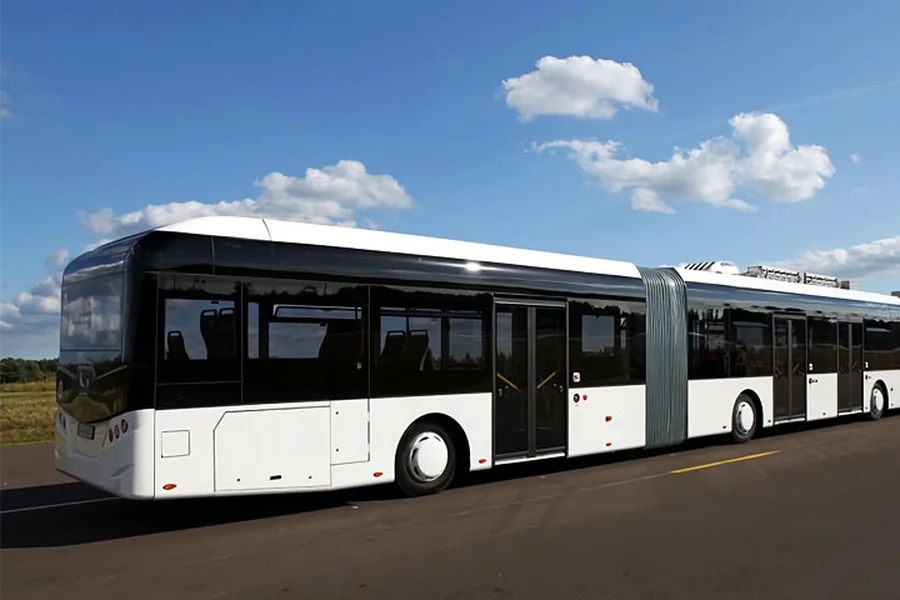
The Worlds Biggest Bus is the DAF Super CityTrain, a double-articulated vehicle that operates in Kinshasa, the capital of the Democratic Republic of Congo. It is 32.20 meters (105.64 feet) long, and is the longest bus in use. This is a DAF truck chassis fitted with two passenger modules, and it is able to accommodate between 100 and 350 people comfortably – and even 600 people during peak hour times, according to reports. It was added in 1989 to alleviate the city’s significant urban transport deficit, and continues to do so.
Meet the Record Holder
Here’s the thing about the Super CityTrain: it’s not some concept vehicle parked behind glass at an auto show. This bus works for a living. Every day, it winds through packed Kinshasa streets, moving people who genuinely need to get somewhere.
Its story starts with a transit collapse. Back in the late 1980s, the DR Congo’s national bus company shut down entirely. Overnight, thousands of commuters had no way to reach their jobs, and frustration boiled over into unrest across the capital. City officials needed a solution, and they needed it fast. The Super CityTrain was that solution.
What sets this record apart from most “world’s biggest” claims is longevity. Plenty of oversized vehicles get built, photographed, and quietly retired. This one has kept working for more than three decades.
Breaking Down the Numbers
Raw specs tell the story better than adjectives ever could. Here’s what you’re looking at:
- Length: 32.20 meters (105.64 feet)
- Unladen weight: 28 tonnes
- Top speed: 42 km/h (26 mph)
- Official capacity: 350 passengers — 110 seated plus 140 standing up front, 60 seated plus 40 standing in the rear module
- Reported peak load: as many as 600 people at once
Trying to picture 32 meters? Line up six or seven family sedans nose to tail. That’s roughly the walk from one end of this bus to the other.
The Transit Crisis Behind It
Kinshasa isn’t a small city. It’s one of the fastest-growing urban centers on the African continent, and its transport network hasn’t always kept pace with the people who need it. When the national operator folded, the city was left with a massive hole in its transit system and no time to build a subway from scratch.
A supersized bus turned out to be the pragmatic fix. One Super CityTrain does the job of several ordinary buses, without the years of tunneling, track-laying, or budget approvals that rail projects demand. For a city where commutes already eat up hours of the day, that kind of capacity per vehicle makes a real difference.
How It’s Actually Built
Rather than one continuous shell, the Super CityTrain is really a tractor unit — the DAF FT 2805 — towing two separate passenger cabins joined by articulated hinges. Those hinges are what let a 32-meter vehicle actually turn a corner instead of jackknifing into oncoming traffic.
A handful of engineering choices stand out:
- Suspension tuned specifically to soak up impact from rough, pothole-heavy roads
- Braking systems calibrated for stopping 28 tonnes safely and predictably
- A deliberately capped top speed of 42 km/h, trading speed for control
- Loudspeakers playing music down the length of the bus, a small but thoughtful touch during crowded rides
None of these decisions happened in isolation. Add length, and you add capacity — but you also add complications in steering, braking distance, and structural stress. Engineers had to juggle all three at once.
It’s Not the Only Giant Out There
While the DAF Super CityTrain owns the commercial record, it’s worth knowing it doesn’t stand entirely alone. Guinness actually splits this category in two: commercial operation and non-commercial operation. That distinction trips a lot of people up.
The AutoTram Extra Grand, developed in Dresden, Germany, holds the non-commercial record. At 30.73 meters (about 100 feet 9 inches), it seats up to 256 passengers. A joint effort between Fraunhofer IVI, the Technical University of Dresden, and Wittur Electric Drive brought it to life, but it never entered permanent city service — it ran as a pilot project instead.
So what’s the real difference? A commercial title means the bus runs every day, on a real schedule, carrying real fare-paying passengers. A non-commercial title can belong to a prototype or a limited test run that never became permanent.
Brazil’s Answer: Volvo Gran Artic 300
One more name keeps popping up in “world’s biggest bus” searches: the Volvo Gran Artic 300. Volvo rolled it out in 2016, marketing it heavily as the largest bus of its time, purpose-built for Brazilian transit corridors.
This one’s bi-articulated, meaning it bends at two points instead of one, letting it stretch further while still handling city traffic and dedicated bus lanes. It never claimed the official Guinness record for sheer length, but the concept mirrors the CityTrain’s logic: move more people per vehicle instead of building an entirely new transit line from the ground up.
Notice the pattern? Both Brazil and the DR Congo reached for a bigger bus rather than a bigger construction budget. When demand spikes faster than infrastructure can grow, that’s often the more realistic move.
Why Don’t More Cities Use Buses This Big?
Fair question. If a single 32-meter bus can move 350-plus people, why isn’t every major city running one? A few practical roadblocks explain it.
Road infrastructure comes first. Tight intersections, narrow lanes, and sharp turns can make a bus this long genuinely unsafe or just impossible to maneuver. Then there’s the human factor — driving a double-articulated vehicle through traffic takes far more skill than piloting a standard 12-meter city bus, and training takes time and money. And finally, not every route has the passenger volume to justify the investment. You need consistent, heavy demand to make a vehicle this size worth building.
Put simply: the idea works beautifully, but only under the right conditions — dense population, few transit alternatives, and roads wide enough to handle it.
Weighing the Trade-Offs
Step back and look at these mega buses as a group, and a pretty clear pattern of pros and cons emerges.
What you gain:
- More passengers per vehicle, which cuts down on the total number of buses a route needs
- Better fuel and energy efficiency per rider compared to running several smaller buses
- Smoother traffic flow overall, since fewer vehicles means less bunching and congestion
What you give up:
- Fewer usable routes, since not every road can physically fit the length
- Higher upfront costs for construction and ongoing maintenance
- Stricter driver training requirements and tighter safety protocols
- Reduced maneuverability compared to a standard-sized bus
Any city weighing this option has to run those numbers carefully before committing.
Where This Might Be Headed
Urban populations aren’t slowing down, particularly across Africa, Asia, and South America. More cities are likely to hit the same wall Kinshasa faced decades ago — too many people, not enough transit capacity, and no time to wait for a subway system to get built.
Oversized buses offer a genuine shortcut around that problem. Don’t be surprised if designs similar to the AutoTram Extra Grand or deployments like the Volvo Gran Artic 300 start showing up in other rapidly growing cities. Electric and hybrid drivetrains, already appearing in some of these vehicles, could make the whole approach cleaner and more practical going forward.
The Worlds Biggest Bus isn’t a novelty act. It’s a working answer to a very real problem, and that’s exactly why it’s still running today.
Final Thought
The DAF Super CityTrain still holds the crown as The Worlds Biggest Bus in regular, everyday use — a title it earned out of necessity, not spectacle. Every meter of its length exists for a reason: moving the maximum number of people, as reliably as possible, without the wait that comes with building new infrastructure from scratch. The AutoTram Extra Grand and the Volvo Gran Artic 300 prove this isn’t a one-city phenomenon either. As cities keep expanding, don’t be shocked if bigger buses start becoming a more common sight on streets far beyond Kinshasa.