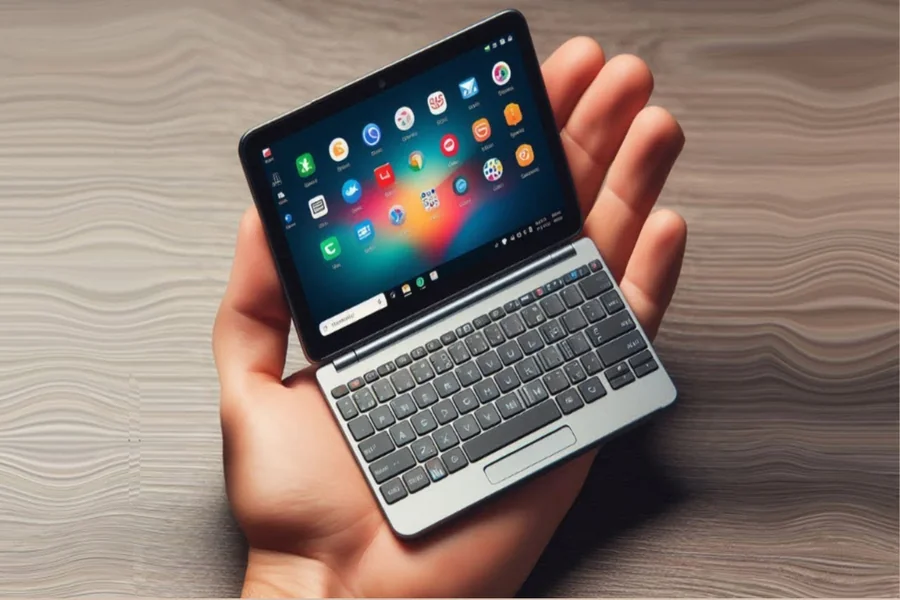
The smallest laptop is small enough to fit in your pocket, and still runs a full desktop operating system. The small computers are sometimes known as mini laptops and/or Ultra-Mobile Personal Computers or UMPCs.
Some small computers have screens as small as 7 inches. For instance, the OneMix line has already featured a 7-inch, touchscreen version that’s approximately 182 x 110 x 17 mm and weighs around 515 grams. It’s compact, but it functions more like a regular laptop than a tablet.
The following are some of the things that compact laptops today have become more capable of. The GPD Pocket 4 and similar models have larger 8.8″ screens and much more powerful hardware and connectivity than previous pocket computers.
Quick Answer: What Is the Smallest Laptop?
However, since manufacturers have different definitions of a laptop, there is no official laptop permanently recognized as the smallest laptop in the world.
However, the smallest viable Windows laptop for consumers is around 7” screens which are mini-laptops.
The OneMix series delivers an in-depth look at how a full keyboard, touch screen, battery, processor, storage and Windows operating system fit into a body a little bigger than a paperback book.
Smallest Laptop Quick Facts
| Feature | Typical Small Laptop Specification |
| Screen Size | Around 7–10 inches |
| Weight | About 500–1,000 grams |
| Operating System | Windows or Linux |
| Keyboard | Built-in QWERTY keyboard |
| Storage | SSD or flash storage |
| Touchscreen | Common on UMPC models |
| Main Purpose | Travel, office work and portable computing |
| Category | Mini laptop / UMPC |
What Is Considered a Small Laptop?
A small laptop would be one that has a screen that is smaller than 11 inches.
The standard compact laptops are typically 11 to 13 inches in size. Mini Laptops get even smaller.
A device has to have several features for it to be considered a laptop:
- Built-in screen
- Physical keyboard
- Processor
- RAM
- Internal storage
- Battery
- Operating system
- Laptop-style folding design
This is a distinction between mini laptops and tablets, smartphones and handheld gaming devices.
How Small Is the Smallest Laptop?
A handful of consumer mini-PC laptops have come with the 7-inch display.
The original OneMix design is about 182x110x17mm and weighs about 515g. It also has a 1920 × 1200 touch screen and a 2-in-1 foldable design.
That means the computer is much smaller than a typical 13-inch or 14-inch notebook.
It comes in a small size to fit many small bags and some large jacket pockets.
Why Are Tiny Laptops Called UMPCs?
UMPC is Ultra-Mobile Personal Computer.
The term is used to refer to very small computers that can be used to offer a portable version of desktop computing.
The popularity of UMPCs was driven by some users’ desire to have a smaller device than a standard PC, but still be able to run Windows applications.
Today’s UMPCs can feature high resolution screens, Wi-Fi, USB ports, and powerful processors, as well as SSD storage.
How Big Is a 7-Inch Laptop?
The display of a 7-inch laptop is measured from corner to corner.
The complete computer is slightly larger than the display.
One example measures only about:
182 mm wide × 110 mm deep × 17 mm thick.
That equals approximately:
7.17 × 4.33 × 0.67 inches.
So its footprint is more like a small book, than a typical notebook computer.
How Much Does the Smallest Laptop Weigh?
Even very small laptops have a weight of nearly 500 grams.
Compared with many normal lightweight laptops, these ones weigh from 1-1.5 kg.
Thus, a small computer weighing approximately 515 grams can weigh less than half the weight of many conventional laptops.
One of the most popular reasons for buying mini PCs is for its low weight.
Small Laptop vs Regular Laptop
| Feature | Mini Laptop | Regular Laptop |
| Screen | 7–10 inches | 13–17 inches |
| Weight | About 0.5–1 kg | About 1–3 kg |
| Portability | Very high | Moderate to high |
| Keyboard | Very compact | Full-size or near full-size |
| Performance | Varies | Usually higher |
| Battery Size | Smaller | Larger |
| Best For | Travel and light work | Everyday productivity |
| Typing Comfort | Limited | Better |
What Can the Smallest Laptop Do?
A tiny laptop can perform many of the same basic tasks as a regular computer.
You can use one for:
- Web browsing
- Microsoft Office
- Google Docs
- Video streaming
- Remote desktop access
- Coding
- Light photo editing
- Online meetings
- File management
- Business applications
Actual performance depends on the processor, RAM and storage installed in the device.
Older 7-inch laptops may struggle with demanding modern software while newer UMPCs can handle considerably heavier workloads.
Can a Small Laptop Run Windows?
Yes.
Many mini laptops run a full version of Windows rather than a mobile operating system.
The OneMix series, for example, has been sold with Windows. More recent compact models such as the GPD Pocket 4 are also designed as full computers rather than simple mobile devices.
This allows users to install traditional desktop applications.
Does the Smallest Laptop Have a Real Keyboard?
Yes, most devices classified as mini laptops have built-in physical keyboards.
The challenge is size.
When manufacturers reduce the overall dimensions of a laptop, the keyboard becomes much smaller.
Keys may be positioned differently from those on a regular laptop. Typing long documents can therefore require some adjustment.
For quick emails, commands and short documents, the keyboard can still be useful.
Can a Mini Laptop Fit in Your Pocket?
Some can.
A 7-inch laptop measuring around 18 cm wide may fit inside a large jacket, cargo or coat pocket.
However, calling a device a “pocket laptop” does not mean it will fit comfortably inside normal jeans.
For most users, these computers are better considered small-bag laptops.
They fit easily inside handbags, travel bags, camera bags and backpacks.
Why Are Small Laptops Useful?
Portability is the biggest advantage.
A tiny laptop can be useful when carrying a normal notebook computer would be inconvenient.
Common users include:
- Travelers
- IT technicians
- Network engineers
- Programmers
- Students
- Journalists
- Field workers
- Business professionals
Some mini computers are particularly useful for technical work because they combine a keyboard with ports that tablets may not provide.
Are Modern Mini Laptops Powerful?
They can be.
The newest generation of compact PCs is much more powerful than early netbooks.
For example, the GPD Pocket 4 has been offered with processors up to AMD’s Ryzen AI 9 HX 370. It also includes USB4, HDMI, USB-A and other connectivity in an 8.8-inch form factor.
This shows that a small computer no longer automatically means very low performance.
However, powerful components can increase heat, fan noise, power use and price.
What Is the GPD Pocket?
The GPD Pocket family is another well-known example of extremely small laptops.
Earlier GPD Pocket models used a body measuring roughly 180 × 106 × 18.5 mm, showing how close these computers can get to handheld dimensions.
Newer models are slightly larger because they provide more powerful processors, larger screens and additional ports.
The GPD Pocket 4 uses an 8.8-inch display and weighs around 770 grams depending on configuration.
Why Don’t Manufacturers Make Laptops Even Smaller?
The keyboard creates one of the biggest limitations.
A screen can be made extremely small, but a physical keyboard still needs enough space for human fingers.
Other limitations include:
- Battery capacity
- Cooling
- Processor heat
- Ports
- Speakers
- Storage
- Trackpad size
- Screen readability
At some point, making a laptop smaller makes it difficult to use.
Manufacturers therefore have to balance portability and usability.
Is a Mini Laptop Better Than a Tablet?
It depends on what you need.
Tablets usually provide larger touchscreens and may offer better battery life.
Mini laptops provide physical keyboards and desktop operating systems.
A small Windows laptop may be more useful for someone who needs traditional software.
A tablet may be better for entertainment, reading and touch-based applications.
What Is the Smallest Practical Laptop Size?
For everyday productivity, screens around 8 to 10 inches offer a more practical balance between portability and usability.
Seven-inch computers can be extremely portable but their keyboards and displays are cramped.
An 8-inch or 10-inch UMPC provides more room while remaining much smaller than a traditional notebook.
That is why many newer mini laptops have moved slightly above the original 7-inch format.
What Is the OneMix Mini Laptop?
OneMix is a range of small computers produced by One-Netbook.
Earlier OneMix models used a 7-inch 1920 × 1200 touchscreen, 360-degree hinge and built-in keyboard.
The original model weighed about 515 grams.
Later OneMix devices became larger and more powerful.
For example, the OneMix5 uses a 10.1-inch 2560 × 1600 display and weighs about 979 grams.
This reflects the wider UMPC trend toward balancing compact size with better usability.
What Are the Disadvantages of the Smallest Laptop?
Extreme portability comes with compromises.
The biggest disadvantages are:
- Small keyboard
- Limited screen space
- Smaller trackpad
- Less comfortable typing
- Limited internal upgrade options
- Potential heat issues
- Higher price for specialized models
Reading spreadsheets or editing large documents can also be difficult on a 7-inch display.
Who Should Buy a Small Laptop?
A mini laptop makes sense for someone who values portability more than screen size.
It may be suitable for frequent travelers, technicians and people who regularly work in locations where carrying a normal laptop is difficult.
For someone working at a desk for several hours every day, a regular 13-inch or 14-inch laptop will usually provide a more comfortable experience.
Interesting Facts About Small Laptops
Tiny laptops are unusual because they combine features normally found in several different device categories.
Some interesting facts include:
- Certain models weigh little more than 500 grams.
- Some use high-resolution touchscreens.
- Many can convert into tablets.
- Full Windows versions can run on mini laptops.
- Some support stylus input.
- USB-C charging is common on modern models.
- Many UMPCs are smaller than a sheet of A5 paper.
- Modern versions can include powerful laptop processors.
Final Thoughts
The smallest laptop shows how much computing hardware can fit inside a tiny device. Seven-inch UMPCs such as earlier OneMix models demonstrate that a complete Windows computer can weigh close to 500 grams and measure only about 18 cm across.
Modern manufacturers have moved toward slightly larger 8-to-10-inch designs because they provide better keyboards, stronger processors and more usable screens.
A tiny laptop will not replace a full-size notebook for everyone. However, for travel, field work and situations where portability matters most, these compact computers provide a useful alternative.