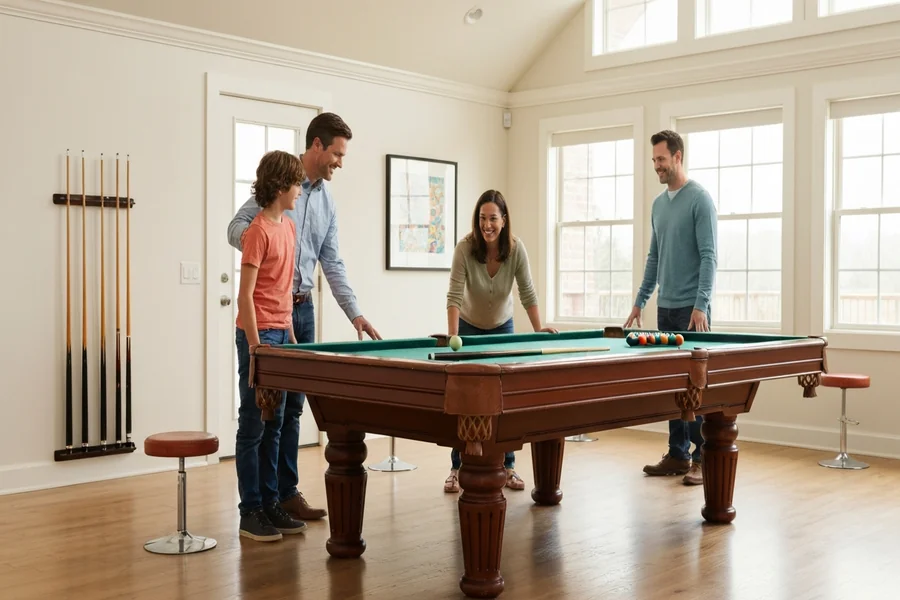
Snooker table dimensions are the dimensions of the table, which include the overall snooker table size, the playing surface, the table height, and the proportions of the table. The playing area of a full size professional snooker table is about 11 feet 8½ inches x 5 feet 10 inches (356.9 cm x 177.8 cm). The cushions, rails, frame and legs have made the entire table bigger. The height of the snooker table is typically about 2 feet 10 inches (86.4 cm). There are also smaller tables to suit homes and limited spaces, but they may vary in size depending on the manufacturer.
Standard Snooker Table Dimensions
Most people looking for snooker table dimensions are interested in the dimensions of a standard full size table. In professional snooker, the table has a large rectangular shape, whose playing area is approximately twice longer than wide.
The standard playing area is approximately 11 feet 8½ inches long and 5 feet 10 inches wide. This is about 356.9 centimeters x 177.8 centimeters in metric measurement.
Sellers may also have rounded sizes making the dimensions appear confusing. A full size snooker table can be referred to as a 12 foot table although the playing area of the table is shorter than 12 feet.
Here are the most important measurements to remember:
| Measurement | Standard Full-Size Snooker Table |
| Playing surface length | 11 ft 8½ in |
| Playing surface width | 5 ft 10 in |
| Playing surface in centimeters | Approx. 356.9 × 177.8 cm |
| Playing surface in meters | Approx. 3.57 × 1.78 m |
| Playing surface ratio | About 2:1 |
| Typical table height | About 2 ft 10 in / 86.4 cm |
| Common market description | 12 ft snooker table |
The playing surface is the most important measurement when comparing tables. Not the outside wooden frame, or cabinet.
This is an important distinction when designing a snooker room. If the table is labeled as being 12 feet long, it will require a lot more than 12 feet of floor space.
What Does A 12-Foot Snooker Table Actually Measure?
There is a question as to why a full-size snooker table is referred to as a 12-foot table when it is just around 11 feet 8½ inches in length.
The solution is that the 12′ description isn’t referring only to the length of the cloth-covered playing area, but is a reference to the standard table size classification.
There are also cushions, rails and side panels in the table. These parts are added to the external dimensions.
When purchasing a table for one’s home, this is crucial. Only the playing surface should not be the only measurement taken.
The buyer should take into account:
- The entire length of the table from end to end.
- Full width on the outside.
- Table’s elevation.
- The distance required between a cue and the ball.
- Space around table for walking.
- Obstacles such as doors, walls, furniture etc.
- The trail had to lead to the room to get the table.
More often than not, it’s not so much the table as the room itself that creates the concern.
Players must have plenty of space to move a cue around each cushion when playing a full-size snooker table. A table can easily be a good size to fit into a room, but its clearance may be too tight for playing.
Snooker Table Dimensions vs. Pool And Billiard Tables
Snooker tables are frequently mixed up with pool tables, as they are both played with balls and cues. They are different, however, in size.
A full-sized snooker table is a long, relatively narrow table. Typically, pool tables come in various ratios and are offered in a number of fixed sizes.
The playing area of a normal snooker table is nearly 2:1. This gives rise to the long playing area characteristic of the snooker game.
| Table Type | Common Playing Surface | General Shape |
| Full-size snooker | Approx. 11 ft 8½ in × 5 ft 10 in | Long and narrow |
| 9-foot pool | Approx. 9 ft × 4.5 ft | 2:1 ratio |
| 8-foot pool | Approx. 8 ft × 4 ft | 2:1 ratio |
| 7-foot pool | Approx. 7 ft × 3.5 ft | 2:1 ratio |
These are typical sizes of playing surfaces and not a specified external table size.
It’s clear when you’re standing next to the tables. A snooker table is large enough to occupy a considerable amount of room in the room. It is also smaller than many pool tables with smaller pockets and balls.
The bigger surface has an impact on players’ shot approach. Snooker is primarily a cue sport, which means that long distance cueing is an important aspect of the game, and a consistent table size and playing conditions are important.
How Much Room Do You Need For A Snooker Table?
Determining the size of a table is just one part of the equation. Also, you will need to work out the playing space around it.
Typical cue length is about 57”-58”. Players must have some space to maintain and maneuver the cue ball without making contact with a wall or object.
Therefor, room for a full-size snooker table must be significantly bigger than the table.
It is helpful to plan for about 5′ of space around each side of the playing area. This may be more or less depending on the length of the cue, playing position, room configuration and the use of short cues in restricted areas.
This can equate to approximately:
22 feet × 16 feet
This is not a standard construction value, but rather a planning value. Less space will be required in some rooms, however, players can find themselves confined around the cushions.
Consider that a playing surface is approximately 11 feet 8½ inches in length and assuming about 5 feet of cueing space on each end, the playing room will be around 21 feet 8½ inches in length.
Similarly, a playing width of approximately 5 feet 10 inches plus 5 feet of clearance to both sides equals about 15 feet 10 inches.
Take accurate measurements of the room before purchasing a table.
Look at the location of:
- Doors
- Windows
- Radiators
- Ceiling fixtures
- Columns
- Sofas and cabinets
- Wall-mounted equipment
- Electrical outlets
The room can appear spacious when empty but will become cumbersome once furniture is placed in it.
Smaller Snooker Tables And Their Dimensions
Not everyone wants to have a full size table. However, there are many people who prefer to play snooker on the small snooker tables found in their homes, clubs, entertainment rooms and practice areas.
Common table sizes are 10 foot, 9 foot, 8 foot and 7 foot table. The dimensions differ by manufacturer, so be sure to verify the manufacturer’s specifications before purchasing.
So snooker can be played in smaller rooms because smaller tables have been developed. They also may be easier to move and set up.
The game isn’t exactly the same as played on a full size table, though.
A smaller table alters the distance between the balls and pockets. Long shots get shorter, playing space decreases.
This might not be a issue when using in the home for casual reasons. If trying to replicate tournament conditions, a full size table would be more suitable.
| Approx. Table Size | Typical Use |
| 12 ft | Professional and serious play |
| 10 ft | Home and club use |
| 9 ft | Practice and recreational use |
| 8 ft | Home entertainment |
| 7 ft | Small rooms and casual play |
These categories serve as a guideline to help compare, but manufacturers can name them differently. Check the dimensions of the playing surface and external area before buying a product.
Important Measurements Beyond The Playing Surface
The size of a snooker table is more than just length and width.
The height of the table is another key measurement. The typical height of a full size table, from the playing surface, is about 2 feet 10 inches. There may be small variations in both manufacturers and table designs.
The slate is also important. A typical quality snooker table will have a slate underneath the cloth as it offers a stable and level playing surface. Multiple sections of slates may be carefully joined and leveled during installation in large tables.
The cushions also impact the ultimate construction and playing qualities. They must be set up properly to ensure that the balls bounce consistently.
Outside of the table is the outside frame.
The cabinet can be as long as 2 feet (60 cm) beyond either side of the playing area. The total footprint can also be influenced by the legs and supporting structures.
This is why buyers should request two different measurements:
- Playing surface dimensions
- Overall table dimensions
They’re both relevant, but they’re questions of two different kinds.
The playing surface will help you understand the space that the balls have. The overall dimensions provide an indication of the floor space used by furniture.
Choosing The Right Snooker Table Size For Your Space
The size will vary based primarily on the use of the table and the available space.
If you are looking for a professional style playing experience, it is natural to choose a full size table. Provides the traditional playing area and enables long shots to grow.
If you’re looking for a smaller table, like for a family room or a smaller recreation room, you might want to consider a 9″ or 10″ table.
When shopping, it is important to go through a simple process:
Measure the room first.
Don’t begin the table and then work out the space later.
Mark the table footprint.
Masking tape on floor to show the outside dimensions of the table.
Add cue clearance.
Indicate extra room required around all the sides.
Test the tight areas.
Stand around the area marked with a cue and practice various shots.
Check delivery access.
Measure doors, stairs, hallways and turns. Even with a table that fits the room, it can be a challenge to enter the table.
Consider installation.
So, if you have a large snooker table, you should consider hiring professional assembly and leveling services. Ensure adequate access for installation crew.
This straightforward planning process can avoid the costly blunder.
Final Thoughts
It’s important to know the snooker table dimensions before purchasing a table, constructing a game room, or replacing an old table. The playing area of a full-size snooker table is about 11 feet 8½ inches by 5 feet 10 inches, but the total size of the table takes up more floor space.
The surrounding room is also important. Space should be sufficient for players to comfortably use a full length cue from various positions around the table.
In situations where space is limited, smaller tables can be practical. They offer a method of enjoying snooker without having to use the same room dimensions as you would for a full-size table.
The secret is to not only consider the table’s advertised size, but also its actual size. Inspect the playing surface, the outside dimensions, table height, table clearance and the delivery path before deciding. By carefully considering the requirements of your room and how you wish to play, you should be able to select a table that will suit you perfectly.


1 Comments