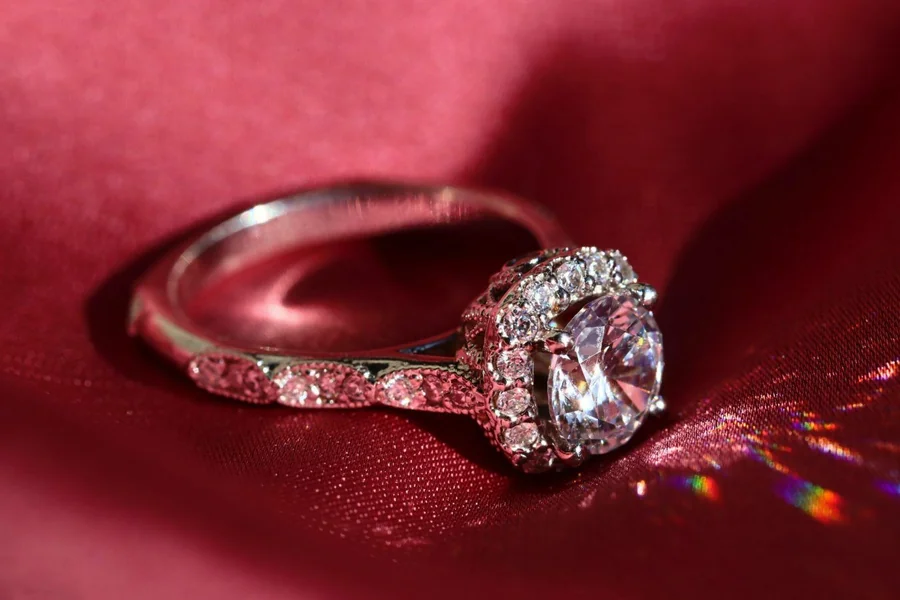
Most wedding rings cost a few thousand dollars. A rare few cost more than most people will earn in a lifetime. The most expensive wedding rings ever recorded typically feature large, flawless, or rare-colored diamonds set in platinum by well-known jewelers like Cartier or Harry Winston. Prices climb into the millions once a stone is rare enough, or once a ring carries the weight of a famous name attached to it. Some of these rings have been sold openly at auction. Others exist only as estimates, since their owners never put a price on paper.
Here’s what actually separates a $2,000 ring from a $20 million one — and why the gap is bigger than most people think.
What Actually Makes a Wedding Ring This Expensive
It’s rarely one thing. A big diamond alone won’t get you to seven figures — you need rarity stacked on top of size, and usually a name attached somewhere.
- Carat weight, but not in a straight line. A 10-carat diamond isn’t twice the price of a 5-carat one. It can be five or ten times the price, because large, high-clarity stones are so much harder to find.
- Color. Blue, pink, and red diamonds are strange outliers in this market. A 5-carat blue diamond can outsell a 15-carat white one without much trouble.
- The jeweler’s name. A ring stamped Cartier or Bvlgari carries a premium that has nothing to do with the stone itself.
- Who owned it. A ring that once sat on Grace Kelly’s hand is worth more than an identical ring with no history behind it — sometimes dramatically more.
- The setting and metal. Platinum costs more than gold to begin with, and a hand-fabricated setting can take a jeweler hundreds of hours.
None of these matter much on their own. Put two or three of them together, and the price stops looking like jewelry math and starts looking like art-auction math.
The Record Holders — What Actually Sold, and for How Much
Auction houses keep the cleanest records here, so this is where the numbers get more trustworthy. Most of what circulates online about celebrity rings is estimate and guesswork — auction results are the exception.
The Pink Star is the one people bring up most. It’s a 59.6-carat pink diamond that sold at Sotheby’s in Hong Kong in April 2017 for about $71.2 million, setting the record for any diamond ever sold at auction. It wasn’t bought as a wedding ring, technically. But it’s the benchmark everyone else gets measured against, and it shows how far a single rare stone can push a price.
Royal and celebrity rings get more attention, partly because the stories are good. Grace Kelly’s engagement ring — a 10.47-carat emerald-cut diamond made by Cartier for her marriage to Prince Rainier III — is one of the most cited examples of a ring’s value ballooning over time. It reportedly cost around $4 million when it was made in the 1950s; today, estimates put it well into the tens of millions, though it’s never gone back to auction, so nobody can say for certain.
Jacqueline Kennedy Onassis’s ring tells a similar story. Aristotle Onassis gave her a diamond cut from the historic 601-carat Lesotho III stone. It sold at auction in 1996 for around $2.6 million. Today, some estimates put its value at $20 million or more — a huge jump, but not an unusual one for a ring with that kind of provenance attached.
One honest caveat: a lot of the “most expensive wedding ring” lists floating around the internet mix up engagement rings and wedding bands, round numbers up, and repeat figures nobody has actually verified. Treat anything without an auction record behind it as an educated guess, not a fact.
Why Platinum, and Why It Costs So Much More
Ask any high-end jeweler why platinum dominates this category, and you’ll get the same answer: it’s not really about looks.
Platinum is denser than gold and holds a stone more securely over decades of daily wear — which matters a lot when the stone in question is worth more than a house. It doesn’t tarnish, it doesn’t need re-plating the way white gold sometimes does, and it’s genuinely rarer than gold to begin with. All of that adds cost before a single diamond gets set into it.
Gold hasn’t disappeared from this market, though. Rose gold in particular has had a real moment over the past decade, mostly because it flatters certain diamond colors — champagne and cognac diamonds especially — better than a platinum or white gold setting does. High-karat gold, 18k and up, still shows up regularly in luxury pieces. It’s just not the default the way platinum is once you’re talking about rings in the six-figure range and beyond.
A handful of one-off rings go further still, using alloys developed specifically for that piece and never used again. That’s less about performance and more about making sure nothing else in the world looks quite like it.
Beyond Diamonds: The Gemstones That Actually Compete
Diamonds still dominate this category, no argument there. But they’re not the only stone capable of pushing a ring’s price somewhere unreasonable.
Colored diamonds are the obvious exception, and they’re strange in a good way — the color, not the size, is what drives the price. Beyond diamonds, a few other stones occasionally show up in ultra-high-end rings:
- Kashmir sapphires, considered the best in the world by most gem dealers, largely because the mines that produced them are essentially exhausted
- Burmese “pigeon’s blood” rubies, prized for a specific deep-red color that’s almost impossible to fake convincingly
- Colombian emeralds, valued for saturation, though they’re famously prone to internal fractures that lower a stone’s grade
These aren’t traditional wedding-ring choices — diamonds still own that space — but they show up often enough in custom commissions that they’re worth knowing about if you’re shopping outside the standard playbook.
Celebrity Rings People Actually Search For
A celebrity engagement gets announced, and jewelers see the effect within days — more calls, more “can you make something like that” requests. It’s a real pattern in the trade, even if most of the underlying dollar figures are estimates rather than confirmed sales.
Beyoncé’s ring from Jay-Z — an 18-carat emerald-cut diamond in a split-shank setting — is usually estimated around $5 million. Jennifer Lopez has worn more than one headline-making ring, including a pink diamond from Ben Affleck and a blue diamond from Marc Anthony, both reportedly in the multimillion-dollar range, though neither price has ever been officially confirmed. Kim Kardashian’s ring from Kanye West, roughly 15 to 16 carats and set in platinum, is commonly valued around $2 million by industry commentators — again, an estimate, not a receipt.
Worth saying plainly: none of these celebrities have opened their books. Every number above is a jewelry expert’s educated guess based on carat weight, cut, and comparable sales. Treat them as reasonable estimates, not facts carved in stone.
Custom-Made or Designer Label — Which Actually Makes Sense
At this price point, buyers usually land in one of two camps.
Custom rings start from a blank page. A jeweler sources the stone, designs the setting around it, and builds something that exists nowhere else. It’s the slower route, and it depends heavily on trusting the jeweler’s sourcing — but the payoff is a piece with zero duplicates.
Designer rings from established houses — Tiffany, Cartier, Harry Winston, Van Cleef & Arpels — trade some of that originality for a guarantee. You’re paying for consistency, a recognizable style, and a name that tends to hold resale value better than an unbranded custom piece does.
Neither choice is objectively smarter. It comes down to whether you want something no one else has, or something everyone recognizes.
What This Actually Means for a Normal Budget
Nobody reading this is likely shopping in the eight-figure range, but the same logic scales down.
Pick one priority — size, clarity, color, or brand — because trying to maximize all four on a normal budget just doesn’t work. Buying a loose diamond and having it set separately is usually cheaper than buying a finished ring off a retail counter, since a chunk of that retail price pays for the assembled design, not the stone itself.
And if you’re spending real money on a colored diamond or a rare gemstone, get it certified by a recognized lab — GIA is the standard most jewelers trust. It affects resale value and it protects you if you ever need to insure the piece properly.
Is an Expensive Ring Actually Worth It?
Depends what you’re measuring. As a financial investment, jewelry is usually a poor one — resale rarely comes close to matching what was paid, unless the stone is rare enough or the provenance is strong enough to matter at auction. As a symbol, none of that math applies. The meaning was never priced in to begin with.
Most couples get the exact same emotional payoff from a modest ring that a Cartier ring gives someone else. The examples in this article are outliers precisely because they’re rare — not because they’re a bar anyone’s expected to clear.
Final Thought
The most expensive wedding rings in the world are really stories about rarity, timing, and whose hand a ring happened to sit on — not a blueprint for what a “good” ring looks like. A famous name or a one-in-a-billion diamond can push a price into the millions, but it doesn’t change what the ring is actually for. Someone spending $500 and someone spending $50 million are marking the same thing. The number attached to it is trivia. What it stands for isn’t.
4 Comments