What is the Size of a Meteor?
The size of meteors varies greatly. The 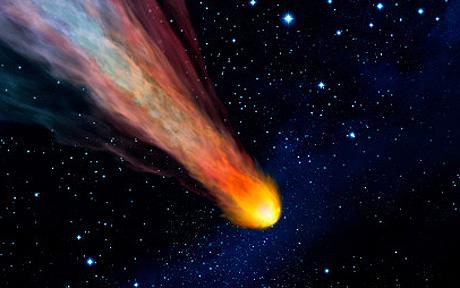 smallest ones are no larger than a particle of sand. The biggest ones reach the size of a boulder. The biggest meteorite weighed 132,000 lbs. It fell in Hoba West in South Africa.
Terminology
There is a lot of confusion surrounding meteors, asteroids and meteorites. Here are the facts.
A meteoroid refers to any object in space that moves throughout interplanetary space. Its dimensions make it bigger than an atom but smaller than an asteroid.
An asteroid refers to any rocky, celestial object that is revolving around the Sun. They are composed of rock and metal. The most well known examples of asteroids are the ones between Mars and Jupiter called the Asteroid Belt.
The meteor refers to the streak of light made by the meteoroid as it goes through the atmosphere. The accepted size of meteors and meteoroids start from 10 micrometers to 10 m across. Other suggested meteoroid dimensions go up to 50 m in diameter.
When the meteoroid hits the ground, the broken fragments are called meteorites. Not all meteors leave fragments; others vaporize upon entering the atmosphere. When destroyed, the meteorites scatter debris called meteoric dust.
To recap: asteroids are large, rocky orbiting bodies. Meteoroids refer to celestial bodies smaller than an asteroid. The meteor is the visible light emitted by the meteoroids. If the meteoroid crashes and leaves debris, the remains are called meteorites.
Note: meteors are often called shooting stars. This term is wrong, because meteors are not stars.
Fireballs, Bolide and Tektites
Apart from the size of meteors, the following terms need to be understood too. A tektite means molten material from the Earth that splattered from a meteorite. These are not meteorites. A fireball is used to describe a meteor that is more luminous than usual.
A fireball also refers to any meteor that is brighter than any planet. It needs to have a magnitude of -3 at the zenith. A bolide is synonymous with a fireball. Officially, there is no specific definition for a bolide. Sometimes the term bolide is used to refer to any projectile that makes a crater.
Meteors and Asteroids Hitting Earth
The sizes of meteors that hit the planet are very small. Every hour, one million meteors hit the Earth’s atmosphere. Less than 160 get into the atmosphere. The biggest ones to actually hit the surface are 50 cm.
Once a year, a 4 meter meteorite might hit. A 20 meter asteroid hits the Earth every 100 years. Every 2 million years or so, a 2 km asteroid will hit the Earth.
One of the most well known meteors is the Peekskill Meteorite which hit on Oct 9, 1992. The meteor covered a path of 800 km. A fragment had a mass of 27 lbs. Today, sophisticated equipment has made it easy to spot meteors as they arrive.
When people think of the sizes of meteors, they usually imagine large planet-destroying boulders. But the facts show meteors are usually no bigger than sand particles.