Size of a Human Skull
The skull is one of the highly interesting parts of the human body. 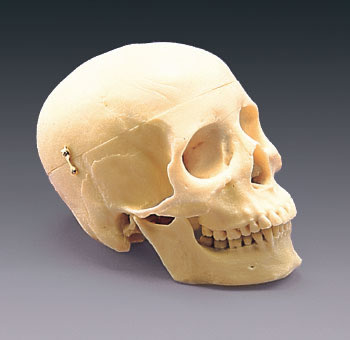 The skull of an adult is comprised of 22 bones. The brain case or neurocranium is made up of eight bones, which form a protective vault covering the brain stem as well as the brain. Meanwhile, the splanchnocranium is another part comprised of bones that support the face. The auditory ossicles are contained within the temporal bones. Aside from these facts, there are more to learn about this important body part including the size of a human skull.
The Size of a Human Skull
From the forehead to the occiput, the average length of an adult skull is around 21 to 22 centimeters. Meanwhile, the average width is about 17 to 18 centimeters. In terms of circumference, the average skull of an adult measures 54 to 57 centimeters. Aside from its basic components, the skull also features sinus cavities, which are in line with the respiratory epithelium.
Additional Facts and Other Interesting Details
Primarily a complex structure, the human skull has bones created from endochondral and intramembranous ossification. During birth, it is still comprised of 404 bony elements. As it grows, these elements start to fuse into a solid bone. At the skull’s roof, the bones are separated by fontanels, which are dense connective tissues. The fontanels are comprised of two posterolateral or mastoid, two anterolateral or sphenoid, one occipital or posterior and one frontal or anterior.
Just like all the other parts of the human body, the human skull as well as the brain can suffer from injuries. After acquiring head injury, a subdural hematoma can lead to increased intracranial pressure. The skull of males is generally bigger than the skull of females. The male skull has prominent temporal lines, glabella and supraorbital ridges. Likewise, the male skull has bigger occipital condyles, larger sinuses as well as squarer orbits. Compared to the female skull, the male has rougher muscle attachments, larger mastoid processes and broader palates.
The front part of the human skull is comprised of the corpus mandibulae, spina nasalis anterior as well as ramus mandibulae. In addition, you can also find within this part the vomer, margo infraorbitalis and margo supraorbitalis. At the side part of the skull, you can locate the protuberantia mentalis, condylus occipitalis and arcus zygomaticus. Other important parts found within this part of the skull are the fossa temporalis, planum temporal and linea temporalis.