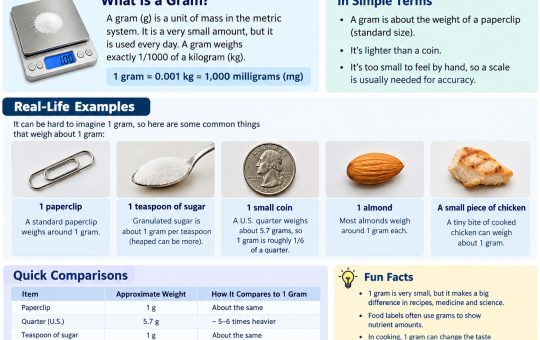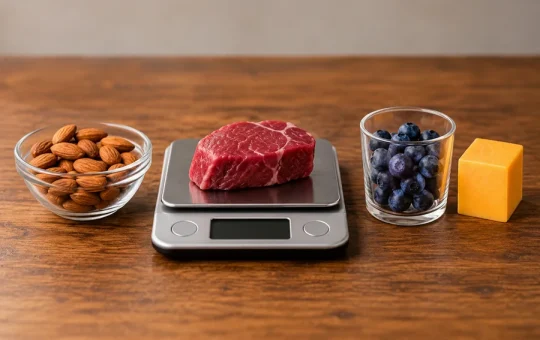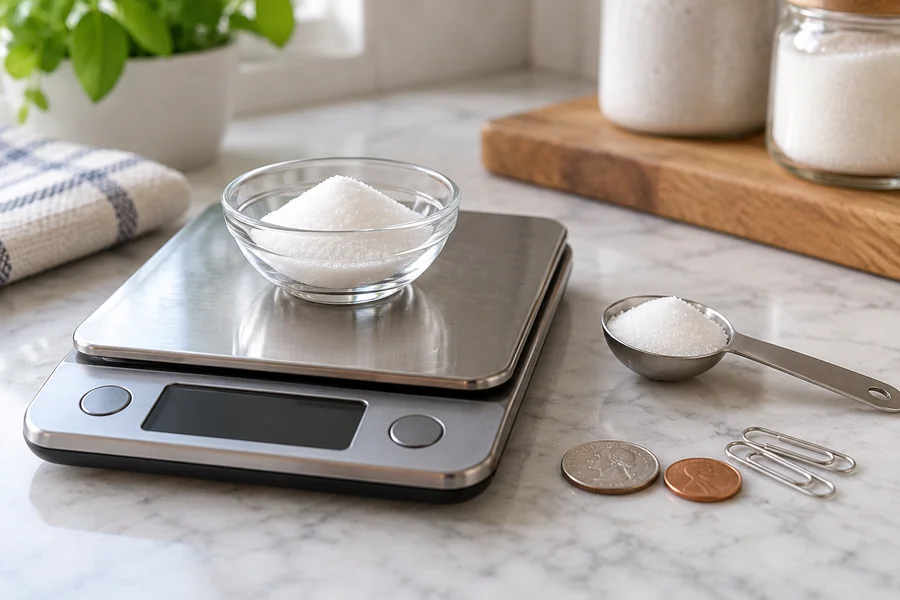
The answer to How much is 10 g, depends on what you are comparing it to. Ten grams is a small quantity of weight. It equals 0.01 kilograms. It is also approximately 0.35 ounces. The 10 grams is used in everyday life to refer to food, jewelry, medicine, powder, or many other small objects.
The difficult thing is, grams measure weight and cups and spoons measure volume. This is what it means that 10 grams of one ingredient could not be the same size as the other 10 grams of ingredient. Hence, it is better to be aware of what you are measuring.
How many ounces are in 10 g?
A quick way to find 10 grams is to convert it to ounces.
Approximately 0.35 ounces is equal to ten grams. This is a little more than one-third of an ounce.
Grams are typically more convenient for precise measurements, such as exact work. It is important in the making of cakes, science, jewelry, and medicine.
When a recipe specifies a measurement by grams, it is typically best to use a digital scale.
What is the conversion of 10 g to kg?
Grams to Kilograms is a very easy conversion.
One kilogram is equal to 1000 grams. Therefore, 10 grams is equal to 0.01 kilograms.
It might not sound much since heavier objects are measured in kilograms.
For instance, the weight of luggage, larger food packages, etc. are measured in kilograms. Lightweight items and small ingredients are often measured in grams.
What is the equivalent of 10 grams in teaspoons?
This is where the specificity of things start to be lost.
A teaspoon is used to measure volume. A gram is a unit of mass. Ingredients will vary in density, meaning that there’s no one answer to 10 grams in teaspoons.
For instance, there is a difference in volume between 10 grams of sugar and 10 grams of flour. Salt might be again.
In general, 10 grams of granulated sugar can be approximated to be about 2.4 teaspoons. This should not apply to all ingredients, however.
For precise measurements, always weigh on a kitchen scale.
How Much Is 10 g in Tablespoons?
Tablespoons are used in the same way as cups.
Without knowing the substance, it is not possible to convert 10 grams to tablespoons.
About 2/3 tablespoon of water is equal to 10 g of water, since 1 tablespoon of water weighs approximately 15 g.
Other ingredients will vary.
The density of butter, flour, sugar, honey and oil are different. So their tablespoon sizes will not be equivalent.
When converting recipes, you’ll first need to know the name of the ingredient before you can proceed with the conversion.
What Does 10 g Look Like?
Without a scale, it’s hard to imagine 10 grams.
A light heavy object might seem larger than a heavy light object.
By comparison, two US nickels weigh ~10 grams combined with each nickel at ~5 grams. This will provide you with a helpful visual aid.
Some ingredients too can have a small spoonful weight, which is about 10 grams. However, the quantity varies depending upon the food.
That is why the only time visual estimates are used is when precision is not important.
Why such a widespread use of grams?
Why this is so much use of grams?
Grams are convenient because they give a precise and uniform weight measurement.
They have a broad range of applications in the food industry, health, science, shipping, jewellery, and packaging.
Grams are more precise than cups or spoons for recipes. This is particularly true when it comes to baking.
Different packing densities of a cup of flour can lead to different sizes. 10 grams on a scale will always be 10 grams.
That’s why many pro recipes are in metric.
To convert to grams: multiply by 10
To convert to g, multiply by 10.
| Measurement | 10 g Equals |
| Kilograms | 0.01 kg |
| Ounces | About 0.35 oz |
| Milligrams | 10,000 mg |
| Pounds | About 0.022 lb |
| Water | About 10 mL |
Water conversion is the result of the fact that 1 milliliter of water is approximately 1 gram at normal conditions.
This conversion may not apply to other liquids and foods.
When to use a Scale?
When accuracy is important, use a scale.
This means baking, portion control, jewellery, medicine, lab work and any situation where their tiny difference might make a difference.
Generally a digital kitchen scale is sufficient to measure foods.
A precision scale might be more appropriate for very small objects.
For an approximate measurement of a little quantity, a spoon could be sufficient. However, if it is just How much is 10 g, the most accurate answer is provided by a scale.
Final Thoughts
So How much is 10 g? It is 0.01 kg or approximately 0.35 ounces in basic weight. It is also equivalent to 10,000 mg.
A 10 gram amount of water is approximately equal to 10 milliliters (mL). Volume measurements will vary for foods and powders.
The key point to keep in mind is that weight and volume are not synonymous.
Use a scale if you require an exact 10g of quantity. It is the quickest and most reliable method.
FAQs
How much is 10 g in ounces?
There are approximately 0.35 ounces in 10 grams.
How much is 10 g in kilograms?
There are 0.01 kilograms in 10 grams.
How many milligrams are there in 10 g?
There are 10,000 milligrams per ten gram.
Is 10 g equal to 10 mL?
The amount of water is approximately 10 millilitres (or 10 grams). There may be other materials with different densities.
How many teaspoons is 10 g?
Depends on the ingredient. Without knowing what substance is being converted, there is no accurate way of converting 10 grams to teaspoons.
Which of these objects weighs approximately 10 grams?
A pair of U.S. nickels weigh about 10 grams together.
Is 10 grams a lot?
No. Ten grams is a small amount and is widely used for ingredients, jewellery and light products.