Choosing an incorrect container size is a costly error. Either you pay for the space that is never occupied or you run out of space on loading day. A good 40 feet line comparison will prevent both.
The 40′ container is the standard size of sea freight worldwide. Available in two heights, most purchasers also compare it to the smaller 20 foot box.
The 40 feet comparison includes the following: size, volume, weight limits, cost factors and best uses. You will also receive an easy checklist to help you select the right one.
40 Feet Container Size and Specs at a Glance
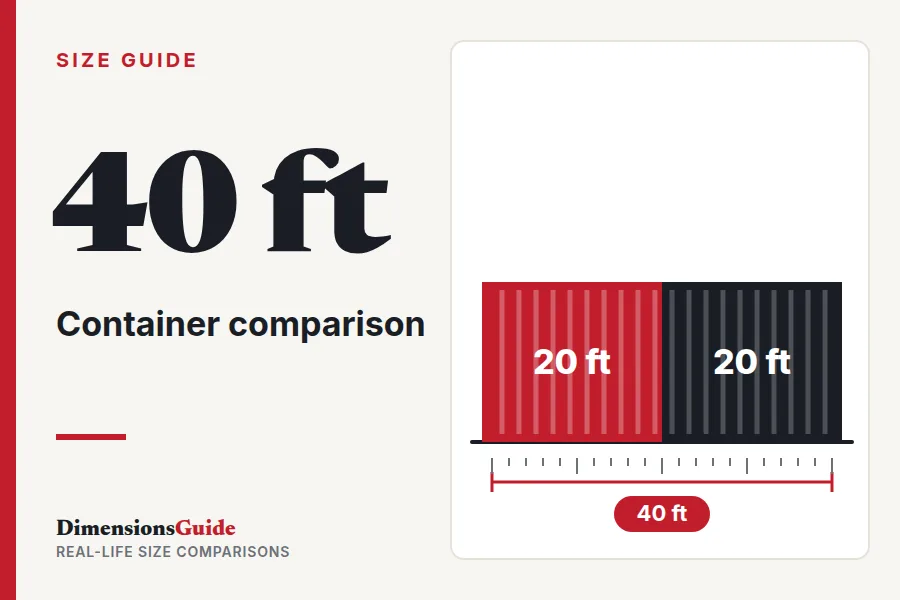
Each 40 foot is 40 feet long and 8 feet wide outside. The main difference is that the first one is shorter than the second one. The height of a standard unit is 8 feet 6 inches. A high cube is 9 feet and 6 inches high.
A 40 foot container is the equivalent of 2 TEUs (twenty foot equivalent units) in shipping. TEU is the unit for measuring capacity in ports and carriers.
The size of the doors are also important. The typical 40-foot box is 7 feet 8 inches wide and 7 feet 5 inches to 7 feet 6 inches tall. Tall loadings must not only enter the box, but also pass through the door.
What size is your cargo, 40 Feet or 20 Feet?
Volume should be used in any 40 feet comparison with the 20 foot container. This has approximately 1172 cubic feet of space inside a 20 foot unit. A regular 40′ unit will contain approximately 2,390 cu. ft. which will give you about double the space. For more context, read about how shippers are coping with 20-foot box shortages.
The same cannot be said for weight. Most boxes specs show the max payload for a 40 foot box to be just higher than a 20 foot box. A dense cargo can be packed to the limit even if the space is not fully utilized.
Use a 20 foot container if:
Your load is large and heavy, e.g. metal parts or stone.
The load would occupy less than 40% of the space in a 40′ container.
Access to delivery site is restricted.
Use a 40 foot container if:
You have a large amount of bulky goods, including furniture, retail goods or electronics.
Otherwise, two 20 foot containers would be required.
For long items you will require the longer interior, approximately 39 feet 6 inches.
To put it simply: The 40-feet comparison includes volume, whereas the 20-feet box includes dense loads and tight spaces.
What’s the Difference between 40 Feet Standard and 40 Feet High Cube?
The comparison most useful to many shippers is standard versus high cube. They both are the same length and width. The high cube is one foot high, which amounts to approximately 300 cubic feet, about 12–13% more volume. You may also like our guides on how high is 40 feet and 20 feet compared to a human.
Here’s what it translates to when it comes to real-world applications:
Space: approximately 2,390 cu. ft. for standard unit and approximately 2,695 cu. ft. for high cube unit.
Interior height: Approx. 7’10” vs 8’10”.
Weight: The load capacity of a high cube is slightly less when empty, and is roughly the same or less than that of a standard cube.
Route restrictions: Some roads, bridges and rail lines may have height restrictions on the taller box. Ask your carrier or trucker about this.
The high cube is not always the solution in a 40 feet case. For lighter, bulkier items like furniture, clothing or stacked cartons additional height may be useful to increase the number of items shipped per trip. A standard unit is generally sufficient when the cargo is compact and heavy; if not, the weight limit will be foremost.
Get rates on both heights. This price difference may be narrow or wide depending on the route and the season.
Revenue and Cost Factors in a 40 Feet Comparison
Price is always a part of each of the 40ft comparisons, but one number does not always mean the whole story. Freight rates fluctuate frequently, and are influenced by numerous factors. Check this list when comparing offers: Another useful comparison is how long is 100 feet.
Route/distance: Longer routes or less busy routes are typically more expensive.
Season and demand: Prices fluctuate depending on the season and demand.
Contract type: Spot rates and contract rates may vary.
Port and terminal charges: handling fees at both beginning and end of the journey.
There is additional cost involved in inland transport, using trucks or rail to and from the port.
Fuel and other charges may be listed as surcharges.
A 40 foot box may be double the amount of space of a 20 foot box and therefore can often be less expensive per cubic foot than two 20 foot boxes. A 40 foot marketplace container is approximately 30% dear to purchase than a 20 foot marketplace container as per one marketplace marketplace. That is a purchase price and freight rates vary, so use actual quotes.
In addition to full container load (FCL), if you have a small cargo you can also check less than container load (LCL). Have the same route read to each forwarder in both sizes, to make this 40 feet comparison fair.
Deciding on the right 40 foot container is a challenging task.
This short checklist will help you make a decision about your 40 feet comparison.
Measure your cargo. Work out the total volume in cubic feet or cubic meters.
Check the weight. Check the capacity to see if it is more than the container’s payload capacity noted on the data plate.
Find your tallest item. If it is higher than the standard box door (approx. 7 ft 5 in.), inquire about the high cube door height.
Plan the load. How much is actually able to fit is determined by the size and stacking of pallets.
Check the route. Check road, rail and terminal boundaries at both ends.
Compare quotes. Ask for quotes on a standard 40′ box, a high cube if available, and two 20′ boxes (if applicable).
Common best-fit examples
Standard 40 foot: Boxed retail stock, electronics and other general dry cargo.
40 foot high cube: Light and bulky items like household goods, large furniture and appliances.
Storage and building projects: Both sizes are used for storage and modular buildings. Homes are a popular choice for high cubes as the additional height appears more open.
Final Thoughts
So, there are three things to consider when comparing a good 40 feet comparison: volume, weight and route. Once you know those, the selection of the container is easy.
For dense or general dry cargo, choose a standard 40′ container. When you have light and bulky items, opt for a high cube, and the additional foot of length will be taken advantage of. Use 20 foot containers if you have a small load or a very heavy load for the size of container.
Prior to booking, measure your cargo, review the payload limit and request quotes for all sizes. Then, your 40-foot comparison will show you the box most suitable for your cargo, and not the most popular.
FAQs
In a 40 feet comparison, what is the difference between standard & high cube?
Height. A high cube is a foot taller on the outside (9 feet 6 inches versus 8 feet 6 inches). This increases the internal capacity by about 12-13%. Length & width remain constant.
How many TEU is a 40 foot container?
Two TEU are equivalent to a 40′ container. One TEU is equivalent to a standard 20 foot container.
Is a 40′ container half the size of a 20′ container?
Yes, in volume, in the vicinity of. The typical 40 foot box will contain approximately 2,390 cubic feet, while a 20 foot box will contain approximately 1,172 cubic feet. The payload limits are not doubled meaning heavy loads could exceed the limit before payload.
Is the shipping cost of a high cube container more?
Not always. Fares are subject to change according to the route, season, carrier and equipment availability. Get quotes for two heights, to make your 40 feet comparison meaningful.
Which is preferable for storage and conversion?
Use a standard box for general storage. More headroom, for shelving, tall equipment and living areas, with a high cube. Always be sure to verify local regulations and access to delivery prior to purchase.