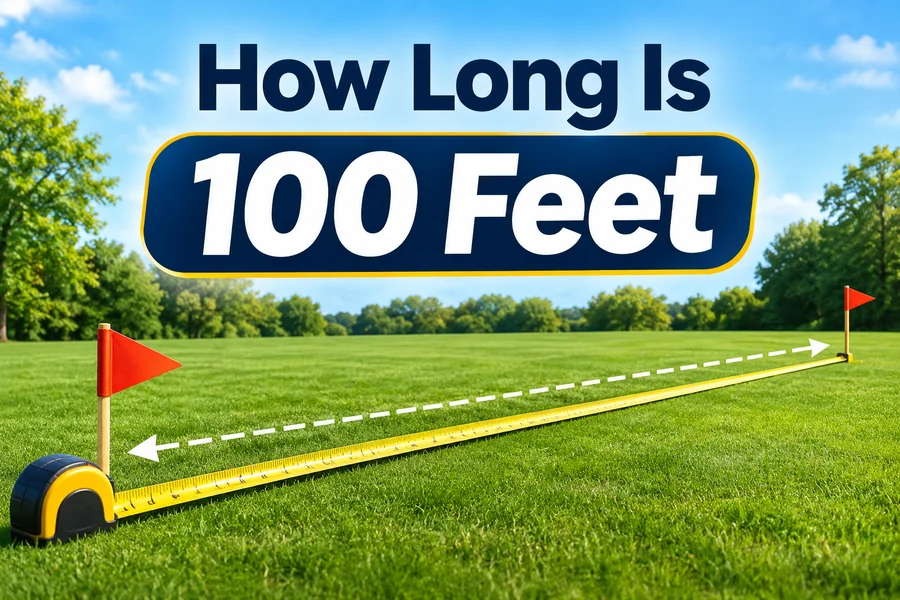
Ever wonder how many feet 100 feet is and what it would look like in real life? The length of 100 feet is a standard unit employed in building, sports, land use, and many other distance estimates. It can be hard to think of without a reference. Making comparisons with a building, swimming pool or a line of cars helps to make it easier to understand.
When working on plot measurements, projects or even just wondering about distance, it’s nice to know what 100 feet looks like. This guide covers the measurement in a simple way and offers simple examples that can be used to help visualize the measurement.
How Long Is 100 Feet?
100 feet is equal to 1,200 inches, 33.33 yards, or 30.48 meters. It’s about one-third the length of a football field (including end zones) and is about the height of a 10 story building, depending on the design of the building.
To conceptualize this distance, imagine that you have 10 objects, each 10 feet long, in a straight line. If both of them added together were 100 feet. The other option is to walk along a straight line for about 100 feet to see how far 100 feet is.
The standard measuring tape might not be long enough to measure the distance conveniently. A measuring wheel, laser distance measure or a marked measuring tape may help for larger spaces.
How Long Is 100 Feet Visually?
The best way to understand 100 feet is to compare it to things and places you are familiar with. This is approximately the distance that an average adult takes steps while walking. (Stride length will vary.) The number of steps can vary by walking pace, age, and height.
Imagine a room that is the length of a long swimming pool or 10 cars parked bumper to bumper. These comparisons are only approximate distances and not exact measurements but do help in recognizing the distance.
You may feel like the other end of a 100-foot space is fairly close in an open space. Other elements such as trees, walls, parked cars and other objects may make the distance more difficult to measure. If accuracy is important, measure rather than use visual estimates.
100 Feet In Different Units (Conversion Section)
Convert 100 feet in to other commonly used units of measure.
| Unit | Equivalent of 100 Feet | Notes |
| Inches (in) | 1,200 inches | Useful for detailed measurements |
| Yards (yd) | 33.33 yards | One-third of 100 yards |
| Meters (m) | 30.48 meters | Standard metric conversion |
| Centimeters (cm) | 3,048 cm | Useful for metric calculations |
| Millimeters (mm) | 30,480 mm | Used for precise conversions |
| Kilometers (km) | 0.03048 km | Just over 30 meters |
| Miles (mi) | 0.01894 miles | Less than 0.02 mile |
The most convenient one to know is that 100 ft = 30.48 m. For rough estimates, use the metric system if you want to use it, then this is about 30.5 meters for daily use.
Things That Are 100 Feet Long
Distance can sometimes be difficult to grasp from just numbers. Real world comparisons help to better understand the size of 100 feet.
The following examples involve familiar buildings, vehicles and sports facilities that can be used to help visualize length. These comparisons are only approximate, unless otherwise stated.
Length Of A Football Field
The standard American football field is 100 yards (without end zones). The playing field between the goal lines is 300 feet long ( because one yard is 3 feet long).
This will make the playing field between the goal lines 100 feet in length. This is a comparison that is helpful because many people have an idea of the size of a football field.
Imagine being on one goal line and taking a walk 1/3 the length of that goal line toward the other goal line, you have a good visual understanding of 100 feet.
Length Of A Swimming Pool
Another useful comparison would be a competitive swimming pool. The length of a pool that can be used for the Olympic Games is about 164 feet or 50 meters.
About 61% of that pool’s length is covered by a distance of 100 feet. Now pretend that you are walking down the pool deck from one end and stopping just past the middle. That will help you get a sense of the distance.
The length of smaller recreational pools can vary greatly, so use the size of the pool as a reference for measurements.
Length Of Ten Parked Cars
Generally, a passenger car would be between 14 and 16 feet long, but there are some variations based on the type of car. So, 10 cars end to end would cover about 140-160 feet.
To get a better idea of scale, imagine six or seven ordinary sized cars lined up. They would measure about 84 to 112 feet in length; 100 feet is within that range.
Keep in mind the distance is only as long as the vehicles and spaces between them. This example is best suited for a rapid visual approximation.
Height Of A Ten-Story Building
The distance between floors in a typical building might be 10 to 12 feet in height, or as much as the ceilings and building construction will allow. So a ten story building would be about 100 to 120 feet tall.
This is helpful to use as a 100 ft height reference for a ten storey building. Some buildings, however, are taller on their lowest level, or the ceiling areas above are greater or an extra structure has been added which alters the building’s overall height.
When gazing up at such a large building, try to imagine that the structure reaches out across the ground in a straight line. That comparison in the mind can also help you to interpret the horizontal distance.
Length Of A Tennis Court
The length of a standard tennis court (between the baselines) is 78 feet. The court is then 100 feet shorter than a distance of 100 feet.
Now, suppose you put a tennis court down along a 100 foot-long line. The line would continue 22′ from the far boundary. An actual analogy for anyone who has played tennis on school, park, or sports club courts.
Consider that the total area to play around a court can be more than the official playing area around the court.
Length Of A School Bus
A full size school bus will typically be 35 to 40 feet in length, but may be shorter or longer. If two buses were joined together, they’d be about 70 to 80 feet long.
A typical set of three buses would be 100 feet or more long. Thus, 100 feet is a bit longer than two standard full-size school buses in a row.
It can be helpful when working out spaces for road usage or parking, or when measuring the staging area for a large vehicle.
Length Of A Basketball Court
An NBA basketball court is 94 feet long. That is 100 feet which is 6 feet longer than the court.
Now, pretend you’re on one side of the baseline and pointing at the other side. It’s already close to 100 feet long, one of the easiest sports-related references to remember.
Some other basketball leagues may have slightly different dimensions for their courts, so the NBA section is best viewed as a particular reference and not a universal standard.
Height Of A Utility Pole
There are many different types of utility poles, each tailored to a particular use, site and the equipment it is required to support. Some are considerably shorter than 100 feet, others taller transmission towers can reach greater heights.
A 100′ structure would be similar in size to a large utility/communications structure. An average neighborhood pole, however, does not necessarily have 100 feet of height.
For an accurate comparison, check the height specifications of the particular pole or structure.
Length Of A Bowling Lane
A normal bowling lane is 60 feet long from foul line to the headpin. The distance of 100 feet is then 40 feet longer than the playing length of the lane.
Now imagine the lane was extended by ⅔ of its length. The total distance would be about 100 feet.
This comparison is helpful because the dimensions of the bowling lanes are standardized, and therefore can provide a sense of the measurement.
Length Of A Row Of Garden Fencing
Garden fencing is normally sold in sections, which can be used as a useful tool for measuring 100 feet. For instance, if you take 10 fence panels of 10 feet, putting them together they would make a total of 100 feet.
The actual width of the panels will differ depending on the manufacturer and the total length of a fence should be calculated before purchasing, based on the product specification.
This example comes in handy for the backyard fence, garden fencing or fencing sizing of a property.
Length Of A Residential Lot
Lot size varies greatly by area and type of property, with some residential lots having a boundary of 100 feet.
For instance, the length of a rectangular plot is 100 feet and the width is 50 feet then the depth of the rectangular plot is 100 feet. If the lot were not blocked, walking from the front boundary to the rear boundary would span that distance.
When precise boundary measurements are required always use a property survey or site plan.
Length Of A Large Recreational Boat
The length of large recreational boats and yachts can range widely. A 100-foot boat is not a regular sized small recreational boat, it is a large yacht instead.
The distance can be visualised by thinking of a ship that’s 100 ft long, running down a marina side. It would be very long which will take up a lot of space on the dock and mooring space as well.
This is an “on the whole” comparison in size. Not every Yacht is 100 ft long and smaller Yachts can be considerably shorter.
Length Of A Long Garden Hose
Garden hoses come in lengths of 25, 50, 75 and 100 ft. A 100 foot garden hose is then a direct and practical measure of the distance to be measured.
When the length of a hose is correct, unrolling a 100 foot hose in a straight line will cover 100 feet. This area can seem smaller if there are curves and bends in it.
This is a great example to use when you are trying to figure out how far water will reach, how far to clean your yard, or how far to reach into the garden to work with equipment.
Length Of A Residential Driveway
Driveways can range from short paths to long access roads. A 100 foot driveway will give a significant separation between a street, home, garage or parking area.
Think of 10 10-foot sections in a straight line from the road to the house. If they could work together, they would travel 100 feet.
When designing a driveway think about vehicle turning space, slope, drainage and local building codes.
How To Measure 100 Feet Without A Measuring Tape
A long measuring tape isn’t always necessary to measure 100 feet. There are a few common techniques for estimating distance.
- Count your steps: Walk normally and count your steps. With an average step size of 2 to 2.5 feet, approximately 40 to 50 steps will cover 100 feet.
- Measure a pathway, driveway or yard with a measuring wheel: Roll the wheel down the ground to measure a path, driveway or yard.
- Use a smartphone: A GPS or measurement app might help to estimate distance but will vary based on the device and situation.
- Use a known object: Compare distance to known object (such as a basketball court, which is 94 ft in length).
- Use a measuring tape or other appropriate measuring device to mark off 10-foot lengths: Using a measuring tape or other suitable measuring instrument, mark off 10-foot lengths 10 times.
The following methods may be helpful for approximate estimates. Use a suitable measuring tool when making construction, property boundaries or other measurements that require accuracy.
Why Knowing 100 Feet Matters In Real Life
Knowing the length of 100 feet can help in numerous everyday situations. The measurement may be required at the homeowner’s home for designing outdoor lighting, driveways, or garden fencing. It can be used by the contractors for estimating the quantities of materials and distances to be covered at the worksite.
It can also be used in sports, event planning, parking plans and outdoor activity designs. Understanding the conversion of 100 feet to meters is helpful when interpreting plans or using measurements in meters.
The use of visual comparisons can save time if they are only required to get an estimate. But they are not meant to take the place of taking proper measurements when safety, construction or legal property boundaries are concerned.
Conclusion
Understanding 100 feet is easier when compared to familiar spaces and objects. It equals 1,200 inches, 33.33 yards, and 30.48 meters. It’s also a bit larger than an average NBA basketball court.
Whether you’re measuring a garden or estimating a driveway or planning a construction project, these comparisons provide a useful method to visualize the distance. To make an estimate quickly, take a count of your steps or use a familiar reference. If precision is important, use an appropriate measuring instrument to measure the entire length.
FAQs:
How long is 100 feet in meters?
100 feet equals 30.48 meters. For everyday use, you can round it to approximately 30.5 meters.
How many steps does it take to walk 100 feet?
It usually takes around 40 to 50 steps for an adult to walk 100 feet, assuming an average step length of about 2 to 2.5 feet. Individual results vary.
What does 100 feet look like?
100 feet is approximately the length of an NBA basketball court plus 6 feet. It is also about one-third of the playing field between the goal lines on an American football field.
Is 100 feet longer than a basketball court?
Yes. A standard NBA basketball court is 94 feet long, so 100 feet is 6 feet longer.
How many yards are in 100 feet?
There are 33.33 yards in 100 feet because one yard equals three feet.