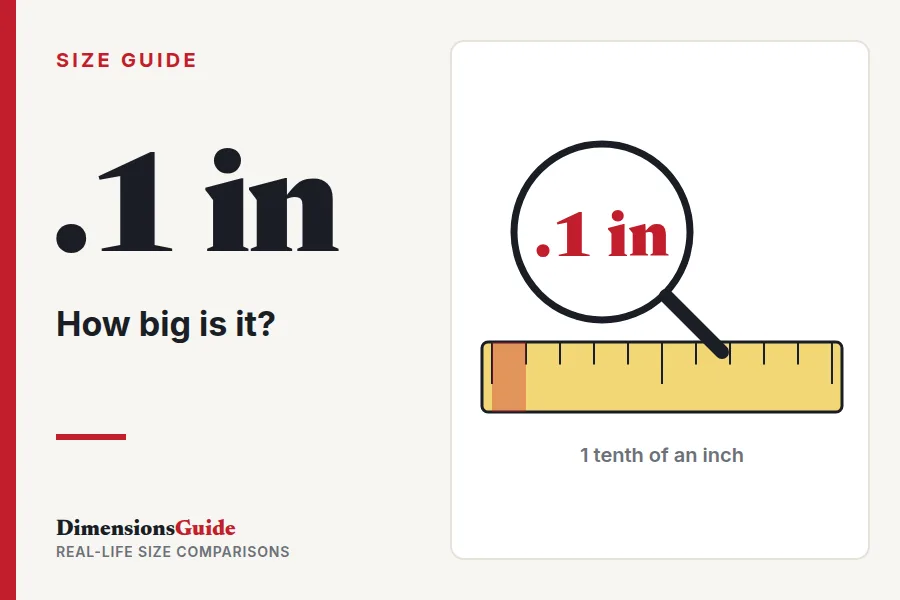
The .1″ might appear on a plan, ruler, or label of a product and you may ask yourself, ” how big is .1 inch? It’s a reasonable question. It’s difficult to imagine small measurements. One-tenth of an inch is .1 inch. It is equal to 2.54 millimeters or 0.254 centimeters. This is just a little more than the thickness of two U.S. dimes.This is a .1 inch size guide using numbers, common items, and easy conversions. You will also discover what this size is used for and how to measure it properly.
What does .1 inch equal?
The number .1 is a decimal. It is equal to 1/10, that is, one-tenth.
Imagine that you have one whole inch, and you divide it into 10 parts. All pieces are 1/8″ in size. 1 inch is equal to 10 pieces.
The commonly asked question is how big is .1 inch since many people are used to the fractions such as 1/2 or 1/4 inch. The use of decimal inches is frequently employed within the field of engineering, electronics and machining, where small size dimensions require numbers to be clearly visible.
What is the length of .1 inch in millimeters and centimeters?
There are 25.4 mm in one inch. This is the standard that is accepted worldwide. To find .1 inch, divide 25.4 by 10.
.1 inch = 2.54 millimeters
.1 inch = 0.254 centimeters
.1 inch = 0.00254 meters
A rough approximation is that .1 inch is roughly equal to 2.5 mm.
Now take a look at a metric ruler. The .1 inch mark is past the halfway point between the 2 mm mark and the 3 mm mark. If you are measuring the size of .1 inch on a metric ruler, find that mark. Compare it with how big is 2 mm.
On a standard ruler, .1 inch falls on which number?
A regular ruler in the USA is divided not in decimals, but in fractions. The marks you see most often are 1/16, 1/8, 1/4, and 1/2 inch. There are also finer rulers that indicate 1/32 and 1/64 inch. For background on why the US still uses inches, see Popular Science’s look at the metric system.
Some of those fractions in decimal form are:
1/16 inch = 0.0625 inch
3/32 inch = 0.09375 inch
7/64 inch = 0.109375 inch
1/8 inch = 0.125 inch
As you can see, there is an overlap between .1 inch and 1/8 inch, which is occupied by .1625 inch to 1/6 inch. The closest size in fraction form is 3/32. The difference is just 0.006 of an inch.
What is the measurement of .1 inch on a fractional ruler? Slightly larger than 3/32″ and slightly smaller than 7/64″.
For quick and easy projects, 3/32″ is a convenient substitute. When precision is required, do not round. DO NOT use the rounded value.
Real-Life Objects That Show How Big Is .1 Inch
Numbers will help, but objects will help more. The following comparisons help to visualize the size. You can also see how long is 2.5 inches.
Two stacked dimes (dimes are United States dimes, which are 13.5 mm in diameter, with a thickness of 1.35 mm each). Two stacked are approximately 2.7mm or just over .1 inch.
US nickel: The thickness of a nickel is approximately 1.95mm. This is about ¾ inch.
Credit cards: The thickness of a typical credit card is approximately 0.76 mm. Three cards on top of each other equals approximately .1 inch.
The typical paper thickness is 0.1 mm, and for a sheet, there are approximately 25 sheets in .1 inch. The thickness of the paper will differ, so use this as a guideline.
Unusual spacing between pins on lots of headers and holes in breadboards is 0.1″.
If you have no ruler in hand to help you visualize how large is .1 inch, the most obvious thing to remember is the stacked dimes.
What is 1 inch in terms of .1?
This is a relatively smaller size that can be seen in various locations.
Electronics. The 0.1 inch (2.54 mm) pitch has been in use for a long time for pin heads, breadboards and through hole chip legs. Many manufacturers’ parts fit due to it.
Machining and engineering. Decimal inches are commonly used in drawings. In this world, .1 inch is also referred to as 100 mils, because 1 mil equals 1/1000 inch.
Print and design. Desktop Publishing is measured in 72 points per inch, which is equivalent to .1 inch. On a 96 ppi screen, it is equal to 9.6 pixels.
Weather. Rainfall is reported in inches. The total of .1 inch of rain is a small amount of rain, commonly referred to as light rain.
The answer to how big is .1″ is important for many readers to see when they encounter this in a product specification and require a quick mental picture.
How to measure .1 inch in other units?
Apply the following rules to get the value of any inch:
Inches × 25.4 = millimeters
Inches × 2.54 = centimeters
Inches × 1,000 = mils
Inches ÷ 12 = feet
Have this table handy to check on how large is .1 inch when used for a school project, craft or technical drawing.
How to Measure .1 Inch Accurately
The first step to a good measurement is the right tool! Below are some easy tips. For a larger size, read how big is 10 inches.
Use a decimal ruler. Some rulers use 10s of one inch. These have .1″ as the first small mark.
Try a digital caliper. There are many calipers available that can measure 0.001 inch. Generally the most suitable option for small components.
Use metric ruler as a backup. Measure 2.54 mm. That is just beyond the 2.5 mm mark.
Face the scale straight on. Readers make errors when reading at an angle.
Don’t round too soon. Record the complete number all the way to the end.
If you need to know a real part’s size in inches, a caliper is much more accurate than a ruler when it comes to measuring .1 inch.
.1 Inch vs .01 Inch vs 1 Inch
It is easy to misread decimal points. A small slip is ten times the size!
1 inch equals 25.4 mm.
.1 inch equals 2.54 mm. It is ten times smaller than 1 inch.
.01 inch equals 0.254 mm. Ten times as small, about the thickness of two or three sheets of copy paper.
Before cutting, drilling or ordering, double check the decimal point. An understanding of the size of .1 inch also helps you identify typing errors in a list of measurements.
Final Thoughts
So, how big is .1 inch? It measures one-tenth of an inch – or 2 ½ 4 centimeters. That’s small, but it is not hard to imagine when you attach it to real things.
Make sure you manipulate the important points. It equals 0.254 cm, 100 mils, and 7.2 points. It is approximately 3/32 inch on a fractional ruler. It is the normal spacing between pins and breadboard holes in electronics.
When you have the next question, about the size of .1 inch, you can use the conversion table, the dime trick, or a caliper for the correct size. When thinking clearly, you will save time, prevent mistakes, and small measurements will be much less confusing.
FAQs
How big is .1 inch in mm?
It is 2.54 mm. This is based on the same rule that 1 inch is equal to 25.4 mm, and so .1 inch equals 2.54 mm.
Is .1 inch the same as 1/10 inch?
Yes. The decimal number .1 is equivalent to the fraction 1/10. Notice that on most standard fractional rulers, 1/10 inch isn’t written.
What fraction is approximately equal to .1 inch?
The smallest common fraction is 3/32 inch or 0.09375 inch. Another close match is 7/64 inch at 0.109375 inch, but it’s just slightly further away.
Which is longer .1 inch or 2 mm?
Yes. Since .1 inch equals 2.54 mm, it is about 0.54 mm longer than 2 mm. A little less than 3 mm. long.
What is the size of .1 inch in terms of my imagination?
Stack two US dimes. Their combined thickness is 2.7 mm or very close to .1 inch. Three stacked credit cards also provide a pretty good size comparison.