How Big is the Sun?
The sun is at the very heart of our solar system and it is 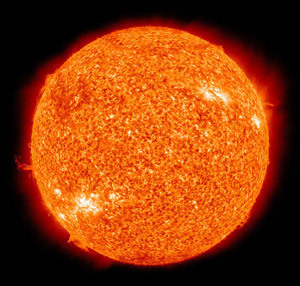 also the largest object in it. If viewed from earth, we see it as a glowing yellow ball of light floating in the sky. It has been a huge influence in the many cultures in the world. We know that the sun itself is venerated and worshipped in many different cultures throughout the history of the world. Many have wondered about this star specifically how large it is and what its dimensions are.
Dealing with the Numbers
The diameter of this nearest star is estimated to be about 109 times larger than the diameter of the earth, which is about 1,392,000 kilometers. Comparing its mass from that of the earth's, it is estimated to be 330,000 times bigger. In fact, it takes up about 99.86% of the entire mass of our solar system. Around 75% of that mass is made up of hydrogen and the rest of it is made up mostly of helium. It also contains heavier elements such as neon, iron, and oxygen, among others but only make up less than 2% of the star's total mass.
Cultural Views
The understanding that sunlight is a source life and energy is not a modern concept. In fact, the idea has long been recognized by human beings from antiquity. Because of this recognized life giving properties, many people throughout the history of the human race have paid homage to it. In effect, there have been many solar deities that can be identified in many ancient cultures.
In Hinduism, there are 12 solar deities known as the Adityas that were later metamorphosed into Surya, the sun god. There is a large amount of evidence of worship devoted to this nearest star in the religion of ancient Egypt. In fact, it was really prevalent during the country's ancient days with many deities in their pantheon related to it such as Menhit, Bat, Bast, Nut, Hathor, Sekhmet, Wadjet, Isis, and Horus.
Present Day Understanding
Our modern day understanding of the sun and its dimensions were due to solar space missions and observations. Various satellites have been launched to observe it such as NASA's Pioneer satellites. This series of solar probes were launched as early as 1959. In the 1970s, the Helios 1 and Helios 2 were launched to study the solar wind at the same distance as the orbit of Mercury.
The space station known as Skylab was launched in 1973. It included, among other things, a solar observatory. The Solar Maximum Mission was launched in 1980 to observe X-rays, gamma rays, and UV radiation that came from solar flares. Other space missions that observed the sun, its dimensions and other properties were launched like Japan's Yohkoh and the Solar and Heliospheric Observatory, which is a collaboration of NASA and the European Space Agency.