Standing in the paint can sizes aisle, the sizes of paint cans can seem confusing. There are small sample jars, quarts, gallons and big buckets, and they all sell for a different amount.
In this guide, the size of paint cans is explained in easy-to-understand terms. You will discover what each size is, how much wall is covered and how to decide which to use for your job.
These figures are all based on the United States and represent average figures. Some brands of coverage may vary, so be sure to look at the label on your can.
How many sizes of paint cans are there?
The majority of paint brands in the U.S. sell paint in the same type of containers. Quarter pint, half pint, pint, quart, half gallon, gallon and 5 gallons are all standard paint can sizes.
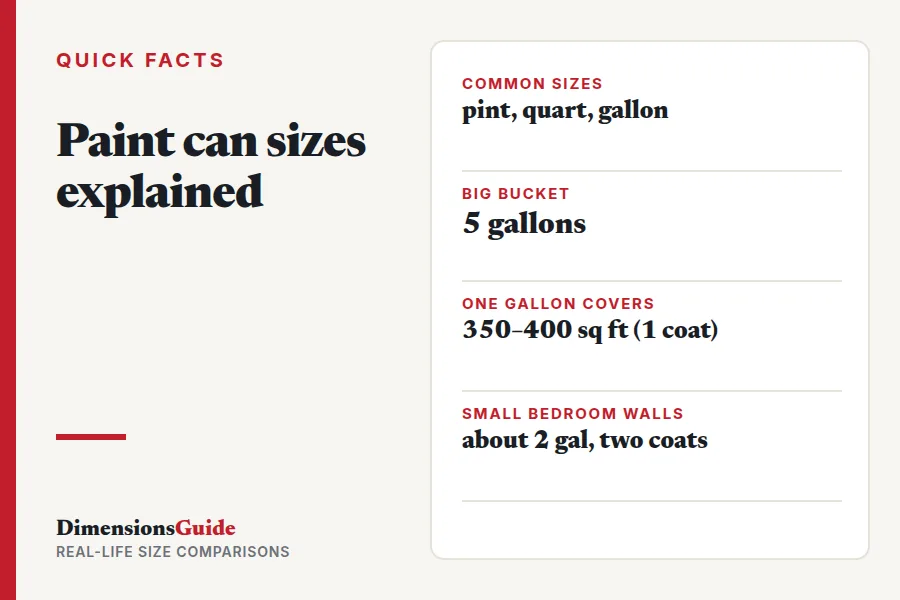
The most commonly used units of volume are the pint, quart and gallon. The smallest cans and the 5-gallon buckets receive fewer stockings, and the exact range will vary based on the brand and the store.
These sizes are just different quantities of liquid. 128 fluid ounces is the capacity of a gallon. The ¼ is a quarter of it, and equals 32 fl ounces. There are 16 fluid ounces in a pint, and 640 fluid ounces in a 5 gallon bucket.
Small Sizes: Quarter Pint, Half Pint and Pint
Small cans are not used for painting whole walls. For more context, see the Almanac’s guide to how much paint you need.
Quarter Pint and Half Pint
A quarter pint is about 12 square feet, and weighs 4 fluid ounces. A half pint will cover approximately 25 square feet and will contain 8 fluid ounces.
Various brands have about 8 ounces of color samples. They are a low cost method to try a shade prior to purchasing a whole can. Look at the sample in the morning light and in the evening light as color may vary as the sun moves across the day.
One Pint
A pint is 16 fluid ounces and will cover about 50 square feet. Ideal for small furniture, picture frames, a single shelf or some trim. Also convenient for subsequent touch-ups.
Mid-Size Cans: Quart and Half Gallon
A quart is used to cover approximately 100 square feet per coat and will contain 32 fluid ounces. The can will be approximately 5 in. tall and 4.5 in. wide. Typical uses are doors, window frames, baseboards, closets and small accent walls. You may also like our guides on how tall a paint can is and how big 15 oz is.
A half gallon will fill approximately 200 square feet and contains 64 fl. ounces. It is not offered by all brands, but when it is, it will work well for a small bathroom like a powder room.
Large Paint Sizes: Gallon and 5 Gallon Paints
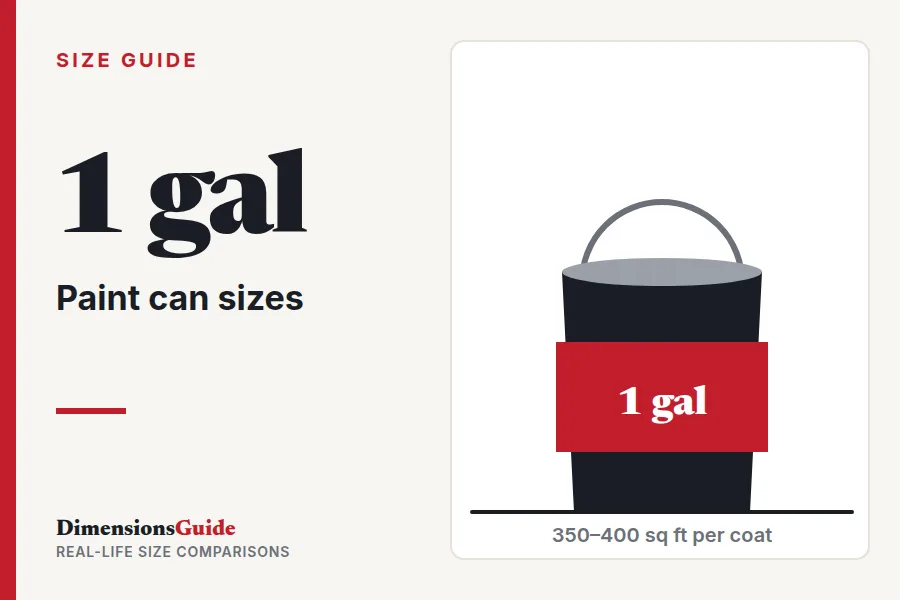
The standard amount for painting a room is a gallon. It contains 128 fluid ounces and will usually cover 350-400 square feet in 1 coat. The can measures approximately 7.5” tall by 6.5” wide. Another useful comparison is milk carton dimensions.
A 5-gallon bucket will have a capacity of 640 fluid ounces and will normally coat 1,750 to 2,000 square feet per coat. It is approximately 14” high and 12” wide. This size is appropriate for several rooms, an entire house paint, ceilings and outside walls.
Full bucket is heavy. Fill in a smaller container or a paint tray, which is easier to handle.
Choosing the correct size for your project
Here are four easy steps to matching paint can sizes with wall surfaces.
Take measurements of each wall width & height, then multiply to determine the area (sq. ft.).
Subtract large openings (door & window).
Multiply by number of coats. Generally, most projects require two applications, particularly if using a dark color.
Take the total and divide by the coverage on the label and then add approximately 10 percent for waste and touch-ups.
Round up to the nearest can. It is better to purchase part of the excess, than to run short partway through the wall.
Example: How Much Paint Does a Bedroom Need?
Let’s look at a practical example of paint sizes. Consider a 12′ x 12′ room with 8′ ceilings.
This is because the wall area is the length of the wall times the height of the wall and equals 48 ft x 8 ft = 384 sq ft.
Remove a door and 2 windows (approx 60 sq ft): 324 sq ft
Three coats: 932 sq ft
At 400 sq ft per gallon: approximately 1.6 gallons
Round to nearest gallon (2). Ceiling paint is typically a different product and a 1-gallon will cover this much.
Does it pay to purchase a larger can?
Often, yes. Often the price per ounce is less for larger cans than for smaller ones, so, for instance, the price per ounce of quart-sized containers may be significantly higher than that of gallon-sized containers.
But lowest price helps only if you are intending to use the paint. Don’t make a decision until you compare prices per gallon. This tip can assist you in determining paint can sizes without overspending.
Consider colour matching as well. If you require more than one can in the same room, purchase all the cans at once and request them to be combined. Different batches may vary slightly.
Common Mistakes When Choosing Paint Can Sizes
Most shortages and waste occur on account of a few simple mistakes.
Lack of a second coat. Use two coats unless manufacturer indicates otherwise.
Ignoring the surface. Rough, textured or porous walls soak up more paint.
Skipping primer. If you are installing new drywall or swapping to a new color, it may require it and will alter the amount of finish paint you’ll need.
Buying too little. It can be difficult to match a color at a later time.
Buying too much. A large bucket for a small size job means a lot of paint that may never get used.
How to Store Leftover Paint
When painting, there will be surplus paint that can be used later for touch-ups. Close tightly, store in a cool, dry area (not in the freezer), and label the lid with the colour name and date.
Final Thoughts
The first two numbers you need to consider when you select the right can are the wall area and the coverage paint can sizes on the label. Small cans are suitable for samples and touch ups. Quarts use for trim and doors. The standard size for most rooms is a gallon and a 5-gallon bucket is ideal for larger jobs or multiple tasks.
Use the measurement as a guideline for two coats, plus approximately 10 percent more. Once you’re familiar with the sizing of these paint cans, you don’t have to have second thoughts about purchasing, and you can avoid waste.
Read the label on the product you choose before you purchase it. It provides the most precise coverage of that specific paint.
FAQs
What are the most common paint can sizes?
The most common paint can sizes are the pint, the quart and the gallon. Many stores also sell small sample sizes and 5-gallon buckets.
How much does a gallon of paint cover?
A gallon usually covers 350 to 400 square feet with one coat. Rough walls and dark colors can lower that number.
What size paint can do I need for a small bedroom?
Most small bedrooms need about 2 gallons for the walls with two coats. Measure your walls first to confirm the amount.
What size is a sample paint can?
Sample cans are often 8 fluid ounces, which is a half pint. That is enough to test a color on a small patch of wall, and it covers roughly 25 square feet.
Are paint can sizes the same in every country?
No. The sizes in this guide are common in the United States. In many other countries, paint is sold in liters, and the available sizes vary by brand and market. Always check the label for the exact volume and coverage.