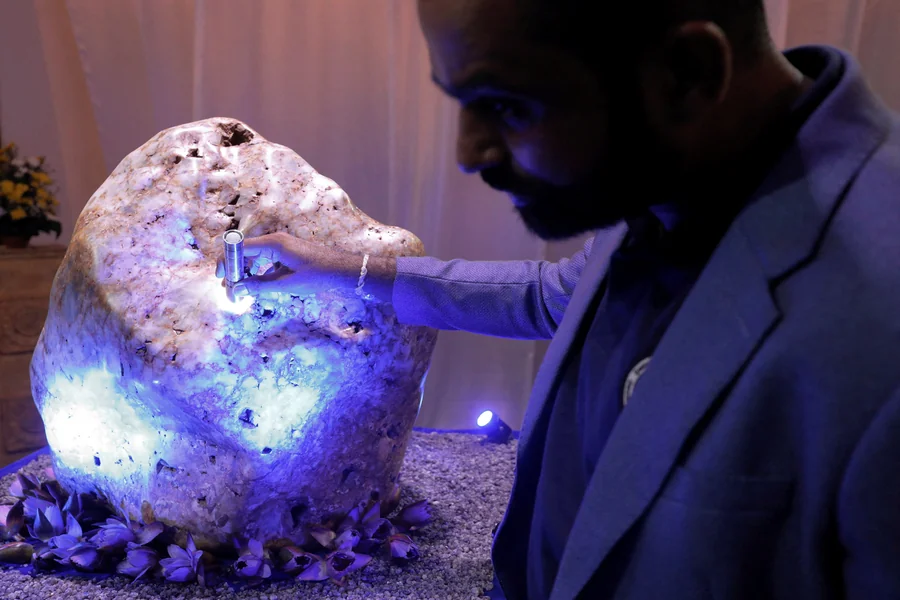
Star of Adam is the largest of all the blue star sapphires and is a massive blue sapphire from Sri Lanka. It is one of the biggest gem quality sapphires recorded weighing about 1404.49 carats. The stone is a member of the corundum mineral family and its star appearance is a facet of needle-like inclusions that refract light in a six-ray pattern. Star of Adam has been found in Sri Lanka, where large and high-quality sapphires are produced, and is still considered to be an excellent specimen in terms of size and quality.
What Is The Biggest Sapphire In The World?
The largest sapphire in the world is the Star of Adam, which is a large star sapphire from Sri Lanka.
The weight of the stone is about 1404.49 carats. An incredible size for a natural sapphire. It is also a star sapphire meaning that the surface of this stone can show a different star-like pattern when light is applied to it.
The Star of Adam is not the regular clear blue sapphire which is used for fine jewelry. It’s a big cabochon with an optical phenomenon called asterism. This effect forms 6 rays on the stone’s surface.
The gemstone is said to have been found in Sri Lanka, where sapphires have been mined for years. Sri Lankan sapphires come in a variety of colors, are clear and large in crystal size.
The word “Star of Adam” is related to a customary belief that Adam came to Sri Lanka after his expulsion from the Garden of Eden. The name is a recent identifier, however, and not a historic name of the stone.
The Star Of Adam: Size, Origin, And Characteristics
The Star of Adam stands out mainly because of its exceptional weight. It exceeds the sapphires that are usually found in jewellers by more than 1,400 carats.
Some of its main features are:
- Name: Star of Adam
- Gemstone: Sapphire
- Mineral: Corundum
- Type: Star sapphire
- Weight: Approximately 1,404.49 carats
- Origin: Sri Lanka
- Color: Blue
- Optical effect: Six-ray asterism
- Cut: Cabochon-style polish rather than a traditional faceted cut
A mineral whose main component is aluminum oxide, sapphire is a variety of corundum. Pure corundum is colourless, but can take on various colours due to the presence of trace elements. Iron and titanium are responsible for much of the colour in blue sapphire.
The star-like effect in a star sapphire is caused in another way. The tiny needle-shaped inclusions, often thought to be mineral rutile, can scatter light in such a way as to make the star effect. The star appears around the stone when these inclusions are arranged appropriately and the stone is cut as a “rounded cabochon” (like a cabochon).
For this reason the Star of Adam is interesting not only because of its size, but also because of its optical properties.
Why Sri Lanka Is Famous For Large Sapphires
Sri Lanka is one of the earliest known natural sources of sapphires. The gemstone industry in the country has been in existence for many centuries, and gemstones from the island have been traded worldwide for many years.
The traditional mining areas are found in parts of central and southern parts of the country. The town of Ratnapura is especially known for the Sri Lankan gem trade. It is sometimes referred to as “City of Gems.
Sri Lankan sapphires come in a variety of colours. Although blue is perhaps the most popular, yellow, pink, purple, orange and colourless varieties are also common.
Sri Lanka is not completely devoid of large sapphires as some areas have a geological setting that allows for such finds. The search for a very large stone that was suitable for display and exhibiting some optical effect is rare, however.
The difference is significant when it comes to the world’s largest sapphire. A large rough crystal is not the same as a cut gem and not the same as a star sapphire and cannot be measured or compared in the same manner.
For instance, some massive sapphires might be discovered in rough. They can be fractured, included or have any other feature that would render them poor for use in traditional jewellery. Others may be cut and/or polished chiefly as collector specimens.
How Big Is A 1,404-Carat Sapphire?
The measurement of the weight of gemstones is standardised as ‘carat’. A carat is equal to 0.2 grams.
This means a 1,404.49 carat gem stone would weigh approximately 0.62 pounds or 280.9 grams.
Compared to the small sapphires that are used in commercial jewellery, many of these sapphires are significantly larger. A few-carat natural sapphire can be a major gemstone especially if it’s rich in color, clear and well cut.
The Star of Adam is thus remarkable in a few respects. It is much larger than most of the jewelry sapphires.
But size is not the only determinant of the value of a gem. The bigger the stone the more valuable the stone is not necessarily true. Other things buyers and collectors will take into account:
- The distribution of colour and the colour itself.
- Transparency and clarity
- Cut and shape
- In the wild or otherwise processed?
- Origin
- The presence and quality of asterism.
- Overall condition
- The documentation and the lab identification.
A large sapphire with poor clarity or colour may not be as marketable as a smaller stone with good clarity and colour.
How Star Sapphires Get Their Star Effect
The most obvious part of the Star of Adam is the star effect or asterism.
Asterism is caused by light passing through aligned needle like inclusions within the gemstone. Note that in the case of star sapphires, the inclusions are frequently rutile, and may also be referred to as “silk.
If inclusions are appropriate in kind and placement and the stone is cut properly, the light can create a star pattern at the surface of the sapphire.
The vast majority of classic star sapphires have a six-ray star on them. The rays converge towards the edges of the finished stone, and radiate towards the center.
It’s most noticeable in direct light. The way the light appears can also change because of the movement of the light or the angle of view.
This is one reason star sapphires are normally fashioned as cabochons. Unlike many transparent gemstones, a cabochon object is usually a gemstone in which the surface is more rounded and smooth.
The quality of the star is also important. The degree of centering, the sharpness of the rays, and the evenness of the effect on the surface are all factors that the gem expert might take into consideration.
How the Biggest Sapphire Compares With Other Famous Sapphires
The Star of Adam is not the only famous large sapphire. Other large sapphires have been noted for their size, place of origin, colour or provenance.
One significant example is the large blue sapphire of the Smithsonian Institution in Washington, D.C., the “Logan Sapphire. It has a weight of 422.99 carats and is surrounded by diamonds.
The Blue Belle of Asia is another renowned gemstone that is a large blue sapphire from Sri Lanka. This stone is 392.52 carats and has been identified as one of the largest high-quality blue sapphires ever found.
Reported over the years are also large rough sapphire specimens. They can be quite large, but it is not always appropriate to compare rough and finished stones.
This is because cutting and polishing alters the weight and the appearance of the gemstone in question. A rough sapphire can lose a significant portion of its mass when it’s cut.
This is also the reason that lists of the “largest sapphire” can be inconsistent at times. Various sources may have different definitions, including:
- Largest rough sapphire crystal
- Largest cut sapphire
- Largest blue sapphire
- Largest star sapphire
- Largest gem-quality sapphire
- The biggest sapphire ever unearthed in a museum or private collection
For this reason, the Star of Adam is more accurately considered one of the largest and most prominent of the known sapphires of any given category, rather than any particular category of sapphire requires the same ranking.
Why The Biggest Sapphire In The World Matters
But the Star of Adam is more than its stunning carat weight.
The size of natural gemstones can tell something about the geological processes that created them. The sapphire forms in a certain type of geological environment, and the presence of a very large crystal indicates that under such conditions, the sapphire can grow very exceptionally.
From the gemological point of view the gemstone is also of significance. The asterism is the result of the microscopic inclusions that it contains, showing the impact that they can have on the light interaction of the gemstone.
Then there is the cultural and commercial aspect. The significant find of large and unusual sapphires has helped to reinforce Sri Lanka’s reputation as a significant source of colored-gemstones.
Ordinary buyers, however, will get a valuable learning curve from the Star of Adam as well: The size of a gem is not everything.
If you are thinking of investing in a sapphire, you might want to ask yourself the following questions:
- What is the material of the stone?
- Has it been treated or not?
- What is the colour and clarity of it?
- From where did it come?
- Does the origin have its own documentation?
- Is there a laboratory report that is recognized for it?
- Does the asking price have comparable market support?
These are better questions to ask than just asking how many carats the gemstone weighs.
Final Thoughts
It is estimated that the Star of Adam weighs about 1,404.49 carats, is the largest known star sapphire and one of the most extraordinary sapphire gems to be linked to Sri Lanka. It is unusual due to its massive size and has a six-ray star effect, giving it a unique appearance.
The gemstone also explains why Sapphires are still significant in the globe of coloured gemstones. They are more than just attractive, they’re popular. Many factors can impact a sapphire’s importance and worth, including color, clarity, origin, treatment, cut, and optical effect.
When looking for the largest sapphire in the world, the name of the Star of Adam should come into your mind. However, it should be kept in mind that the term ‘biggest’ may refer to rough crystals, finished gemstones, blue sapphires or star sapphires. That’s an appropriate context for the Star of Adam’s remarkable size.