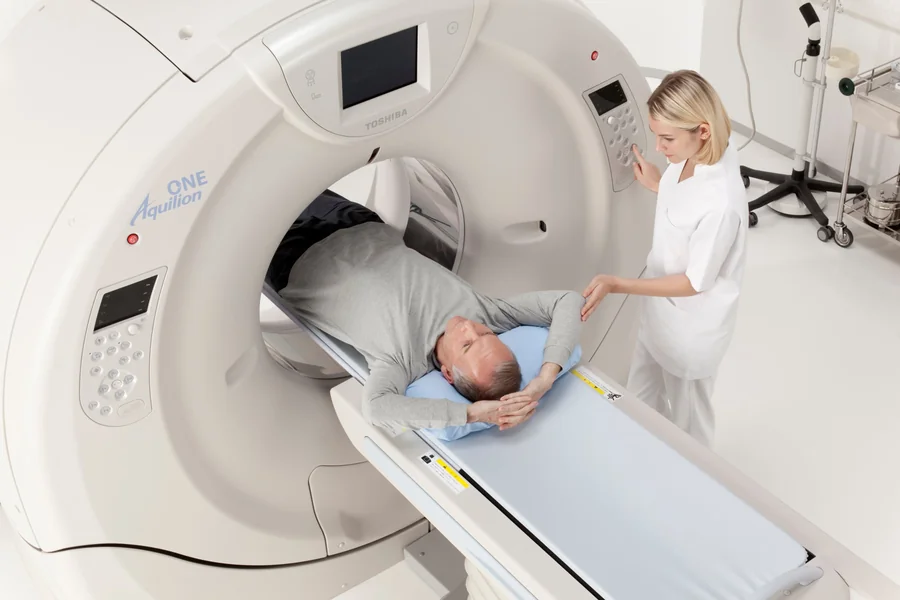
A CT scanner is a large machine in medicine which uses X-rays to generate detailed images of the body across the sections. The main scanner, known as the gantry, is typically 6–7 feet (1.8–2.1 m) wide and 5–7 feet (1.5–2.1 m) tall for the majority of models. During a scan, the patient table goes through the center of the gantry. Much more space is required for a complete CT imaging room, as the table, control area, the equipment, the staff and the patient’s movements must also be accommodated.
If you have ever been in a hospital and been exposed to a CT scanner you might have asked how big is the machine? A first impression of it can be daunting, particularly when compared with other medical imaging devices.
The reassuring thing is that the scanner itself is not that big, compared to the size of the CT room. The machine’s main body is focused in the middle of a circular frame known as the gantry. The images are created as a motorized table transports it through the center of the gantry.
Actual dimensions will depend on the manufacturer, model, detector design and clinical use. A standard hospital CT scanner can also be larger than a small, clinic-sized CT scanner, or a CT scanner designed for an extremity (body part).
What Are The Typical Dimensions Of A CT Scanner?
The best way to comprehend the size of a CT scanner is to break the machine down into its main components. Gantry is the big round piece housing the X-ray tube and detectors. The patient table slides through the gantry during an examination.
The approximate size for many conventional CT scanners is:
- Gantry width: about 6 to 7 feet (1.8 to 2.1 meters)
- Gantry height: about 5 to 7 feet (1.5 to 2.1 meters)
- Gantry depth: typically 2-4 feet (0.6-1.2 m) deep
- Bore opening: typically 65 to 85 cm, depending on the bore size model
- Table is length of patient: typically 7 to 9 feet (2.1 to 2.7 meters) long
These measurements are a general range, not exact specifications. There are some modern scanners with larger bores for patient comfort or to accommodate specific examinations.
The scanner’s overall footprint is also affected by the table. The table size needs to be sufficient to fit inside and out of the gantry. Adequate space must also be left around the equipment for patients and healthcare workers.
However, the size of the circular gantry is not the only factor that should be used to determine the size of a CT scanner. There is a much greater space requirement for safe operation than there is for the physical machine.
How Big Is The CT Scanner Opening?
The bore is the opening in the middle of the Gantry. The area through which the patient table slides.
The bore size is critical as it dictates where a patient can be placed in the scanner. The diameter of the bore in standard CT scanners ranges from 65 to 75 cm and some newer devices have a larger bore of 80 to 85 cm or larger.
There is the possibility of extra space for some patients and/or procedures in a larger bore. It may also be helpful for the placement of medical equipment around the patient.
But a bigger opening doesn’t necessarily mean the whole scanner is bigger. Manufacturers can engineer scanners with larger bores but not so large as to be impractical in a hospital imaging department.
The table also has weight and movement restrictions. These are different for different models and hospitals confirm the specifications of the manufacturer before using a scanner on patients who weigh more.
The bore size is more important for patients than the total size of the scanner. You don’t walk through a long tunnel as in some MRI machines. Instead, you are lying on a table which is being moved through what is a relatively small circular hole.
How Much Room Does A CT Scanner Need?
The CT machine is not the only space required to construct an imaging system. Typical components of a CT suite are a scanning room, a control room, and patient preparation and movement areas.
The size of the room will depend on the local building regulations, radiation protection requirements, equipment specifications, and design of the healthcare facility.
In a typical CT scanning room, enough space would be required for:
- The scanner and patient table
- The medical staff may need to have a knowledge of the proper precautions to take around the patient.
- Wheel chairs and beds for patients.
- Emergency equipment
- Medical accessories such as IV accessories, etc.
- Doors and access routes:
- Radiation shielding
- Proper clearance around scanner
Many CT rooms are much bigger than the scanners themselves. This is intentional. Healthcare workers must be able to move around and maneuver people, equipment, and to face medical situations.
A radiation shielded barrier is typically used to separate the control room from the scanning room. The technologist controls the scanner from the control area and can communicate with and monitor the patient while they are undergoing the examination.
Hospitals considering installing a CT typically use the manufacturer’s plans for site planning, and not just the dimensions of the scanner.
How Heavy Is A CT Scanner?
But CT scanners are not only big; they’re heavy also. The weight is dependent on design and configuration.
A gantry may be quite heavy, several thousand pounds. The patient table is another factor that increases the weight, and other equipment connected with the scanner will add to the overall installation load.
This is important if the CT scanner is located in an existing structure. The structural integrity of the floor, the way to transport it, the elevator, the doorways and access to the installation site may have to be considered.
A scanner might come in various parts instead of being one complete unit. Installation techs then take the components and place and connect them to the final installation site.
Prior to the installation, facilities will do the following checks:
- The width and height of the doors.
- Hallway dimensions
- Elevator capacity
- Floor load capacity
- Ceiling height
- Equipment access routes
- Electrical requirements
- The size of the cooling and ventilation needs.
These details are particularly relevant if the scanner is being replaced with a new scanner. The new equipment could be of varying size and needs for infrastructure.
How Does CT Scanner Size Compare With MRI And Other Imaging Machines?
CT scanners and MRI machines may appear to be alike, because they both have a large circular shape. However, their physical designs are different.
The gantry is typically shorter for a CT scanner. The patient table goes through a fairly short opening and the scanning itself is fairly rapid.
The bore or tunnel of an MRI scanner is generally longer. The MRI system also has a large magnet and is quite sensitive to the presence of metals or the environment.
Here’s a simple example of a comparison:
- MR scanner: Large round tube with a long bore.
- MRI scanner: The larger one is the MRI scanner, which has a longer bore.
- X-ray machine: Usually much smaller and more open.
- Compact ultrasound machine with separate examination bed: Compact and mobile.
- The PET/CT scanner is a combination of the CT and PET system and requires a larger installation, in general.
PET/CT systems are more useful to distinguish from conventional CT scanners. They integrate two imaging technologies into one system, allowing for a larger footprint of the equipment.
Specialised CT systems are also available. For instance, dental cone-beam CT scanners are developed for dental and maxillofacial imaging and might be considerably less cumbersome than conventional full-body hospital CT scanners.
The term “CT scanner” thus refers to a number of different machines. The size may be widely different, depending on use.
Why CT Scanner Size Matters For Patients And Hospitals
The dimensions that are most critical to the patient are typically the bore size and table capacity. All of these factors are related to positioning and comfort.
It’s reasonable to inquire of the imaging center about the size of the bore opening on the CT scanner and the weight limit on the table of the device prior to the appointment if you are worried that you will be unable to fit in the machine.
The questions are more extensive for hospitals and clinics. The installation of a CT demands careful planning as the equipment needs to be physically installed as well as operate safely within the premises.
Radiation shielding may be a factor to consider when planning rooms. The scanning room is designed based on the applicable safety standard and regulation since the CT scanner is based on ionizing radiation.
There are also proper electrical power and environment requirements for the equipment. Cooling systems and other infrastructure may be required, depending on the type of scanner.
Another factor to take into account is workflow. A room that is technically suitable for the scanner could be awkward if it doesn’t have adequate room for a patient bed, wheelchair, staff, or emergency equipment.
That is why manufacturers have specific installation instructions. They may contain the size of the scanner, clearances required, loading specifications for floors, electrical requirements, and suggested room layouts.
When designing a CT room, the manufacturer’s installation instructions should always be followed over any general sizing that can be found online.
Final Thoughts
Therefore, what’s the size of a CT scanner? The width of a typical full body CT scanner is about 6 to 7 feet and the height is approximately 5 to 7 feet, while the depth of the gantry is approximately 2 to 4 feet. The central bore is typically around 65 to 85 cm in diameter for the models.
But, the scanner is just one of the space needs for a CT examination. The patient table can be longer than the gantry, and more room is required in the room for patients, staff, equipment, safety and movement.
This size may differ from manufacturer to manufacturer and scanner type. The dimensions of a standard hospital CT scanner will vary from the size of a compact dental CT scanner or a special CT scanner.
As a general rule, the CT machine isn’t as big as a room’s main machine, it’s just a big circular machine, more like a small room’s main machine. Always refer to manufacturer’s technical specifications and site-planning documents for exact measurements for installation or renovation.