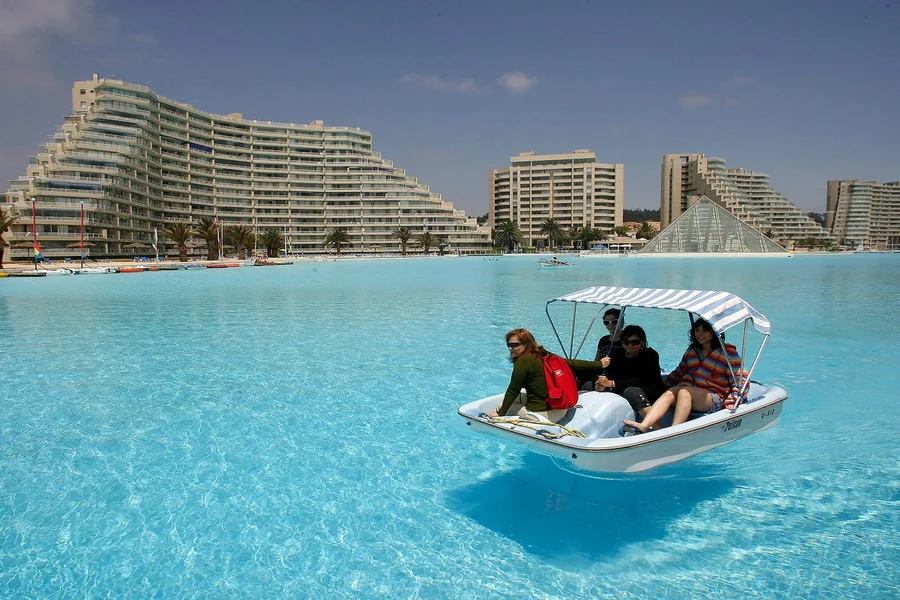
The worlds biggest swimming pool sits at the San Alfonso del Mar resort in Algarrobo, Chile. It is over 1013 meters in length, approximately 8 hectares in area and contains nearly 66 million gallons of seawater. It is also known to have the largest swimming pool on Earth, according to Guinness World Records, and the deepest place in the pool is 115 feet deep. Pumps are used to draw seawater directly from the Pacific, filter and maintain it clean enough for swimming, sailing and even kayaking.
San Alfonso del Mar: The Record Holder
San Alfonso del Mar is located on the southern coast of Chile, about 100 km from Santiago. Actually the construction was underway for years prior to the opening of the pool in December 2006 — years in fact. Instead of adopting the traditional rectangular form, the designers took the form of a natural lagoon. That’s why it’s so well known by so many.
There’s no garden hose filling this thing up. A suction and filtration system which is computer controlled extracts water directly from the ocean, filters it and circulates it around. The heat from the sun takes care of the rest, and the water will be heated to approximately 26ºC, which is approximately 9ºc more than the sea right by it.
The resort was not constructed around the pool as an added feature. The whole property was planned around the lagoon, which is surrounded by flats, walkways and small beach areas to allow visitors to use the lagoon as a private coastline. That’s one of the reasons for the project being so expensive and long. The creation of a pool is one thing.The construction of a pool is one thing. It is a whole new game to create a full-fledged resort around a body of water this large.
How Big Is It, Really?
It’s very difficult to visualize numbers and here’s what it really means:
- Length: about 1,013 meters (3,323 feet) — longer than ten football fields lined up end to end
- Surface area: roughly 8 hectares, close to 20 acres
- Water volume: around 66 million gallons, or 250 million liters
- Deepest point: 115 feet
- Scale comparison: about 20 times the size of a standard Olympic pool
Put the volume another way: that’s enough water to fill more than 100 Olympic-sized pools. It’s no surprise the project took years and a serious budget to pull off. Walking a full lap around the pool from end to end will take at least 12 – 15 minutes at a moderate pace. Not many people know that until they get to one side and look for the other side.
Citystars Sharm El Sheikh: The Rival by Area
While San Alfonso del Mar is a winner on length and volume, of course, it’s not the only pool worthy of a claim to fame. Citystars Sharm El Sheikh, Egypt, constructed a lagoon (Lagoon 1) of approximately 96,800 m² (9.68 ha). That’s actually larger than San Alfonso del Mar by surface area, although it is shorter length-wise, around 740 meters.
The Citystars lagoon is recognised as the largest man-made crystal lagoon by area by Guinness. So, which is the “biggest”? Truthfully, it depend on what you’re measuring. There are three different contests: length, surface area, and volume and each pool has its own trophy. It’s a pitfall for many who are looking for a single “largest” winner, since both resorts use the word and they’re both right.
The Citystars project is located in the Sinai desert, an even more impressive location. The creation of the lagoon in an arid climate involves issues of evaporation, heat and water supply which are not the same as those experienced by a coastal Chilean resort.
How These Giant Pools Get Built and Maintained
You can’t just dig a hole and call it done. Projects at this scale need real engineering work behind them:
- Massive excavation to carve out the basin
- Reinforced linings, usually concrete or composite, to stop leaks
- Industrial-grade filtration systems processing millions of gallons a day
- Pumps strong enough to draw water from the ocean or another large source
- Constant chemical treatment to keep everything safe to swim in
None of that comes cheap. San Alfonso del Mar reportedly spends millions annually just on upkeep. That ongoing cost is probably the biggest reason more resorts haven’t tried to copy the idea. Filtration alone has to run around the clock, since a static body of water this large would turn murky or unsafe within days without constant circulation. Engineers also have to account for weather, tides, and long-term wear on the pool’s lining, all of which add to the maintenance bill year after year.
Why Bother Building a Pool This Big?
Tourism, mostly. A pool this size becomes a landmark by itself — people book trips specifically to see it. But there’s a practical side too.
Coastal resorts sometimes prefer a controlled lagoon over open-water swimming, especially where currents or tides make the ocean risky. A massive artificial pool gives guests that ocean-swimming feeling — boats, kayaks, open water — minus the unpredictability. Guests get clear water, manageable depth zones, and none of the rip currents that can make natural beaches dangerous.
Then there’s the branding angle. Holding a world record generates press coverage, and press coverage fills rooms. Few marketing lines land as well as “home to the world’s largest pool.” It’s the kind of detail that spreads on its own, through word of mouth, travel articles, and social media, without the resort needing to spend heavily on advertising.
Other Massive Pools Worth Knowing About
San Alfonso del Mar and Citystars get most of the attention, but they’re not alone. A few others deserve a mention:
- Orthlieb Pool, Casablanca, Morocco — once ranked among the largest saltwater pools before newer builds passed it, measuring 150 by 100 meters.
- Ocean Dome, Japan — a huge indoor wave pool, impressive for its time, though it shut down in 2007.
- Newer resort lagoons across the Middle East and Asia — several recent developments have built large artificial lagoons, though none quite reach the scale of the top two.
None of these match San Alfonso del Mar or Citystars in raw size, but they show the appeal of giant pools isn’t limited to one country. Developers across different continents keep chasing the same idea: give guests an unforgettable body of water and let that become the reason people book a stay.
Could Something Bigger Get Built?
Fair question, especially with resorts constantly competing for attention. Engineering-wise, sure, something larger could get built. The real obstacles are cost, access to water, and the ongoing maintenance bill.
A pool this size needs a dependable water source — usually an ocean or sea nearby — plus the infrastructure to filter and treat that water nonstop. It also needs a location where land and construction costs actually make sense financially. Given how much these projects already cost, whoever builds the next one will need deep pockets and serious backing.
Records in this space tend to shift eventually, so don’t be shocked if a new contender shows up within the next decade. Gulf countries in particular have shown a pattern of building record-breaking structures, from tall buildings to artificial islands, so a new mega-pool wouldn’t be out of character for that region.
Fun Facts About the worlds biggest swimming pool
Some extra details make San Alfonso del Mar’s pool even more interesting once you get past the raw measurements:
- It holds enough water to supply a small town for a while.
- Visitors can sail small boats and paddle kayaks across parts of it.
- The resort markets it as a private beach alternative, complete with sand along sections of the shoreline.
- Construction reportedly cost close to two million dollars — and that’s before counting years of upkeep since it opened.
- The pool’s deepest section is roughly equal to a ten-story building measured from top to bottom.
Little details like these explain why the pool became such a conversation piece after it opened, and why people still bring it up whenever giant swimming pools come up in conversation.
What It’s Like to Visit
Travelers who make the trip to San Alfonso del Mar often describe the scale as something photos don’t fully capture. Standing at one end and looking toward the other, the far shore genuinely looks distant, almost like a real beach rather than a pool. Water activities go well beyond basic swimming — guests can rent kayaks, small sailboats, and paddleboards, treating the lagoon more like a private sea than a resort amenity.
Visiting doesn’t require booking a room at the resort itself in every case, though access rules have shifted over the years depending on ownership and management changes. Anyone planning a trip specifically to see the pool should check current visitor policies before arriving, since resort pools sometimes restrict access to guests only.
Final Thought
So, what’s the actual biggest swimming pool in the world? Depends how you measure it. By length and volume, San Alfonso del Mar in Chile still takes the title. By surface area, Citystars Sharm El Sheikh in Egypt edges ahead. Either way, both represent serious engineering achievements, built to turn an ordinary resort stay into something people remember long after checkout. Whether either record gets broken soon is anyone’s guess — but for now, these two remain the benchmark.


4 Comments