Test Tube Dimensions
The test tube is a piece of glassware used in labs for storing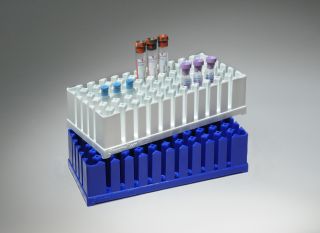 liquids. It is also known as a sample tube or culture tube. It is one of the most common equipment found in laboratories.
Test Tube Dimensions
These are available in a variety of sizes. Some of the most common sizes you will come across are 13 x 100 mm, 16 x 150 mm, 19 x 150 mm and 16 x 120 mm. Other sizes are available, but most of the ones used in labs are between 50 to 200 mm long and 10 to 20 mm wide. Most of these are sold in packs of six, twelve or more.
Characteristics
The tube is shaped like a finger and made of glass or plastic. The tube is clear and the top is open. The bottom usually has a U-shape, although a few tubes do not.
Those with bigger test tube dimensions are called boiling tubes and made specifically for boiling liquid. Very often, the open top has a flared lip. This is to help pour out the contents.
There are varieties in the design; there are tubes with felt bottoms. Some are designed to take in ground glass stoppers. Others can accept a screw cap. The test tubes usually have a white glazed area or ground glass for labeling purposes.
Application
The test tube is used for mixing, holding and heating liquid or solid chemicals. They are utilized frequently for assays and qualitative experiments. The U-shape bottom minimizes any pouring loss. They are also very easy to clean.
The elongated neck helps slow vapors from spreading. The test tube can also be used for electrolysis demonstrations. In this instance, the test tube is stuffed with water. It is upturned in a beaker full of water.
Various test tube dimensions are utilized frequently in biology. They are used for handling and culturing insects, plant cuttings, seedlings, bacteria etc. The test tube is also used in medicine to hold blood or other liquids.
Test tubes are also used in forensics to collect blood and other samples. Often, a test tube with a stopper is used for chemical samples. Sometimes the test tube is used outside the labs. People sometimes use it to hold spices or flowers.
Testing Oxygen Gas with a Test Tube
Besides the test tube, you will need fine steel wool grade 00, a glass of water (3/4 full) and the test tube clamp and ring stand. You’ll also need a pen.
Step 1
Get a piece steel wool. Roll it up into a 1 inch diameter ball. Put in the test tube, all the way down. Use the pen to push the ball all the way down.
Step 2
Invert the tube and put it into the water. Keep it there for a week then you’ll see it has rusted. This test proves the existence of oxygen, as oxygen is needed for steel to rust.
When performing experiments, different test tube dimensions may be needed. For this reason, scientists often have different tube sizes with them in the lab.