There have been diamonds that have been sold for amounts that are still hard to believe. The size of the stones isn’t the only thing. The scarcity, history of ownership and the time when a jewelry piece is put on the auction block can all drive up the price into some realm few jewels can ever enter. Here is a list of the most expensive diamond necklaces ever, the reasons behind each necklace’s price tag, and what really makes a diamond necklace go from ‘impressive’ to ‘eight figures.
What Makes a Diamond Necklace Expensive?
While size is the name that’s often in the news, it’s not always the story. Color, clarity and cut all play a role and with coloured diamonds, rarity in nature plays a much bigger role than carat weight.
Then there’s provenance. A necklace belonging to a royal family, one of Hollywood’s stars, or one of a famous collector will command more than just the stones themselves. People aren’t simply buying a diamond; they’re buying the narrative that goes with it.
There are a couple of factors that are taken into account to the highest degree by auction houses and collectors:
- The weight of each diamond and the overall count of diamonds.
- Color grade, especially rare fancy colors
- The precision of clarity and cut.
- Who owned it before
- The jeweler or house behind the design
- How competitive bidding got on sale day
The L’Incomparable Diamond Necklace
There’s no better topper than this one! There is a 407.48-carat yellow diamond, one of the largest internally flawless diamonds ever discovered, in the center. It is a back story almost too good: this was said to have been unearthed in the 1980s by a young girl in the Democratic Republic of Congo, rather than by a geologist with tools.
Mouawad chose the necklace around that stone, suggesting the smaller ones in white diamonds. When finished it’s worth about 55 million dollars and it remains one of the most lucid examples of the power a single, extraordinary gem can have on a necklace’s value.
The Wittelsbach-Graff Diamond
It is a separate stone most of the time, although it has been found on necklaces, and when it is, its worth only increases. The Wittelsbach-Graff has roots that extend back into the 1600s — European royalty, long lost and a decades later rediscovery at auction.
It was bought by Laurence Graff in 2008 for approximately 23.4 million dollars and recut. But, much as with any historic stone, there was no universal consensus on the decision, and the outcome, a deeper more saturated blue, only made it more desirable. Not many blue diamonds of this color, much less this size.
The Chopard 201-Carat Necklace
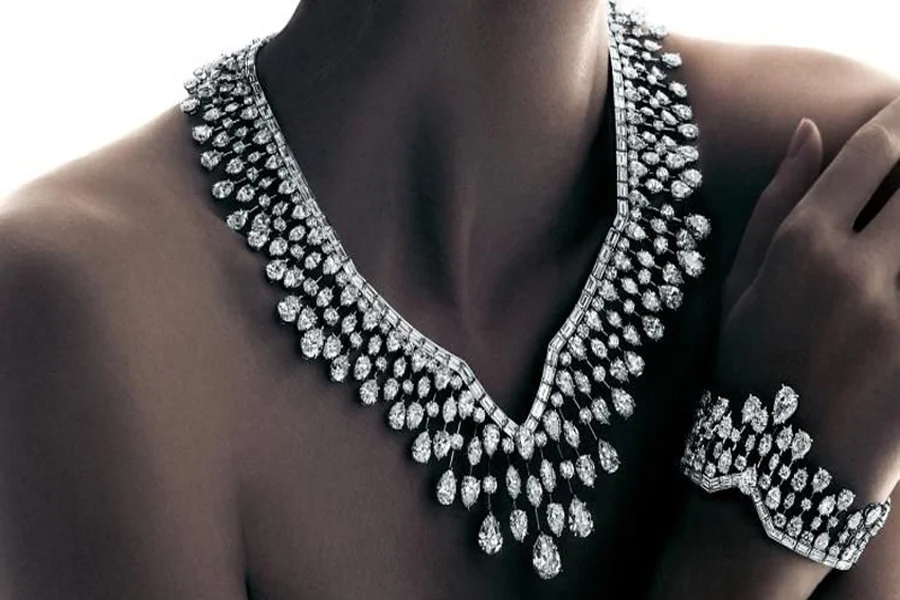
Chopard took a different approach here. Instead of building around one massive stone, they used over 201 carats spread across hundreds of smaller diamonds, arranged in cascading rows. The piece was made for the brand’s 150th anniversary and is valued at around 100 million dollars — one of the highest figures on this list.
It’s proof that scale and design can rival a single showstopper diamond. The necklace has shown up on red carpets more than once, which hasn’t hurt its reputation either.
The Bulgari Necklace Worn by Elizabeth Taylor
Not the priciest piece here, but worth including. Taylor’s Bulgari necklace sold at auction for over 8 million dollars, a number driven as much by who wore it as by the emerald-cut diamonds themselves.
That’s the pattern with celebrity jewelry — pieces routinely sell above their raw market value because buyers are paying for the name attached to them. Taylor’s collection in particular gets studied by auction houses precisely because it shows how much a famous owner can move the price.
The Moussaieff Red Diamond Necklace
Red diamonds are about as rare as colored stones get. Fewer than 30 of significant size are known to exist anywhere. The Moussaieff Red is usually shown as a solo stone, but it has appeared in necklace settings that show off its trillion cut and deep, saturated red.
Estimated value: north of 20 million dollars. Set into a necklace with complementary stones around it, that number only goes up — the craftsmanship adds as much as the rarity does.
Cartier’s Historic Diamond Necklaces
Cartier has made more than a few necklaces that belong on any “most valuable” list. One built for a Middle Eastern royal family used over 500 carats of diamonds and reportedly took years to finish. Exact resale figures aren’t always public, but estimates put several Cartier pieces well into the tens of millions.
The house’s reputation for precision means older pieces tend to gain value, not lose it. When a verified Cartier necklace with solid provenance comes up for sale, bidding wars aren’t unusual.
Why Colored Diamonds Command Higher Prices
There’s a reason colored stones dominate this list. White diamonds are already rare — colored ones need even more specific conditions to form, which makes them harder to find by a wide margin.
- Yellow diamonds: the most common fancy color, but still far rarer than white
- Blue diamonds: get their color from trace boron during formation
- Pink and red diamonds: form through a structural distortion in the crystal lattice, an unusual process
- Green diamonds: colored by natural radiation exposure over millions of years
Because these conditions almost never line up, a colored diamond of real size will often outsell a colorless one several times over, carat for carat.
How Auction Houses Set Record Prices
Christie’s and Sotheby’s don’t just put a necklace on a table and take bids. Gemologists grade every stone first, and provenance researchers dig as far back into the ownership history as records allow. All of that goes into a catalog buyers use to justify what they’re willing to pay.
From there, it comes down to who wants it most. A necklace estimated at 20 million can close at 30 million or higher if two collectors — or a collector and a museum — decide they’re not backing down. That’s part of why final prices are so hard to predict, even for people who do this for a living.
Where These Necklaces Are Today
Most of the necklaces on this list aren’t sitting in a display case somewhere. They’re in private vaults, bank storage, or family trusts, especially the ones tied to royal collections that rarely surface in public.
Some do get loaned out for exhibitions or temporary museum displays. But given what they’re worth, most owners keep them in climate-controlled storage and bring them out only for insured appraisals, special events, or the occasional gallery showing.
Final Thought
What ties these necklaces together isn’t just the price tag — it’s the combination of rare geology, serious craftsmanship, and, more often than not, a story worth telling. A diamond pulled from mining rubble by chance. A stone recut against tradition. A necklace worn by someone the whole world recognized. The value on paper is impressive, but it’s really the history behind each piece that makes it worth what it is.