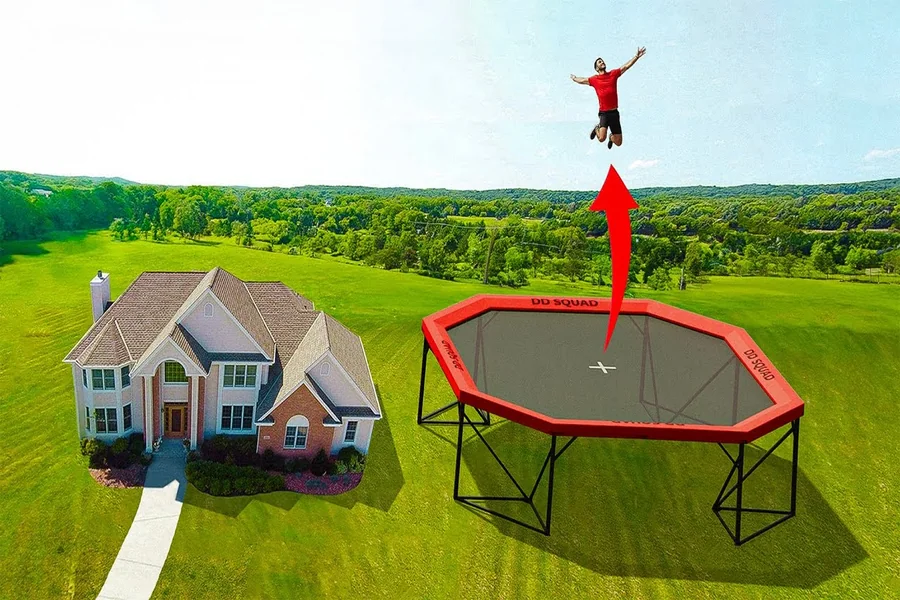
The trampoline that is the largest is much larger than the backyard or trampoline park trampolines. There are giant trampolines that are over 30 feet across, and special record-breaking trampolines that can be over 200 feet long.
The answer is, however, dependent upon the meaning of “largest”. According to Akrobat, its Megatramp is the largest trampoline in the world that is above ground or freestanding. It measures about 10 × 10 meters (32.8 × 32.8 feet). In the meantime, Guinness World Records has designated a 58.6m (192ft 3in) trampoline in Winnipeg, Canada as the longest permanent trampoline.
In this article, we take a closer look at the largest trampolines, their sizes, made from what, uses and how they differ from ordinary backyard trampolines.
Largest Trampoline Quick Facts
| Feature | Size or Detail |
| Largest freestanding trampoline claim | Megatramp |
| Megatramp size | 10 × 10 meters |
| Megatramp size in feet | 32.8 × 32.8 feet |
| Approximate surface area | 100 square meters |
| Longest permanent trampoline | 58.6 meters |
| Longest trampoline in feet | 192 ft 3 in |
| Guinness record location | Winnipeg, Manitoba, Canada |
| Record achieved | April 2026 |
| Standard large backyard trampoline | About 14–17 feet |
| Main uses of giant trampolines | Acrobatics, exhibitions, events, and professional training |
How Big Is the Largest Trampoline?
The largest freestanding trampoline available today is the Akrobat Megatramp, which is 10×10 meters or about 32.8×32.8 feet.
This leaves a footprint of approximately:
Approximately 1,076 sq ft or 100 sq m.
Akrobat created the Megatramp in collaboration with the DD Squad to perform extreme trampoline performances. The company says it is the world’s biggest trampoline for above-ground use.
It’s not your usual home trampoline! A big residential trampoline could be no more than 14, 15 or 16 feet wide.
What Is the Largest Trampoline in the World?
There’s no one right answer, since trampoline records can be broken in a number of ways.
Akrobat is promoting 10 x 10 metre Megatramp as the world’s largest above ground trampoline for a large freestanding jumping platform.
The Longest Permanent Trampoline category is used by Guinness World Records. The title goes to APEX Adventure-Plex Winnipeg, Canada.
The trampoline measures:
- 58.6 meters long
- 192 feet 3 inches long
- In Winnipeg, Manitoba
- Record recognized in 2026
It is included in Guinness’s “longest trampoline (permanent)” category.
Thus, if someone is looking for the largest trampoline, he could mean the widest giant trampoline, or the longest trampoline that has been installed.
Largest Trampoline Size Compared With Regular Trampolines
The difference becomes clearer when the dimensions are compared.
| Trampoline Type | Typical Size |
| Small kids trampoline | 6–8 ft |
| Medium backyard trampoline | 10–12 ft |
| Large backyard trampoline | 14–16 ft |
| Extra-large backyard trampoline | 16–17+ ft |
| Olympic competition trampoline | About 17 × 10 ft |
| Megatramp | About 32.8 × 32.8 ft |
| Longest permanent trampoline | 192 ft 3 in long |
A 10 × 10-meter trampoline therefore occupies considerably more space than even the largest common residential models.
It is designed for specialized use rather than a typical backyard.
How Large Is a 10 × 10 Meter Trampoline?
The size of a 10 x 10 meter trampoline doesn’t seem exceptionally large until you translate this into something you’re more familiar with.
It is approximately:
- 32.8 feet long
- 32.8 feet wide
- An area of 100 square meters.
- 1,076 square feet in area
For comparison, the theoretical area of a 15′ round trampoline in the backyard is about 177 square feet.
In other words, the total rectangular size of the Megatramp is about six times 10 × 10 square meters.
This usable jumping space may vary due to the use of frames, pads, springs and other structural elements which occupy part of the total jumping area.
The 13 × 13 Meter Supernova Trampoline
In 2022 another big trampoline came up during the Akrobat Bounce Bridge event in Ljubljana.
The trampoline, also named “Supernova”, was approximately 13 x 13 meters (42.7 x 42.7 feet).
At the time, Akrobat called it the world’s largest trampoline. It was installed in a big trampoline event over the river Ljubljanica.
It was this size and therefore occupied an area of:
- 169 square meters
- or about:
- 1,819 square feet
Other special features of the event were the long trampoline bridge and smaller professional trampolines.
Record descriptions and categories are not uniform, which can cause Supernova and Megatramp to be found in different searches for the world’s biggest trampoline.
What Is the Longest Trampoline?
This is the current Guinness Record for the longest permanent trampoline – 58.6 m or 192 ft 3 in.
APEX Adventure-Plex Winnipeg, Manitoba, Canada has the record. The title is been secured in 2026 according to Guinness.
Rather than just stacking several average trampolines side by side it was designed and installed as a continuous jumping surface.
At almost 200 feet long, it is considerably longer than the length of many residential properties.
Why Are Giant Trampolines Built?
Extremely large trampolines are usually not made for normal backyard use.
They can be created for several purposes.
Professional Acrobatics
Large surfaces give trained performers more space to build speed and complete advanced jumps.
Professional teams may use them for:
- Flips
- Aerial tricks
- Group routines
- High jumps
- Stunt performances
Public Events
Giant trampolines attract attention at sporting events and exhibitions.
The Akrobat trampoline events in Ljubljana, for example, combined huge trampolines with professional acrobatic performances.
Trampoline Parks
Commercial trampoline centers may install long connected jumping systems that allow visitors to bounce over much greater distances than conventional home trampolines.
Record Attempts
Some giant trampolines are designed specifically to challenge existing size or performance records.
How Is the Largest Trampoline Built?
Building a trampoline measuring tens or hundreds of feet requires much more engineering than constructing an ordinary backyard trampoline.
Several major components are involved.
Heavy-Duty Frame
The frame must withstand repeated impact from jumpers.
Large commercial trampolines normally use strong steel structures designed to distribute loads across a wide area.
Large Jumping Surface
The jumping mat must remain flexible while supporting significant dynamic forces.
The material also needs to resist stretching and wear from repeated use.
Spring or Tension System
Springs or other tension systems create the rebound.
On very large trampolines, engineers must carefully balance tension across the jumping surface.
Uneven tension could make the trampoline unpredictable.
Protective Padding
Padding covers hard frame components and spring areas.
This reduces the risk of direct contact with the structure.
Structural Support
A giant trampoline may require specialized foundations or support systems.
Commercial installations must account for:
- Jumper weight
- Repeated impacts
- Frame movement
- Wind exposure
- Surface stability
- Long-term structural fatigue
Largest Trampoline vs Olympic Trampoline
Olympic trampolines are designed for performance rather than maximum size.
A competition trampoline is approximately 5.05 meters long and 2.91 meters wide, or roughly 16.6 × 9.5 feet.
A 10 × 10-meter giant trampoline therefore has a much larger overall footprint.
| Feature | Olympic Trampoline | 10 × 10 m Megatramp |
| Length | About 16.6 ft | 32.8 ft |
| Width | About 9.5 ft | 32.8 ft |
| Main purpose | Competition | Extreme acrobatics/events |
| Portability | Relatively portable | Specialized setup |
| Typical users | Competitive athletes | Trained stunt performers |
Despite being smaller, Olympic trampolines can produce significant bounce because their dimensions, bed tension, and springs are optimized for competitive gymnastics.
How Big Are Normal Backyard Trampolines?
Residential trampolines come in several common dimensions.
8-Foot Trampoline
An 8-foot model works well where yard space is limited.
It is usually aimed at younger jumpers or households that do not have room for a larger setup.
10-Foot Trampoline
A 10-foot trampoline provides more jumping space while remaining suitable for many smaller yards.
12-Foot Trampoline
Twelve feet is a popular family size.
It provides noticeably more room than an 8- or 10-foot model.
14-Foot Trampoline
A 14-foot trampoline provides a large jumping surface and requires a sizeable clear area around it.
15- to 17-Foot Trampoline
Models between 15 and 17 feet are among the largest commonly purchased residential trampolines.
Even these look small beside a professional 32.8-foot-wide Megatramp.
How Much Space Does a Large Trampoline Need?
You should never choose a trampoline based only on its listed diameter or frame dimensions.
Additional clearance is necessary around the equipment.
For example, a 15-foot trampoline should not automatically be placed in a space exactly 15 feet wide.
Room is also needed around the frame for safe access and separation from nearby objects.
Potential obstacles include:
- Fences
- Walls
- Trees
- Outdoor furniture
- Utility poles
- Buildings
- Low branches
Vertical clearance is also important because jumpers can rise well above the trampoline bed.
Always follow the manufacturer’s installation and clearance requirements for the specific model.
Can You Buy the World’s Largest Trampoline?
Akrobat states that its Megatramp is available with personalized pricing and professional transportation and installation arrangements.
However, this is not comparable to buying an ordinary backyard trampoline.
A giant professional trampoline requires substantial space and specialized installation.
Most homeowners would find a 12- to 16-foot residential model far more practical.
Is a Bigger Trampoline Better?
Not necessarily.
A larger trampoline provides more surface area, but size alone does not determine performance or safety.
Other important factors include:
- Frame quality
- Weight capacity
- Spring design
- Jumping mat quality
- Protective padding
- Safety enclosure
- Installation
- Intended user age
- Manufacturer specifications
For a normal household, choosing a properly sized and well-built trampoline is generally more useful than simply choosing the largest model available.
How Many People Can Use a Large Trampoline?
A large jumping surface does not automatically mean several people should jump together.
Many residential trampoline manufacturers specify one jumper at a time, regardless of the trampoline’s diameter.
Multiple people bouncing together can create unpredictable rebound forces and increase collision risk.
Professional group performances are different. They involve specialized equipment, controlled conditions, and experienced athletes.
Always follow the specific trampoline manufacturer’s rules and weight limits.
Final Thoughts
The term largest trampoline can describe several different designs. For a giant freestanding structure, Akrobat’s Megatramp measures approximately 10 × 10 meters or 32.8 × 32.8 feet. Earlier event installations such as the 13 × 13-meter Supernova were even larger in overall footprint.
Length is a different record. Guinness World Records currently lists the 58.6-meter (192-foot-3-inch) permanent trampoline at APEX Adventure-Plex Winnipeg as the longest permanent trampoline.
These dimensions show just how different professional and record-setting trampolines are from the 8- to 17-foot models commonly used in backyards. For everyday use, the right trampoline is not simply the biggest one. Available space, construction quality, weight limits, and proper installation matter just as much.