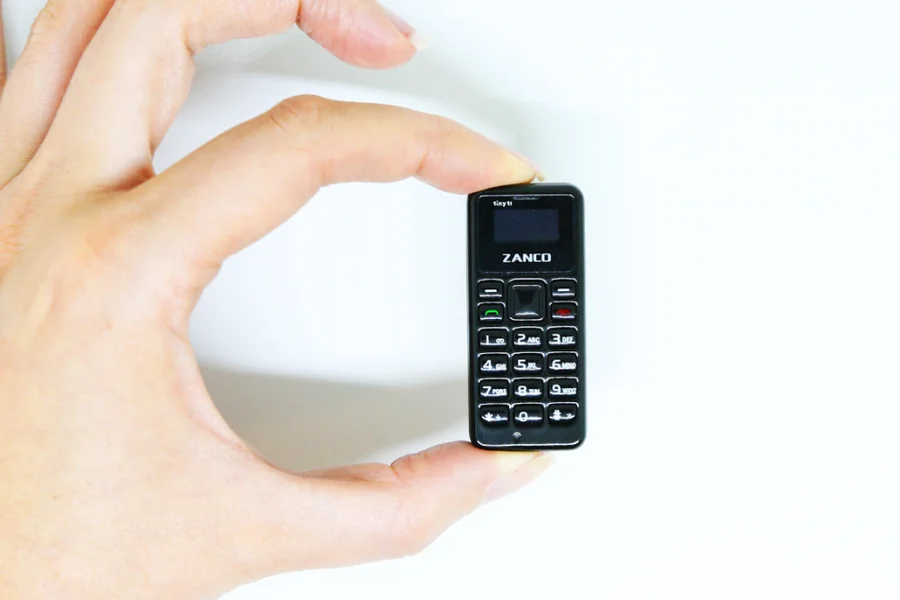
The Zanco Tiny T1 is the smallest cell phone widely known that is extremely small in size. Its dimensions are 46.7 mm x 21 mm x 12 mm, which is the size of a human thumb. It’s a real mobile phone, although it’s small, you can call and text from it.
The Tiny T1 was released in 2017 via crowdfunding and sent to purchasers. It is not a “smartphone,” but was designed as a simple feature phone. That’s important because fitting current cameras, big batteries, touch screens and high-powered processors into the same size would be nearly impossible.
Why Are Smallest Cell Phones So Difficult to Make?
Shrinking the Smallest Cell Phone seems easy until you have to put everything inside the phone. There are several factors that manufacturers need to keep in mind.
- Talk Time – The smaller the battery, the less energy it can store, and this can affect the talk time.Standby Time – The smaller the battery, the less it will store and this can impact standby time.
- Screen space – With a small screen there’s not much room for messages, menus or contact information.
- Key Pad – If the keypad is too small to press, then physical buttons become difficult to press.
- Antennas – Cellular and Bluetooth antennas still require sufficient space to function properly.
- Speakers and Microphones – These parts should still be usable with the entire device being as short as a few centimeters.
That’s why the majority of really tiny phones eliminate advanced functions instead of attempting to make the most of every part of a common smartphone.
The Cell Phone That Holds the Small-Size Record
The Zanco Tiny T1 is only 46.7 mm tall, 21 mm wide and 12 mm thick. In other words, the size is about 1.84 inches tall and weighs a mere 13 grams. It features a very small 0.49-in OLED display and has a resolution of 32 × 64 pixels.
It still features a full numeric keypad below the display. Users can insert a Nano SIM, make telephone calls and send SMS messages.
The mobile phone has 32 MB of RAM and 32 MB of storage. It can store about 300 contacts, about 50 SMS messages and the very latest 50 incoming/outgoing call records.
Today’s phones will have much more storage but that isn’t really the issue. Designed to perform two primary functions, the Tiny T1 is supposed to text and make calls.
How Small Is the Zanco Tiny T1?
Here is a quick look at its dimensions and basic specifications.
| Specification | Zanco Tiny T1 |
| Height | 46.7 mm / 1.84 in |
| Width | 21 mm / 0.83 in |
| Thickness | 12 mm / 0.47 in |
| Weight | 13 g |
| Display | 0.49-inch OLED |
| Battery | 200 mAh |
| Network | 2G GSM |
| SIM | Nano SIM |
| Contacts | Up to 300 |
| Internet | No |
| Camera | No |
The phone is small enough to disappear inside a normal pocket and can even be compared in size to a USB flash drive. Engineering & Technology described it as roughly thumb-sized when examining the device.
What Can the Smallest Cell Phone Actually Do?
The answer is surprisingly small for modern day standards.
The Zanco Tiny T1 is capable of calling out, accepting calls and sending SMS. It also supports Bluetooth and is charged via Micro-USB port.
The 200 mAh battery would last for approximately 3 days of standby and for up to 180 minutes of talk time.
What it doesn’t have is significant as well.
No touch screen, camera, mobile internet, social media, Wi-Fi or modern app ecosystem. It’s not meant to be a flagship for iPhone or Android.
The Biggest Problem With Using It Today
The Tiny T1 is only available for 2G GSM networks. Not so much as an issue when it was first released, but it is certainly a restriction currently.
Numerous mobile operators worldwide already have either retired from 2G networks or are soon ending support for them. Just because you have the phone doesn’t mean that you can make calls with it.
It had to be supported by GSM bands, e.g., 850/1900 MHz or 900/1800 MHz, depending on the version. It does not work with 3G, 4G and 5G.
So, before making any decisions, it is important to look at local carrier compatibility for anyone considering one today.
What About the Smallest Smartphone?
This is where the answer changes.
The Zanco Tiny T1 is an extremely small cell phone, but it is not a smartphone. If you want Android apps, Wi-Fi, cameras and 4G connectivity, the device has to become larger.
One example is the Unihertz Jelly Star. It has a 3-inch touchscreen and measures 95.1 mm × 49.6 mm × 18.7 mm. It weighs 116 grams.
That makes it more than twice as tall as the Tiny T1, but it operates much more like a modern smartphone.
The Jelly Star runs Android 13 and includes 8 GB of RAM, 256 GB of storage, a 48 MP rear camera, an 8 MP front camera and a 2,000 mAh battery. It also supports 4G LTE, Wi-Fi, Bluetooth 5.3, NFC and GPS.
So there are really two different categories.
| Phone | Type | Dimensions | Weight |
| Zanco Tiny T1 | Feature phone | 46.7 × 21 × 12 mm | 13 g |
| Unihertz Jelly Star | Android smartphone | 95.1 × 49.6 × 18.7 mm | 116 g |
The Zanco wins easily on physical size. The Jelly Star wins when modern smartphone functions are required.
Why Would Anyone Want a Phone This Small?
For most people, an extremely small phone would be inconvenient as a primary device. Typing messages on tiny buttons and reading a half-inch display gets difficult quickly.
There are still situations where the concept makes sense.
A small phone can work as a lightweight backup device. It takes almost no room in a bag or pocket. That may appeal to runners, cyclists or travelers who do not want to carry a full-size smartphone.
It can also appeal to people looking for a digital-detox phone. There is no endless scrolling because there are no social apps, video platforms or internet browser.
And then there is the novelty factor. A working phone that is barely larger than a thumb is interesting simply because most modern phones have gone in exactly the opposite direction.
Small Phone vs Regular Smartphone
The difference becomes obvious when you compare a miniature phone with today’s typical smartphone.
Modern smartphones commonly use screens around 6 inches or larger because people watch videos, take photos, browse websites and play games on them.
A phone like the Tiny T1 was designed around calls first.
That changes almost everything. It needs far less processing power, much less storage and a much smaller display. Removing cameras, high-speed cellular hardware and touchscreen components makes it possible to shrink the body dramatically.
The trade-off is functionality.
A full-size smartphone might replace your camera, GPS unit, music player, wallet and laptop for some tasks. The world’s smallest cell phone is closer to a basic communication tool.
Could Cell Phones Become Even Smaller?
Technically, yes.
Electronics continue to shrink, and smaller batteries, processors and communication modules make extremely compact devices possible. But there is a physical limit where making a phone smaller stops being useful.
Human fingers do not shrink along with electronics.
Buttons still need to be pressed. Screens still need to be read. Speakers need enough room to produce understandable sound. Batteries need enough capacity to keep the device running.
At some point, another millimeter of size reduction creates more problems than benefits.
That is why manufacturers usually compete to make smartphones thinner or lighter rather than dramatically shorter and narrower.
Final Thought
The smallest cell phone commonly identified as a fully functioning mobile handset is the Zanco Tiny T1. At just 46.7 × 21 × 12 mm and 13 grams, it is closer in size to a USB drive than a normal phone.
Its tiny body comes with major compromises. You get calls, SMS, Bluetooth and a basic display, but no apps, camera, Wi-Fi or modern cellular connection. Its dependence on 2G also makes network compatibility increasingly difficult.
If you mean the smallest practical smartphone rather than the smallest basic phone, devices such as the Unihertz Jelly Star offer a better balance. They are noticeably larger, but they provide Android, 4G, cameras and the features people expect from a modern mobile device.
The Tiny T1 remains interesting for one simple reason: while nearly every phone maker spent years making screens bigger, this phone went as far as possible in the opposite direction.